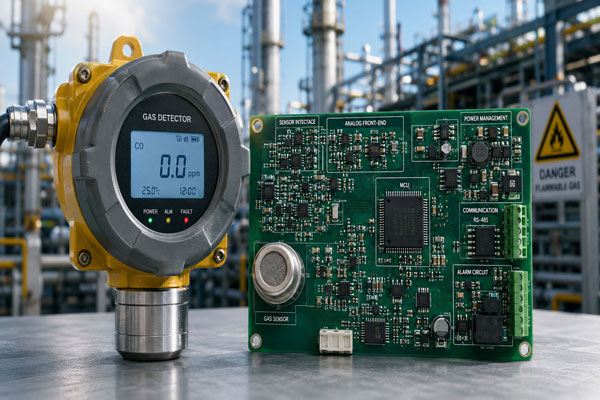
A chemical air detector is only as reliable as the electronics behind its sensing system.
In industrial environments, gas detection equipment may need to continuously monitor hazardous gases while operating under temperature variation, vibration, electrical interference, and long operating cycles. This places higher demands on the Chemical Air Detector PCB Assembly than on a standard control board.
From our manufacturing experience, the most critical areas are usually not simply component placement. They are sensor signal integrity, analog circuit assembly, power stability, soldering quality, functional testing, and traceability.
Kingda provides integrated PCB manufacturing, component sourcing, SMT/THT assembly, inspection, testing, and final assembly for industrial safety electronics.
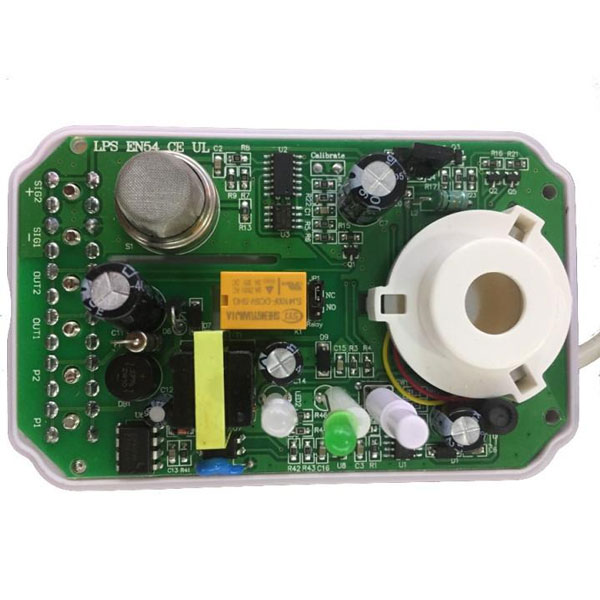
Key Manufacturing Challenges
A typical Gas Detection PCBA may integrate:
- Gas sensor interface
- Analog front-end
- ADC
- MCU
- Power management
- Temperature and humidity sensing
- Alarm circuits
- RS-485 / Modbus or other communication interfaces
- Display and control interfaces
These circuits do not have the same manufacturing sensitivity.
For example, the sensor interface and analog front-end may handle very small signals, while the power section and communication circuits can generate considerably more electrical noise.
Therefore, production quality depends on maintaining the correct relationship between PCB layout, component selection, soldering process, and electrical testing.
Sensor Interface and Analog Circuit Assembly
The gas sensor is normally one of the most sensitive parts of the system.
Depending on the application, the detector may use electrochemical, catalytic, semiconductor, infrared, or other sensing technologies. Each technology has different electrical characteristics.
For PCBA manufacturing, particular attention should be paid to:
- Sensor interface components
- Precision resistors and capacitors
- Operational amplifiers
- ADC connections
- Grounding
- Signal routing
- Connector soldering
- Leakage and contamination
A small assembly defect or incorrect component can introduce signal offset or instability that may not be obvious during visual inspection.
This is why electrical and functional testing is especially important for gas detection products.
SMT Assembly: Controlling Small and Sensitive Components
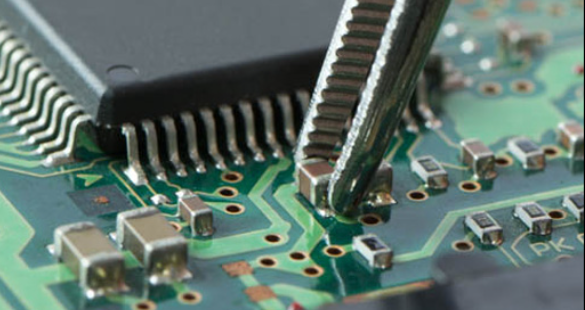
Modern gas detection boards often use compact components to integrate sensing, processing, communication, and power functions into a small PCB.
Typical components may include:
- 0201 / 01005 passives
- QFN
- LGA
- Fine-pitch ICs
- MCU
- ADC
- RF modules
- Industrial connectors
For these assemblies, solder paste printing is one of the first process points that can affect yield.
In production, we pay particular attention to:
- Stencil aperture design
- Solder paste volume
- PCB support
- Component placement accuracy
- Reflow temperature profile
SPI and AOI can be used to identify printing and placement problems before they become larger batch issues.
For hidden solder joints, such as QFN or BGA packages, X-ray inspection can provide additional process visibility.
Power Supply and Signal Integrity
Gas detection equipment often operates continuously, so stable power is essential.
The PCBA may include multiple voltage rails for:
- Sensors
- Analog circuits
- MCU
- Communication modules
- Displays
- Alarm circuits
In practical manufacturing, unstable power can sometimes appear to be a sensor problem when the actual cause is a soldering defect, component issue, grounding problem, or power-supply abnormality.
Therefore, production testing should not only verify whether the board powers on. Critical voltage rails and key electrical nodes should also be checked where required.
Functional Testing Is Critical
For a Chemical Air Detector PCB Assembly, passing AOI does not necessarily mean the board is functionally correct.
A typical functional test may verify:
Power → Sensor Interface → Signal Acquisition → MCU Processing → Alarm → Communication
Depending on the product, testing may include:
- Power-up
- Sensor signal simulation
- ADC reading
- Gas concentration calculation
- Alarm threshold response
- Buzzer / LED
- Relay output
- RS-485 communication
- Display
- Fault detection
For low-volume production, flying probe testing can be useful when a dedicated ICT fixture is not economically justified. For repeat production, ICT and dedicated functional fixtures can provide faster and more consistent testing.
Calibration and Traceability
Gas detection products require more than assembly accuracy. The relationship between the sensor output and the displayed gas concentration must also be controlled.
Depending on the product design, production may involve:
- Sensor calibration
- Zero-point adjustment
- Sensitivity verification
- Temperature compensation
- Alarm threshold verification
Production records should also be linked to the corresponding PCB, component batch, firmware revision, and test results.
This traceability becomes valuable when a customer later reports a field issue. Engineers can trace the affected production batch and determine whether the problem is related to a component lot, PCB revision, assembly process, or testing result.
Quality Control for Gas Detection PCBA
From a manufacturing perspective, an effective quality process can be summarized as:
Incoming Inspection → SMT → SPI → AOI → X-Ray if Required → THT → Electrical Test → Functional Test → Calibration → Final Inspection
Not every project requires every inspection method. The testing strategy should be determined by the PCB structure, component types, production volume, and product risk.
For example:
| Area | Key Production Focus |
|---|---|
| Sensor interface | Signal stability and solder quality |
| Analog front-end | Component accuracy and low-noise assembly |
| Power supply | Voltage stability and protection |
| MCU | Programming and functional verification |
| Communication | Interface and signal integrity |
| Alarm circuit | Buzzer, LED and relay operation |
| Connectors | Soldering and mechanical reliability |
Why Integrated PCB and PCBA Manufacturing Matters
For chemical air detection products, PCB manufacturing and assembly are closely connected.
PCB stack-up, pad design, component spacing, grounding, test points, and thermal characteristics can all influence the final assembly process.
With an integrated manufacturing workflow:
PCB Manufacturing → Component Procurement → SMT → Inspection → Testing → Calibration → Final Assembly
engineering issues can be identified and resolved more efficiently without coordinating multiple independent suppliers.
Kingda combines PCB manufacturing and PCBA production with DFM/DFA, component sourcing, SMT/THT assembly, SPI, AOI, X-ray, electrical testing, functional testing, and traceability.
Conclusion
A reliable Chemical Air Detector PCB Assembly requires careful control of both manufacturing processes and electronic performance.
The key is not simply achieving a high SMT placement rate, but ensuring that the completed PCBA can reliably:
Acquire sensor signals → Process detection data → Trigger alarms → Communicate with external systems → Operate consistently over time.
For industrial safety electronics, Kingda‘s one-stop manufacturing approach combines PCB manufacturing, component sourcing, precision SMT assembly, inspection, functional testing, calibration support, and traceability to help customers move from prototype and low-volume production to stable manufacturing.
The goal is simple: consistent assembly quality, reliable signal acquisition, and dependable gas detection performance.