What Is Conformal Coating?
Conformal Coating is a thin protective layer applied to a printed circuit board (PCB) and its electronic components. The coating conforms to the contours of the board and components, helping protect sensitive circuitry from environmental stresses such as moisture, dust, chemicals, salt contamination, temperature changes, and mechanical vibration.
The primary purposes of PCB Conformal Coating are to improve environmental protection, electrical insulation, and long-term reliability. By creating a controlled protective barrier, conformal coating can reduce the risk of corrosion, contamination-related leakage currents, and certain forms of electrical degradation.
However, conformal coating is not a universal solution for every PCB. The appropriate coating material, thickness, coverage, and curing process should be selected according to the application environment, component compatibility, required reliability, and manufacturing process.
Conformal coating is particularly useful in applications where PCBs may be exposed to humidity, condensation, chemicals, temperature cycling, or airborne contaminants, including automotive electronics, industrial controls, aerospace systems, medical equipment, power electronics, and outdoor electronic devices.
Types of Conformal Coating Materials
Different Conformal Coating Materials provide different combinations of flexibility, chemical resistance, temperature resistance, moisture protection, and ease of repair. The most common material families include acrylic, silicone, polyurethane, epoxy, and parylene.
1. Acrylic Conformal Coating
Acrylic coatings are widely used because they are relatively easy to apply, cure, inspect, and remove. They provide good protection against moisture and environmental contamination while offering relatively straightforward rework compared with many more chemically resistant coating systems.
Acrylic coatings are often considered for consumer electronics, industrial electronics, and general-purpose applications where moderate environmental protection is required.
2. Silicone Conformal Coating
Silicone coatings offer excellent flexibility and good resistance to temperature extremes. Their elasticity allows them to accommodate differences in thermal expansion between components and the PCB.
For this reason, silicone is commonly considered for automotive, aerospace, industrial, and other applications exposed to repeated temperature changes or mechanical stress.
3. Polyurethane Conformal Coating
Polyurethane coatings provide strong resistance to moisture, chemicals, abrasion, and many solvents. They can be useful where the PCB may encounter aggressive environmental conditions.
The trade-off is that some polyurethane systems can be more difficult to remove during repair or rework. Process selection should therefore consider both environmental requirements and future serviceability.
4. Epoxy Conformal Coating
Epoxy coatings form a relatively hard and durable protective layer. They can provide strong resistance to moisture, chemicals, abrasion, and mechanical damage.
Because cured epoxy can be difficult to remove, it is generally selected when long-term protection is more important than easy rework. Care must also be taken with curing shrinkage, thermal expansion, and component compatibility.
5. Parylene Conformal Coating
Parylene is deposited through a vapor-phase process rather than conventional liquid spraying or dipping. It can form a very thin and highly uniform coating, including coverage around complex component geometries.
Parylene provides excellent moisture and chemical protection and is used in applications requiring high environmental resistance, including certain medical, aerospace, and specialized electronic systems.
Selecting Conformal Coating Materials should therefore be based on the complete application rather than simply choosing the material with the highest individual performance rating.
PCB Conformal Coating Application Methods
The PCB Coating Process can be performed using several application techniques. The appropriate method depends on board geometry, production volume, coating material, required thickness, masking requirements, and process control requirements.
Spray Coating
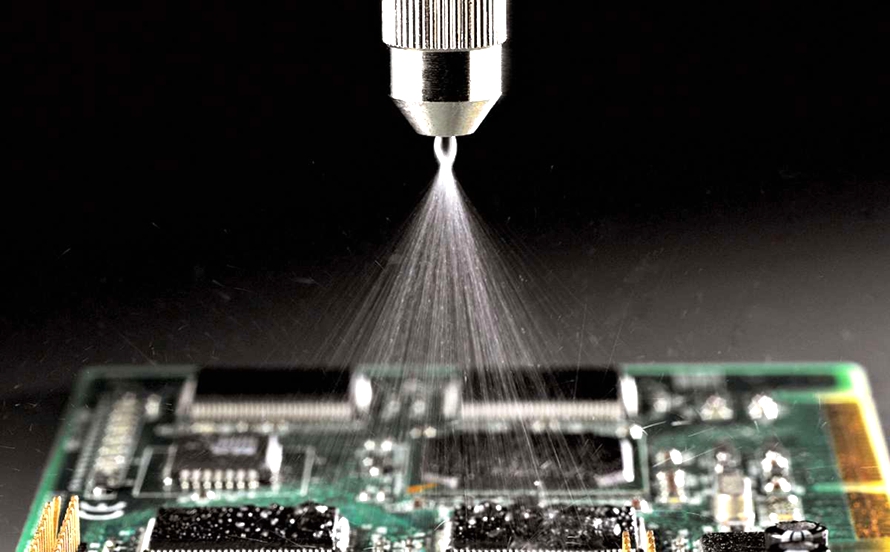
Spraying is one of the most flexible methods for applying conformal coating. Manual spray systems can be useful for prototypes, repairs, and low-volume production, while automated spray systems provide better repeatability for larger production volumes.
Spray parameters such as flow rate, spray distance, nozzle configuration, board movement, and coating viscosity must be controlled to achieve consistent coverage.
Dip Coating
Dip coating involves immersing the PCB into the coating material. It can provide comprehensive coverage and is suitable for boards with relatively straightforward geometries.
Important process variables include immersion speed, withdrawal speed, coating viscosity, temperature, and drainage behavior. Dip coating may require additional attention to areas that should remain uncoated, such as connectors, switches, test points, and heat-transfer surfaces.
Brush Coating
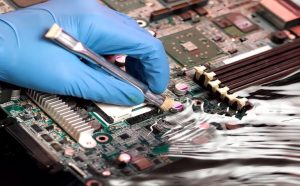
Brush application is useful for prototypes, localized coating, repair, and selective application. It provides good control over specific areas but generally depends more heavily on operator technique.
For production applications requiring tight thickness tolerances and repeatability, automated methods may be preferable.
Automated Selective Coating
Automated selective coating systems can apply material to predefined PCB areas while avoiding connectors, test points, switches, and other keep-out regions.
These systems can improve process consistency and reduce unnecessary coating consumption. Automated equipment can also help control coating thickness, positioning accuracy, and production repeatability.
Key Steps in the PCB Coating Process
A controlled PCB Coating Process normally includes several stages:
- PCB cleaning and preparation – Remove flux residues, dust, oils, and other contaminants that could interfere with adhesion.
- Masking – Protect connectors, switches, test pads, heat sinks, and other areas that must remain free of coating.
- Coating application – Apply the selected coating using spraying, dipping, brushing, or automated selective coating.
- Thickness control – Verify that the coating is within the specified thickness range.
- Drying or curing – Follow the coating manufacturer’s specified curing conditions.
- Inspection – Check coverage, uniformity, defects, and uncoated areas.
- Rework, if required – Correct localized coating defects without damaging the PCB or components.
Surface cleanliness is particularly important. Contamination beneath the coating can reduce adhesion and may contribute to corrosion or electrical leakage over time.
Benefits of PCB Conformal Coating
Improved Environmental Protection
A properly selected PCB Conformal Coating can help protect circuitry from moisture, dust, salt contamination, and certain chemicals. This barrier can reduce the possibility of corrosion and contamination-related electrical problems.
The actual protection level depends on the coating material, coverage, thickness, curing quality, and environmental conditions.
Improved Electrical Insulation
Conformal coating can increase the insulation between exposed conductive features and help reduce the risk of leakage or surface conduction under humid or contaminated conditions.
This can be particularly useful in compact electronic designs where contamination resistance and electrical insulation are important. However, coating should not be used as a substitute for appropriate PCB creepage, clearance, and insulation design.
Corrosion Protection
Moisture and ionic contamination can accelerate corrosion on exposed metal surfaces. A suitable coating can act as a barrier against these environmental factors and help preserve PCB and component reliability.
Increased Mechanical and Environmental Durability
Some coating systems can provide additional protection against vibration, dust, abrasion, and localized mechanical exposure. Flexible coatings such as silicone can also accommodate certain levels of component movement and thermal expansion.
Key Considerations for PCB Conformal Coating
Material Compatibility
Compatibility between the coating and the PCB assembly is essential. The coating should not adversely react with solder masks, component bodies, adhesives, labels, thermal interface materials, or other assembly materials.
Special attention should be given to components that may be sensitive to coating materials, including certain switches, sensors, optical devices, connectors, and components with pressure-equalization requirements.
Application Defects
Common coating defects include:
- De-wetting
- Pinholes
- Bubbles
- Cracking
- Blisters
- Uneven coverage
- Excessive coating thickness
- Insufficient coating thickness
- Contamination under the coating
- Coating on areas that should remain uncoated
De-wetting can occur when the coating does not properly adhere to or spread across the PCB surface. Contamination, surface energy, material compatibility, and coating viscosity can all contribute to this problem.
An excessively thick coating may also increase drying or curing time and, depending on the material, contribute to cracking or solvent entrapment.
Coating Thickness and Uniformity
Coating thickness is one of the most important process parameters. The required thickness depends on the material and application requirements rather than a single universal value.
Too little coating may provide insufficient environmental protection, while excessive thickness can increase curing time, create defects, affect component performance, or complicate rework.
Therefore, Conformal Coating Testing should include appropriate methods for verifying coverage and thickness according to the coating specification.
Conformal Coating Inspection and Testing
Inspection is an essential part of Conformal Coating Testing and process control.
UV Inspection
Many conformal coatings contain a fluorescent tracer that makes inspection under ultraviolet light easier. UV inspection can help identify coating coverage, missed areas, and certain process inconsistencies.
However, UV inspection alone does not prove coating thickness or complete protection. Areas with insufficient thickness may require additional inspection methods.
Visual and Microscopic Inspection
Visual inspection can identify obvious defects such as bubbles, cracks, contamination, uneven coating, and exposed areas.
Microscopic inspection can provide more detailed examination of small components, dense PCB areas, solder joints, and localized coating defects.
Thickness Measurement
Depending on the coating system and production requirements, thickness can be evaluated using suitable measurement techniques. The method should be selected according to the coating material, substrate, and required accuracy.
Adhesion and Reliability Testing
For demanding applications, coating qualification may include adhesion, moisture resistance, thermal cycling, chemical resistance, insulation resistance, or other environmental tests.
The specific test program should be based on the product’s operating environment and applicable industry requirements.
Service Life and Durability
The service life of a coated PCB depends on several factors, including:
- Coating material
- Coating thickness
- Surface preparation
- Curing quality
- Operating temperature
- Humidity and condensation
- Chemical exposure
- Mechanical vibration
- Thermal cycling
- PCB and component materials
A coating that performs well in a dry indoor environment may not provide the same protection in a high-humidity, corrosive, or outdoor application.
Therefore, PCB Reliability should be evaluated at the system level rather than based solely on the presence of conformal coating.
Conformal Coating Repair and Rework
Repairing a coated PCB requires careful removal of the coating from the affected area without damaging components, solder joints, or PCB surfaces.
Depending on the coating type, localized removal may involve approved solvents, mechanical methods, controlled abrasion, or other specialized techniques. The method should be compatible with both the coating and the underlying assembly.
After repair, the exposed area should be thoroughly cleaned and inspected before the coating is reapplied. The repaired region should provide appropriate overlap with the surrounding coating so that environmental protection is restored.
Because different coating materials have very different removal characteristics, the coating manufacturer’s technical documentation should be followed during rework.
Industry Standards for Conformal Coating
IPC-CC-830 is a commonly referenced industry specification for qualification and performance requirements of electrical insulating compound coatings for printed wiring assemblies.
The exact standards and qualification requirements depend on the application, customer specifications, and regulatory environment. Automotive, aerospace, medical, industrial, and other high-reliability products may have additional requirements beyond a general conformal coating specification.
Manufacturers should therefore define coating material, application process, inspection criteria, and reliability testing requirements before production.
Conformal Coating for Different Industries
Different industries have different environmental and reliability requirements.
Automotive electronics may encounter temperature cycling, vibration, humidity, condensation, and contamination. Coating selection should account for these combined stresses.
Aerospace electronics may require high reliability under temperature variation, vibration, pressure changes, and other demanding operating conditions.
Medical electronics may require careful consideration of material compatibility, cleaning processes, reliability, and product-specific regulatory requirements.
Industrial electronics may be exposed to dust, chemicals, humidity, vibration, and extended operating periods.
Consumer electronics may use conformal coating selectively where additional environmental protection is needed without interfering with connectors, controls, sensors, or heat dissipation.
Why Choose Professional PCB Conformal Coating Services?
Professional PCB Coating requires more than simply applying material to the surface of a PCB. Proper results depend on material selection, surface preparation, masking, application parameters, curing, inspection, and traceability.
A professional manufacturing process should consider:
- PCB and component compatibility
- Required coating coverage
- Target coating thickness
- Masking requirements
- Curing conditions
- Environmental requirements
- Inspection methods
- Rework requirements
- Production volume
- Applicable standards and customer specifications
For high-reliability products, these factors should be defined during the engineering and DFM stages rather than after PCB assembly has already been completed.
Kingda PCB Conformal Coating Services
Kingda can support PCB manufacturing and assembly projects that require conformal coating as part of their environmental protection strategy.
The appropriate coating solution should be selected according to the PCB structure, component characteristics, operating environment, coating requirements, and production process. Application methods can be evaluated based on project requirements, including spray, selective coating, dip coating, or localized application.
A controlled process should also include appropriate PCB preparation, masking, coating application, curing, inspection, and rework procedures. For projects with demanding reliability requirements, coating specifications and inspection criteria should be defined before production begins.
Best Practices for PCB Conformal Coating
To achieve consistent coating performance, manufacturers should:
- Select the coating material according to the actual operating environment.
- Confirm material compatibility with PCB laminates, solder masks, components, and adhesives.
- Thoroughly clean and prepare the PCB before coating.
- Clearly define coating keep-out areas.
- Control coating thickness and uniformity.
- Follow the specified drying or curing profile.
- Use appropriate visual, UV, microscopic, and thickness inspection methods.
- Establish clear rework and repair procedures.
- Validate coating performance for demanding environments.
- Maintain process and material traceability throughout production.
Conclusion
Conformal Coating provides an effective protective layer for PCBs operating in environments where moisture, dust, chemicals, temperature changes, vibration, or contamination may affect electronic reliability.
A successful PCB Conformal Coating process requires the right material, controlled application, proper curing, adequate inspection, and compatibility with the complete PCB assembly. Acrylic, silicone, polyurethane, epoxy, and parylene each offer different performance characteristics, so material selection should be based on actual application requirements.
By integrating coating selection and process control into PCB design, assembly, and PCB Reliability planning, manufacturers can improve environmental protection while maintaining electrical performance, serviceability, and long-term product reliability.