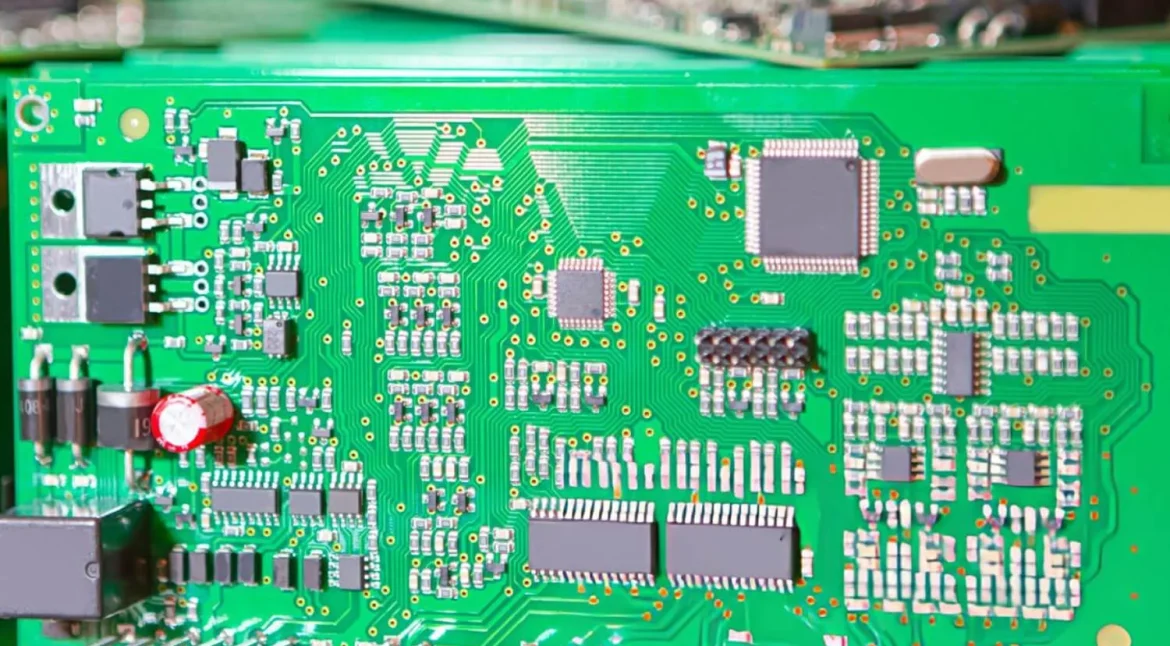
Conformal Coating Masking and Keep Out Control
Conformal coating protects a board only where it is present, and the areas where it must not be present are as important as the areas where it must. Masking is the step that keeps the two apart.
Areas That Must Stay Clear
Connectors, test points, adjustment trimmers, relay contacts, optical surfaces and any surface that has to make electrical contact are the usual exclusions. A coating on a connector body can prevent mating or trap contamination.
The keep out belongs on the assembly drawing rather than in a note. Our coating notes describe the process that follows it.
Masking Materials
Peelable masks, tapes, boots and dispensing fixtures are all used. The choice depends on the geometry, the number of boards and whether the mask has to survive a cure or a reflow.
A mask that leaves adhesive behind has replaced one defect with another. Our cleanliness notes describe the check.

Coating Thickness and Coverage
The thickness is specified for the cured film, and the film thins over edges and peaks on tall components. Measuring on a flat area gives a number that does not describe the edges where protection is needed most.
The measurement should therefore include a component edge and a board edge. Our coating inspection notes describe where to measure.
Connector Protection
A connector that is masked should be inspected after demasking for coating creep and for adhesive residue. Both are difficult to remove once the assembly is closed.
Where the connector is not masked, the coating has to be applied around it. Our connector notes describe the geometry that results.
Cure and Its Effect on the Mask
A thermal cure subjects the mask to the same temperature as the coating, so the mask has to be rated for it. A UV cure reaches the film only where light does, which is a limitation on shadowed areas.
The cure schedule should be recorded as a profile. Our thermal measurement notes describe the recording.
Verification
The verification is a coated board examined under ultraviolet light, which makes the film visible and shows thin areas and pinholes. The keep out areas are checked in the same pass.
A visual check under white light alone will not show a thin film. Our quality notes describe the lighting that is used.
Records and Rework
The mask type, the application method, the coating material and the cure profile should be recorded per lot. Where a board is reworked, the coating has to be removed locally and reapplied, and the record should show it.
Our rework notes describe the local removal.
Process Control and Verification
On a design of this kind, connector protection is the item that decides how the rest of the board is arranged. Where the requirement is not written down, the shop supplies its own default, and the default is chosen for the process rather than for the design. The measurements that matter are the repeatable ones: conductor width and spacing, annular ring, finished hole size, plating thickness and surface finish are all verifiable on a coupon that travels with the panel.
Running a first article through the same checks as the production panel confirms that the two agree, and that comparison is the cheapest form of process control available at prototype stage. Keeping a sample from the panel turns a dispute into a measurement, because the same coupon can be re-examined by both parties without rebuilding the batch.
Reviewing the design before the data is released is cheaper than correcting it after the panel is in the tank, because every step downstream inherits the decision made at the front end. Documenting the assumption is part of the design work, and a short note on the drawing prevents a question that would otherwise arrive a day later and cost a day of schedule.
The process window is set by the narrowest step in the flow, so an improvement anywhere else shows up as margin rather than as yield until that step is addressed. A short note on the drawing about handling, storage or packaging is often worth more than an extra decimal place on a tolerance.
Where a value sits close to a process limit, the drawing should say so, since the shop can then open the process window rather than working to a nominal figure that carries no tolerance.
Process Control and Verification
On a design of this kind, connector protection is the item that decides how the rest of the board is arranged. Where the requirement is not written down, the shop supplies its own default, and the default is chosen for the process rather than for the design. The measurements that matter are the repeatable ones: conductor width and spacing, annular ring, finished hole size, plating thickness and surface finish are all verifiable on a coupon that travels with the panel.
Running a first article through the same checks as the production panel confirms that the two agree, and that comparison is the cheapest form of process control available at prototype stage. Keeping a sample from the panel turns a dispute into a measurement, because the same coupon can be re-examined by both parties without rebuilding the batch.
Reviewing the design before the data is released is cheaper than correcting it after the panel is in the tank, because every step downstream inherits the decision made at the front end. Documenting the assumption is part of the design work, and a short note on the drawing prevents a question that would otherwise arrive a day later and cost a day of schedule.
Process Control and Verification
On a design of this kind, connector protection is the item that decides how the rest of the board is arranged. Where the requirement is not written down, the shop supplies its own default, and the default is chosen for the process rather than for the design. The measurements that matter are the repeatable ones: conductor width and spacing, annular ring, finished hole size, plating thickness and surface finish are all verifiable on a coupon that travels with the panel.
Running a first article through the same checks as the production panel confirms that the two agree, and that comparison is the cheapest form of process control available at prototype stage.
Process Control and Verification
On a design of this kind, connector protection is the item that decides how the rest of the board is arranged. Where the requirement is not written down, the shop supplies its own default, and the default is chosen for the process rather than for the design. The measurements that matter are the repeatable ones: conductor width and spacing, annular ring, finished hole size, plating thickness and surface finish are all verifiable on a coupon that travels with the panel.
A first article check confirms that the process and the drawing agree on the points listed above, and that the coupon data supports the values used in the design.

Where a measurement falls outside the expected window, the sample is retained so that the cause can be established before the balance of the batch is released.
FAQ
Can the keep out be defined by a note? A note helps, but the areas should be drawn, because the operator applying the mask works from the drawing rather than from the text.
Is peelable mask reusable? It is not, because it deforms on removal and loses its sealing edge.
What does gopcb provide for coating work? We provide a drawn keep out rather than a text note, masking material chosen for the cure it must survive, thickness measured on a component edge and a board edge as well as a flat area, inspection under ultraviolet light, and a recorded mask, material and cure profile per lot.