Customer Supplied Material: Verifying Boards, Parts and Loss
When a customer supplies the boards and the components, the assembly house is working with material it did not buy, cannot replace at short notice and cannot treat as freely as its own stock. The customer supplied material arrangement is common in development and in products where the design team controls the bill of materials, and it works well when both sides agree in advance how the material will be verified, how much loss is normal and how the two accounts will be reconciled at the end. Left undefined, the same arrangement produces a dispute on the first order where a component turns out to be short.
What Arrives and What Is Checked
The material verification starts at receipt. The printed circuit boards are checked against the released artwork for the revision marking, the surface finish, the panel form and the quantity. A board that carries a different revision marking from the one in the purchase documentation is a problem to be raised before the order starts, not after, because the assembly programme is written for a specific revision.
The components are checked against the bill of materials for the part number, the package, the quantity and the packaging form. A reel that carries the correct part number in an unexpected package is a real occurrence, and it is caught by comparing the physical part against the specification rather than by trusting the label alone. The storage condition is recorded as well, since a moisture sensitive device that has been supplied without its desiccant indicates an exposure history that has to be considered.
Where the material has been supplied loose, or where the quantity is exactly the finished requirement, that is noted at receipt rather than at the end. The feeder needs a certain number of parts to load reliably, and the attrition allowance that is normal for placement and reflow has to come from somewhere.

What the Assembly House Brings
In this arrangement the supplier contributes the process rather than the parts, and the value is in the printing, the placement, the reflow, the inspection and the test. Consumables such as the solder paste, the stencil and the packaging are usually supplied by the assembly house, and the scope of that contribution is stated clearly so that the boundary between the two sides is a line on a page rather than an assumption.
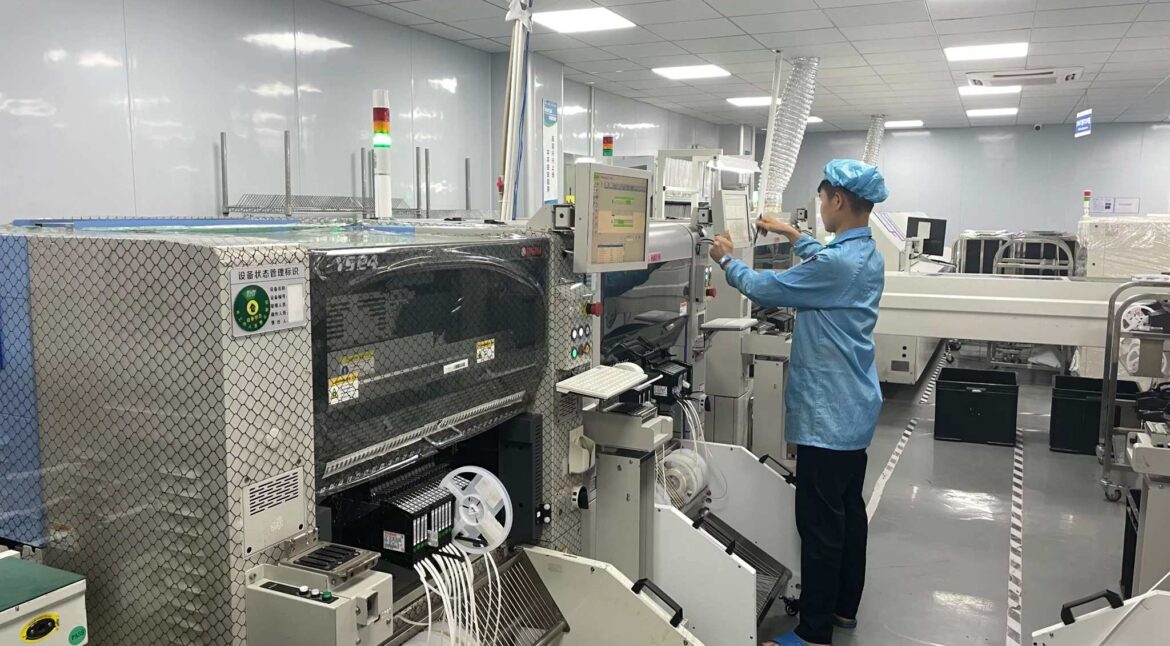
The process itself is unchanged. The stencil is designed for the pads and the packages in the bill of materials, the placement programme is built from the coordinate file, the paste deposit is measured after printing and the first article is confirmed before the batch is released. A customer supplied order is not a lower grade of service, since the process cost is the same whether the components came from the customer or from stock.
Agreeing the Loss
Attrition is the part of the conversation that most often goes unrecorded. Every assembly process consumes a small proportion of the components supplied to it. Some are lost at the feeder as tape is threaded or a nozzle misplaces a part; some are consumed in the setup of the machine; some are attached to boards that fail inspection and cannot be repaired. The rate depends on the package, on the quantity and on the product, and a realistic allowance for a small run is proportionally larger than for a long one.
The practical approach is to agree the allowance before production and to state it as a percentage of the requirement rather than as a number of pieces. The customer then knows what to send, and both sides know what the expected consumption is. Where the specification calls for a minimum order quantity that exceeds the requirement, the surplus is documented as customer property and returned rather than absorbed.
Traceability and Reconciliation
Customer supplied material remains the customer’s property throughout the process, and the record has to reflect that. The material is stored separately from the general stock, the receipt is recorded against the order, and the issue to the line is documented. Where the same component appears in two orders, the batches are kept distinct so that a question about one of them can be answered without ambiguity.
At the end of the order the accounts are reconciled: what was received, what was consumed, what was consumed by attrition, what was returned and what remains in stock for a repeat order. That reconciliation is what allows the next batch to be planned without ordering parts that are already in the building, and it is also the record that supports any claim about a defective component, since it establishes where the part came from and what happened to it.

Where the Difficulties Appear
The first difficulty is the short supply. A critical device arrives one piece short because the customer counted the free samples in the reel. The line either stops, or substitutes a part that has not been qualified, or produces one board fewer than ordered. None of those is a good outcome, and all of them are avoided by verifying the count at receipt.
The second is the unannounced substitution. A component that has been replaced with a functionally equivalent part whose package or polarity marking differs is a defect waiting to happen, because the programme and the orientation data were written for the original. Any substitution is therefore confirmed before placement rather than discovered afterwards.
The third is the material that has been opened and repacked. A reel that has been rewound can present the parts in the opposite direction from the one the programme expects, and a tray that has been refilled from loose parts loses both its orientation and its identity. The incoming inspection stage exists precisely to catch these conditions while the material is still in its packaging, and our assembly operation applies it to customer supplied orders through SMT assembly and turnkey PCB assembly, with the alternative supply route handled by component procurement and the records held under quality management. PCBA testing closes the loop.
The Boundary Between the Two Accounts
Most disputes in a customer supplied arrangement come from an unstated assumption about where one party’s responsibility ends. The material belongs to the customer, the process belongs to the supplier, and the point at which a component stops being material and becomes part of a product is the boundary that has to be written down.
The supplier is responsible for handling the material correctly: the storage conditions, the exposure control, the static protection and the traceability of the issue to the line. The supplier is also responsible for identifying a problem with the material when it is found, and for stopping rather than continuing to build with a part that does not match the specification. What the supplier cannot be responsible for is a defect that is inherent in the material and invisible at receipt, such as a component that has been damaged by the customer’s own earlier handling or a device that has been supplied below its stated grade.
The customer is responsible for the accuracy of the bill of materials, for the completeness of the supply and for the specification of any substitution. The customer is also responsible for stating which parts are critical, since a part that carries a certification requirement is not interchangeable with a visually identical alternative.
Writing that division down before the first order removes almost all of the argument that otherwise occurs at the end of it, when the parties are looking at a shortfall and reconstructing events from memory. The record kept at receipt, at issue and at reconciliation is what makes the conversation a review of documents rather than a disagreement about recollections.
Repeat Orders and the Material Left Behind
A customer supplied arrangement almost always leaves material in the building after the order has shipped, and how that material is handled decides how smooth the next order will be. Left in an unlabelled box, it becomes unusable, because neither its identity nor its storage history can be established. Recorded against the order and stored under the conditions its specification requires, it becomes stock that the next batch can draw on immediately.
The reconciliation at the end of each order therefore serves two purposes at once. It settles the account for the batch that has just been produced, and it produces the opening position for the next one. A customer who receives that statement can plan a repeat order without ordering parts that are already in the building, which is a saving that costs nothing to obtain and is regularly lost when the record is not maintained.
FAQ
Who supplies the solder paste and the stencil? Normally the assembly house, since they are consumables of the process rather than parts of the product, and the scope is agreed at the quotation stage.
How much loss should be expected? A percentage that depends on the package and the quantity, agreed before production and stated on the order rather than estimated afterwards.
What happens to the surplus? It remains the customer’s property, is stored separately and is returned or carried forward to the next order.