Flexible PCB Core Logic: From Materials to Manufacturing Processes
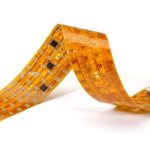
In thin and light devices such as folding screen phones, smartwatches, and Bluetooth earphones, there is another kind of black technology hidden inside: FPC circuit boards, also known as flexible printed circuit boards. They can bend, fold, and twist, as soft as plastic film, yet they can realize complex circuit connections.
The soul of FPC lies in material selection, which is the key to making it soft. Unlike the glass fiber boards of rigid PCB, the substrates of FPC are mainly polyimide, or PI, and polyester, or PET. PI is currently the most mainstream choice. It has excellent temperature resistance, can withstand extreme temperatures from minus 200 to 200 degrees Celsius, and has strong chemical stability. It is suitable for soldering and long-term use. High-end electronic products basically use PI substrates. PET has lower cost and good softness, but poor temperature resistance. It can only be used in low-temperature and simple connection scenarios, such as low-end connecting cables.
In addition to the substrate, the copper foil of FPC also has particular requirements. FPC commonly uses electrolytic copper and rolled copper. Electrolytic copper has low cost, but general flexibility. It is suitable for products with static bending or few bending times. Rolled copper is repeatedly rolled, and its crystal structure is more compact. Its bending resistance is several times that of electrolytic copper. The hinge parts of folding screen phones and frequently moving devices must use rolled copper to ensure that tens of thousands of bends do not break.
Next is layer design. The number of layers of FPC determines circuit complexity and flexibility. Single-layer FPC has the simplest structure, with only one layer of conductive circuits and a protective film on one side. It has low cost and the best flexibility, suitable for simple signal transmission, such as earphone cables. Double-layer FPC has circuits on both sides, connected through vias. It can realize more complex circuits. Flexibility is slightly reduced, but functionality is stronger. It is the mainstream choice for consumer electronics. Multilayer FPC presses multiple double-layer FPCs together like a sandwich. It can realize high-density wiring and is suitable for high-end products such as 5G phones and medical equipment. However, the more layers, the worse the flexibility and the higher the cost. During design, a balance must be found between function and flexibility.

Line width and spacing are core parameters of FPC design, directly affecting circuit performance and production yield. Because FPC is thin and light, its line width and spacing are much smaller than those of rigid PCB. Conventional FPC line width and spacing can reach 0.1 mm and 0.1 mm, and high-end precision FPC can even reach 0.05 mm and 0.05 mm. If the line width is too small, current carrying capacity is insufficient, and it is easy to overheat and burn out. If the line width is too large, it occupies space and affects flexibility. If the spacing is too small, short circuits and signal interference are likely to occur. Especially for high-frequency signals, spacing must be strictly controlled. During design, comprehensive calculation must be made according to current magnitude, signal frequency, and process capability, and blind pursuit of fineness should be avoided.
Process complexity is the technical threshold of FPC, especially blind and buried via processes. Ordinary vias penetrate the entire board layer, while blind vias only open the surface layer and intermediate layers, and buried vias only open between intermediate layers. Blind and buried vias can save space, improve wiring density, and make FPC thinner and lighter. They are the core process of high-end FPC. However, the process is difficult, requiring laser drilling and precise alignment, and the cost is higher. Simple FPC does not need blind and buried vias. For complex high-density FPC, reasonable design of blind and buried vias can greatly improve performance. In addition, FPC also has processes such as coverlay, stiffener, and gold plating. The coverlay protects circuits, the stiffener increases local hardness for easy soldering, and gold plating improves conductivity and corrosion resistance. These processes must be matched according to product requirements.
Panel utilization directly relates to the production cost of FPC. FPC production is laid out on the entire panel. The higher the utilization rate, the lower the cost per piece. FPC shapes are irregular, so layout must be optimized during panelization to reduce gaps. At the same time, considering process edges, positioning holes, and cutting margins, it cannot be overly compact. For example, long strip FPC can be staggered, and irregular FPC can be combined and nested to improve panel utilization. In addition, the size and shape of FPC should also be standardized to avoid overly complex irregular designs, which not only reduces process difficulty but also improves panelization efficiency.
FPC circuit boards seem simple, but they are actually a comprehensive art of materials, design, and processes. From soft PI substrates to bending-resistant rolled copper, from simple single-layer structures to multilayer blind and buried via high-density designs, every parameter affects the performance and cost of FPC. To get started with FPC, first master these core logics. Then, by going deeper into details later, you can easily handle various flexible circuit design needs.
Gopcba provides professional PCB manufacturing, PCB assembly, prototype PCB assembly, low-volume PCB assembly, high-volume PCB assembly, SMT PCB assembly, through-hole PCB assembly, mixed-technology PCB assembly, flex PCB assembly, PCB design layout, components procurement, rapid PCBA prototyping, conformal coating, PCBA testing, box build assembly, wire cable harness assembly, medical PCBA, telecommunications PCBA, energy PCBA, industrial PCBA, artificial intelligence PCBA, Internet of Things PCBA, PCB capabilities, and PCBA capabilities. You can also visit our blog, learn about us, see why us, review our quality management, or contact us for more information.