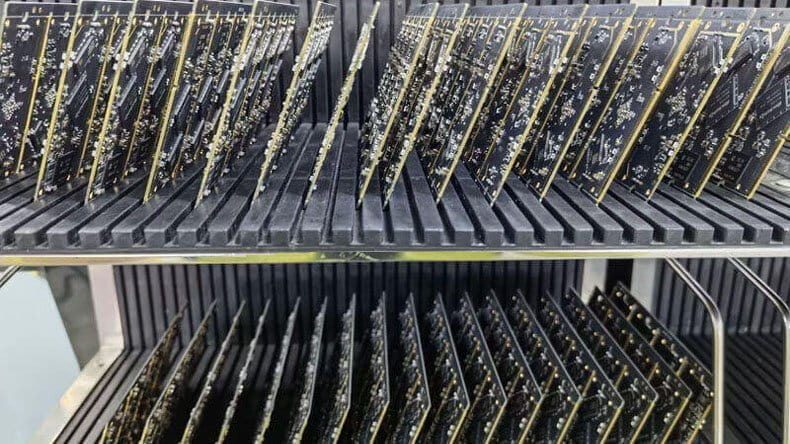
High Tg Thick Copper PCB: When Both Are Needed
A high Tg thick copper board combines two separate requirements in one laminate: a resin system that stays rigid at elevated temperature, and copper layers heavy enough to carry current or spread heat. Each is available on its own, and combining them changes the process in ways that are worth understanding before the stackup is fixed.
What High Tg Means
The glass transition temperature is the point at which the resin changes from a rigid solid to a softer state. Below it the laminate behaves elastically, and above it the material expands faster and its mechanical properties decline, which is why the value is quoted so often.
A high Tg material is not simply a better board. The transition temperature determines how a board behaves during lead-free reflow and in service at elevated ambient, and the material is chosen against those conditions rather than against a preference for higher specification.
<img src="https://www.gopcba.com/wp-content/uploads/2025/05/未标题-6.jpg" alt="High Tg thick copper PCB cross section with heavy copper layers” />
What Thick Copper Means
Copper weight is expressed in ounces per square foot. A standard board uses one ounce on the outer layers, while heavy copper constructions use two, three or more, with the heavier weights appearing on inner layers as well as on the surface.
The purpose is current capacity and heat spreading. A heavy copper layer allows a large current to be carried with reduced temperature rise, and blocks of copper can move heat away from a power device more effectively than a thin layer can.
Why the Two Requirements Appear Together
Heavy copper and high current usually mean heat, and heat is what makes the glass transition temperature relevant. A power board that runs warm will see the laminate near its transition, where the resin is at its weakest and the expansion is greatest.
The combination therefore appears in power converters, motor drives, battery management and high current distribution boards, where the copper carries the load and the temperature does not return to ambient between cycles.
Selecting the Material
The laminate has to tolerate the lamination cycles the construction requires and the assembly temperatures the product will see, while providing a bond to heavy copper that survives cycling. Resin content and flow are adjusted by the manufacturer for these applications.
The properties that matter are the transition temperature, the decomposition temperature and the expansion in the through-thickness direction, since the last of these stresses plated barrels. The comparison is between candidates, not against a general threshold.
Fabrication Limits
Heavy copper changes what can be fabricated. The minimum trace width and spacing increase, because the etching process must remove more material and the sidewalls undercut more, so a design that relies on fine features cannot simply be built on heavy copper.
Registration also becomes harder. Thicker copper is usually accompanied by a thicker laminate, and the accumulated tolerance across the stackup affects how accurately the layers line up.
Etching and Line Control
Etching heavy copper is a slower process, and it tends to undercut the trace, narrowing it below the artwork dimension. Designers compensate by drawing the traces slightly wider, a practice that has to be agreed with the fabricator rather than assumed.
The surface also matters. Resin residue and oxide have to be removed before plating so that the bond between layers is sound, and inadequate preparation produces the plating defects that only appear after thermal cycling.
Lamination and Resin Flow
Heavy copper creates thickness variation across the layer, and the prepreg has to flow enough to fill the spaces beside a thick trace without leaving voids. Where the copper is very thick, the surface is planarised with resin before lamination so that the next layer has a flat base.
Multiple lamination cycles may be needed, and each one adds heat history to the material. The laminate selection therefore has to account for the total number of presses rather than for a single cycle.
Drilling and Plating Heavy Boards
Drilling a thick board produces a deeper hole with a higher aspect ratio, and plating copper into it uniformly is harder. The plating thickness on the barrel is the parameter that governs reliability, and it should be verified by cross section rather than assumed.
Larger holes are generally used to keep the aspect ratio manageable, which also means larger pads and more space on the layer. That in turn reduces the routing density, so the design has to be planned around the construction rather than adjusted afterwards.
Thermal Performance
The benefit of heavy copper is measured in temperature rise. A wide, thick trace carries a given current at a lower temperature than a thin one, and the difference can be large enough to change the choice of components or the size of the enclosure.
The calculation should be made for the actual stackup, since the current capacity of an inner layer differs from that of an outer layer and depends on the copper weight on each. Assuming a value from a table for a different construction is the usual source of an overheating trace.
Applications
Typical uses are motor controllers, inverters, high brightness lighting, battery chargers and equipment that has to survive a hot environment while carrying significant current through the board itself.
In each case the board is doing thermal and electrical work that would otherwise need a heatsink or a cable, and the construction is chosen because it removes parts from the assembly rather than because the laminate is inherently better.
Cost Considerations
Heavy copper material costs more, the etching takes longer, the process window is narrower and the yield is lower. The result is a board that may cost several times an equivalent standard construction, which is why the requirement should be justified rather than assumed.
The comparison should include the parts that the construction removes. A board that carries its own current and spreads its own heat may be cheaper in total than a thin board with a heatsink, even though the board itself costs more.
Working With the Fabricator on a Heavy Stackup
Heavy copper is a speciality process, and the conversation should start before the layout is finished. The achievable minimum width, the number of lamination cycles and the maximum copper weight all vary between suppliers and are best established with a quotation rather than discovered at delivery.
Provide the current each layer must carry and the temperature rise that is acceptable, not only the artwork. A fabricator that understands the intent can suggest a stackup that meets the thermal requirement with less copper than the design assumed, which reduces both cost and lead time.
Verification and Acceptance
Verification for these boards concentrates on the hidden features: plating thickness in the barrel, resin fill between heavy traces and the dielectric thickness that determines the impedance. Coupons from the same panel are the practical way to check all three.
Thermal reliability testing completes the picture. Thermal cycling exposes the difference in expansion between the heavy copper and the resin, and the resulting data on barrel integrity is what confirms the material and the process were matched to the application.
FAQ
Do I need high Tg for a heavy copper board? Usually, because the current generates heat. Where the board runs cool and is assembled with a low temperature process, a standard material may be adequate.
Can fine traces be used on heavy copper? Only within the wider limits that the process permits. Heavy copper raises the minimum width and spacing, so the routing density has to be planned around it.
How thick can the copper be? It depends on the fabricator. Above a few ounces the process changes and fewer suppliers remain capable, so the requirement should be confirmed at the quotation stage.