Immersion Tin Finish: Thickness, Whiskers and Shelf Life
Immersion tin is a thin metallic coating deposited on copper by a displacement reaction. It provides a flat, solderable surface for fine pitch assembly and press-fit connectors, and it does so without the gold of an electroless nickel immersion gold finish and without the organic film of an OSP.
Its weakness is that the coating is thin and it is consumed by the same reactions that make it useful. Thickness, intermetallic growth, whisker behaviour and storage all have to be controlled together, because each of them shortens the usable life of the surface.
What Immersion Tin Offers
The coating is matt silver-white, uniformly flat, and it covers the copper rather than sitting on top of it as a plated layer would. Flatness matters for fine pitch devices, where a coplanar surface allows a consistent paste deposit and reliable placement.
It also has good electrical contact behaviour and is widely used on press-fit holes, where a ductile tin surface deforms against the pin. The absence of gold removes any risk of gold embrittlement in the joint, which is one reason it appears in high reliability work. It is also compatible with the same reflow alloys as other finishes, so no process change is needed at assembly.
How the Coating Forms
The process is a displacement reaction: the solution contains tin ions, and the copper surface dissolves as the tin deposits, so the coating grows by exchanging one metal for another. Deposition stops when the copper is covered, which is what limits the achievable thickness.
Because the reaction is self-limiting, the thickness depends on the chemistry, the temperature and the dwell. Additives control the grain of the deposit and prevent the copper from being attacked too aggressively, and a change of additive concentration shows up first as a variation in thickness across the panel. Bath temperature and dwell follow the same pattern, and both are easier to hold than the concentration.
Thickness and Its Control
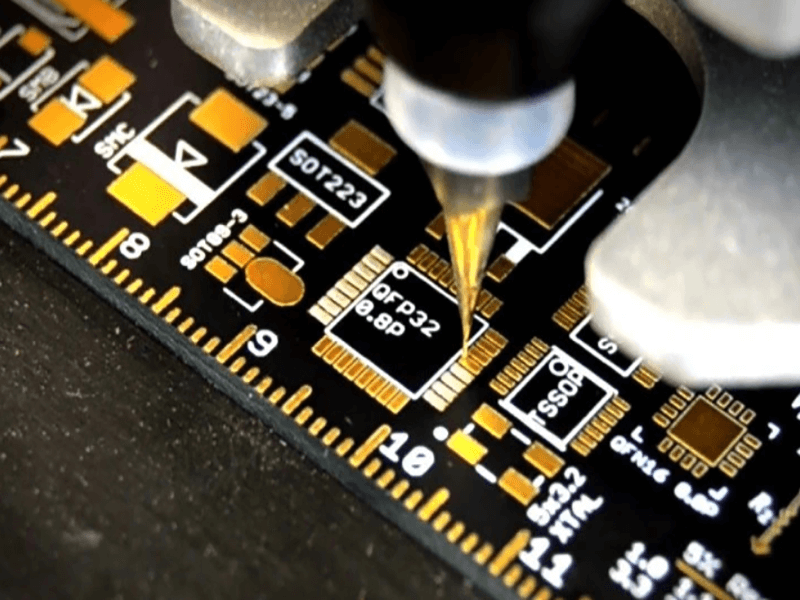
A typical specification is 0.8 to 1.2 µm, with 1.0 µm as the design target. Below about 0.8 µm the coating is porous and there is not enough tin to form sound joints after reflow, while above about 1.2 µm the deposit becomes less uniform and the process window narrows.
Thickness is measured by X-ray fluorescence on pads that represent the panel, and the technique and its limitations are the subject of the notes on coating thickness measurement. Measuring several positions rather than one is important, because a displacement process can be thinner in the centre of a dense area where the local copper area is large. Panels from both ends of the rack should be measured, since the reaction slows as the bath is worked.
The Intermetallic Layer and Aging
Even at room temperature, tin and copper react to form an intermetallic compound at the interface, and that reaction consumes tin from the coating. The growth is slow but continuous, and over months it removes a measurable fraction of the available tin.
The process accelerates sharply at soldering temperature, where several tenths of a micrometre of tin can be converted in a single reflow. A board that has been through two reflows has less tin available for the joint than one that has been through one, which is why the finish is normally limited to a small number of thermal cycles.
Whisker Risk and What Drives It
Tin coatings can grow thin filaments spontaneously, and those filaments can bridge adjacent conductors. The risk depends on the deposit stress, the grain structure, the substrate underneath and the thermal history of the board.
Two controls are used in practice. A nickel underlayer between the copper and the tin changes the stress state and reduces growth, and the intermetallic layer that forms at the interface also relieves stress, which is why pure thin tin over copper is less prone than a thicker deposit. The general behaviour of these filaments is described in the notes on tin whisker risk.

Handling, Packaging and Storage
The coating is soft and easily marked, so boards are handled by the edges and separated by interleaving that does not abrade the surface. Scratches expose copper, and a scratch on a fine pitch pad is a solderability defect that no inspection downstream will find.
Storage follows the supplier recommendation, typically in a sealed bag with desiccant and a stated storage life of six to twelve months. Nitrogen packaging extends the useful life on some processes and is worth asking about where the product is stored for a long period. Humidity is the main environmental factor, because a humid surface oxidises faster and solders less readily, which is why the storage rules are the same ones that apply to other sensitive finishes.
Solderability Over Time
Solderability is verified with a wetting balance or a dip and look test, with the acceptance criteria in the applicable surface finish specification rather than written by the shop. The test measures how quickly the surface wets and how strongly it pulls, and both figures change with the age of the coating.
The change is gradual, so a board that passes at the start of its storage life will continue to pass for months and then fail. Keeping a sample from each lot and re-testing it at intervals shows the trend and gives warning before the incoming material fails, and the sample is stored in the same packaging as the product, and the method itself is described in the notes on wetting balance testing.
Comparing With Other Finishes
Against electroless nickel immersion gold, immersion tin is cheaper and has no gold embrittlement risk, but it ages faster and has a shorter storage life. Against OSP it offers a longer shelf life and better contact behaviour, and against hot air solder levelling it offers far better flatness for fine pitch.
The comparison therefore turns on the product rather than on the finish alone. A board that will be assembled within weeks of fabrication and carries fine pitch parts is a good candidate, while a board that will sit in storage for a year, or that needs multiple reflows, is usually better served by another finish, as the selection guidance in the notes on surface finish selection sets out.
Verification and Records
Incoming checks for immersion tin are thickness by fluorescence, an appearance check under magnification and a solderability test on a sample. Those three give a reasonable view of a lot without destructive sectioning, which is usually reserved for a failure investigation.
The record should carry the lot, the thickness readings with their positions, the solderability result and the date, so that a later field failure can be compared with the finish the board actually received. A section showing the tin and the intermetallic layer is the evidence of last resort and is worth keeping when a joint failure is being argued.
FAQ
How thick should immersion tin be? Between 0.8 and 1.2 µm, with 1.0 µm as a common target. Thinner coatings are porous, and thicker ones are less uniform and less predictable.
How long can immersion tin boards be stored? Six to twelve months in a sealed package with desiccant, as stated for the process. The coating continues to convert to intermetallic during that time, so the useful life is less than the shelf life.
Is immersion tin suitable for multiple reflows? It can survive a small number, but each reflow consumes tin and thickens the intermetallic layer. Where three or more thermal cycles are expected, another finish should be considered.