Industrial Control Board Design: EMC, Protection and Environment
An industrial control board is not a consumer board with a wider temperature rating printed on it. The differences run through component choice, layer count, protection circuitry and the supervisory logic that keeps a machine running when something goes wrong. A board that controls a production line has to survive electrical abuse, humidity, vibration and decades of service, and it has to fail predictably rather than unpredictably.
What Makes an Industrial Board Different
The starting point is the environment. Industrial equipment is expected to operate over a wide ambient range in humid, dusty or chemically active surroundings, and often to remain in service long after the consumer product generation that shares its silicon has disappeared. Long term availability of every part, including connectors and power devices, becomes a design constraint rather than a procurement afterthought.
That in turn shifts the priorities. Commercial grade parts selected purely on price are not appropriate; components must be rated for the temperature and humidity the enclosure will actually see. Enclosure design, coating and derating all matter more than peak performance, because a board that shuts a plant down has failed regardless of how fast its processor runs.
Layer Count, Planes and EMC Behaviour
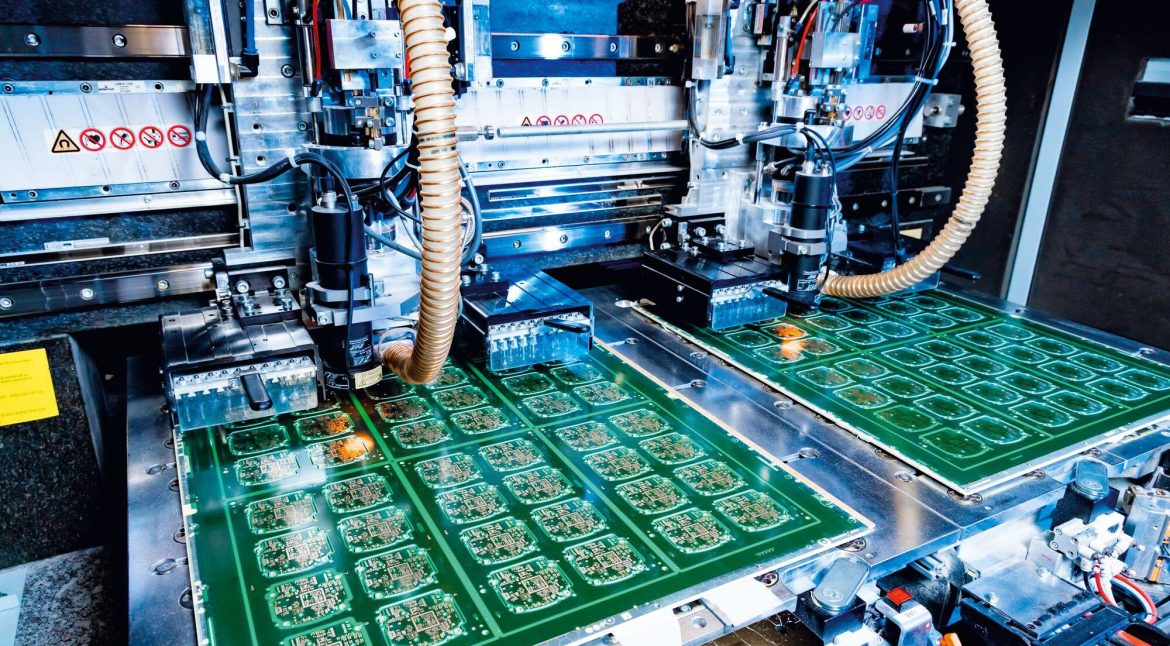
Industrial motherboards typically use six or more layers. The reason is electromagnetic compatibility rather than routing convenience. A continuous reference plane beneath every signal layer gives each trace a defined return path, which controls loop area and reduces both emissions and susceptibility. Removing layers to save cost usually shows up later as intermittent faults that are extremely difficult to reproduce.
Layer assignment should place high current and noisy switching circuits on the outer layers with a ground plane immediately beneath, and route sensitive analogue or communication lines against a quiet reference. Splitting planes carelessly creates slots that force return currents to detour, which is a common source of radiated emissions. The principles behind plane design are set out in power plane splitting rules.
Components for Temperature, Humidity and Life
Industrial grade components are specified with wider temperature ranges and better tolerance to moisture than commercial equivalents. Electrolytic capacitors deserve particular attention, because their lifetime falls sharply with temperature and they are usually the first part to fail. Where a design must last, solid capacitors or a derated electrolytic chosen with a calculated life figure is a better decision than the smallest part that fits.
The board surface itself needs protection. Conformal coating guards against condensation, dust and corrosive atmosphere, and its application has to be planned rather than added at the end, since connectors, test points and certain packages must be masked off. The trade-offs are discussed in conformal coating and board protection.
Protecting Field Interfaces from ESD and Surge
Every conductor that leaves the enclosure is a path for interference to enter, which is why ESD protection and surge protection begin at the connector. Serial lines, network ports, USB connections and parallel interfaces all need protection before the signal travels into the board. That protection normally combines a clamping device such as a transient voltage suppressor with a series element and, where the interface leaves the cabinet, galvanic isolation.
Placement is as important as part selection. The clamp must sit between the connector and the sensitive circuitry, with the shortest possible path to the ground reference it discharges into, because the inductance of a long trace turns a fast edge into a voltage spike. A protection device placed a few centimetres away provides far less benefit than one placed at the pin. Current carrying capacity for the associated power rails is checked with a trace width current calculation rather than by convention.
Different threats need different responses. An electrostatic discharge delivers a very fast, high voltage, low energy pulse, while a switching transient or a nearby strike delivers a slower but far more energetic surge. A device chosen for one will not necessarily handle the other, so a practical interface usually pairs a fast clamp close to the connector with a bulkier energy absorbing element behind it, separated by series impedance or a fuse that limits the current reaching the silicon.
It is also worth verifying that the protected node cannot be driven above its supply rail through a parasitic path elsewhere on the board. Protection that is bypassed by a neighbouring trace provides no benefit at all, and the failure usually appears as a damaged device rather than as an obvious layout error.
Power Architecture, Isolation and Creepage
Industrial boards frequently mix low voltage logic with higher voltage field wiring in the same enclosure. That demands deliberate separation: isolated power domains, defined creepage and clearance distances across the barrier, and routing that never runs a logic trace alongside a switching node. Compromising the barrier to make routing easier is a reliability decision disguised as a layout decision.
Power architecture also determines what the board does when the supply is disturbed. Wide input range regulators, hold-up capacitance and inrush control keep the logic alive through brownouts and supply dips that would otherwise reset the controller. Where the field supply is genuinely hostile, input filtering and transient suppression belong at the entry point rather than distributed across the board.
Supervisory Functions: Watchdog and Reset
The watchdog timer is what separates an industrial board from a consumer one in the eyes of the operator. If the firmware locks up, the watchdog fails to receive its expected service and forces a restart, allowing the equipment to recover without human intervention. Designing one properly means deciding what the reset does, how long recovery takes, and how the fault is logged so that repeated restarts are visible rather than silent.
Reset and supervision should be considered together. Power supply monitors hold the processor in reset until the rails are valid, brown-out detectors prevent execution at marginal voltage, and a status output gives the maintenance engineer something to observe. On equipment that runs unattended, an LED and a logged restart counter are often the only diagnostic evidence available.
Interface and Expansion Planning
Interface provision is driven by the application, and industrial equipment tends to accumulate connections over its service life. Serial ports, network interfaces, USB and legacy parallel connections are common, and each needs its own protection. Expansion through established mezzanine or backplane families, used together with a motherboard and a passive backplane, lets a single design serve several machine variants.
Display outputs follow the same logic. Analogue video, low voltage differential signalling, HDMI and DVI interfaces appear on the same board in different product configurations. Where the panel is remote, differential signalling with matched pairs is the practical choice, and its routing rules resemble those for any other high speed pair. EMI control around these interfaces is covered in EMI suppression design principles.
FAQ
Why do industrial boards need six or more layers? Not for routing capacity but for reference planes. A continuous plane under every signal layer defines the return path, which controls electromagnetic compatibility and makes the board far more tolerant of the electrical noise present in industrial environments.
What does a watchdog timer actually protect against? Firmware lock-up. If the program stops servicing the watchdog, the device forces a reset so the equipment recovers automatically instead of requiring an operator to cycle the power.
Is conformal coating always required? It is strongly recommended wherever condensation, dust or corrosive atmosphere is possible. The decision affects connector choice and test strategy, so it should be taken early rather than applied as a finishing step.