Ionic Contamination and Cleaning Verification
Flux residue is not inert. The activators that make a flux work are ionic, and if they remain on the board in the presence of moisture they will carry current between conductors, corrode the metal and eventually produce a failure that appears long after the product was tested.
Cleaning removes them, and verifying that the cleaning worked is a measurement problem. The board either has an acceptably low level of ionic material on its surface or it does not, and the difference is not visible.
What Ionic Contamination Is
The contamination is a mixture of flux activators, plating salts, handling residues and the ions released by the materials of the board itself. It is measured in equivalent amounts of sodium chloride per unit area, which is a convenient way of expressing the total ionic content regardless of what the ions actually are.
The specification for a product is usually expressed as a maximum value of that equivalent, and the figure depends on the application. A consumer product with a conformal coating will tolerate more than a medical device with exposed conductors and a high impedance circuit.
How the Measurement Works
The standard method is to extract the contamination from the board into a known volume of a solvent, usually a mixture of alcohol and water, and then measure the resistivity of the extract. The ionic material increases the conductivity, and the result is converted into the equivalent figure.
The extraction matters as much as the measurement. The solvent has to reach the surfaces where the residue is, and the process takes time. A short rinse measures the easily removed material and misses the residue under a component, which is exactly where the risk is highest.
Resistivity of Extract and Its Meaning
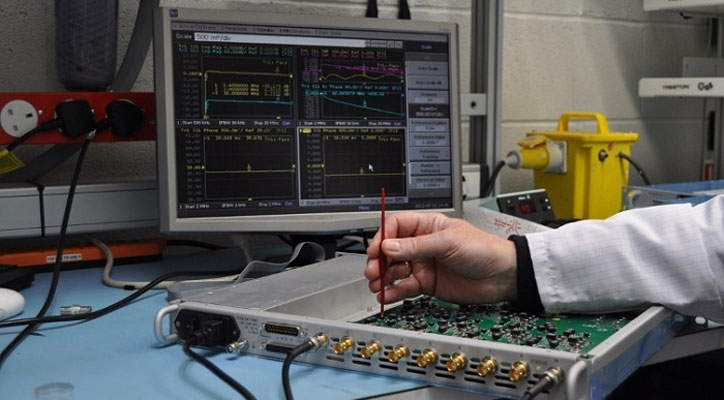
The resistivity of extract is a bulk measurement of the board. It says that a certain amount of ionic material was removed, and it does not say where it was or which ions they were. A board can pass the test and still carry a concentrated residue in a location that matters.
Understanding that limit is what makes the test useful. It is a process control tool, not a guarantee, and it is most valuable when it is tracked over time so that a change in the cleaning process is visible before a defect appears.
Cleanliness Specification and Process Window
A cleanliness specification is only meaningful if the process can hold it consistently. The cleaning machine has parameters: the chemistry, the temperature, the impingement and the rinse quality, and each of them affects the result.
The water used for the final rinse is particularly important. Rinse water that is recycled without adequate treatment carries ions back onto the board, and a machine that is working perfectly can still leave contamination because of the water quality. Monitoring the rinse water conductivity is a cheap check on that part of the process.

No Clean Flux and When It Applies
A no clean flux is formulated so that its residue is safe to leave in place. The classification indicates the level of activity and the conditions under which the residue can remain, and the classification is not a licence to skip cleaning in every case.
Where the product will be coated, or where the circuit has high impedance nodes, or where the environment is humid and the field life is long, the residue may still have to be removed. The decision depends on the product and the environment, not only on the label on the flux.
Cleaning Verification in Production
Verification is a sampled routine. Boards are taken from production at a defined frequency, extracted and measured, and the results are compared with the specification. The samples should include boards from different positions on the panel and from different points in the shift.
Where the result drifts, the cause is usually in the machine: a chemistry that has aged, a spray that has clogged, a rinse that is not being changed. Tracking the measurements as a trend makes the drift visible long before the boards start to fail, which is the same principle that applies to any cleaning process.
Interaction with Conformal Coating
Coating adheres to a clean surface and to a contaminated one differently. Residue under a coating can promote corrosion, and the coating may not bond at all where the surface energy has been changed by the residue.
Where a product is coated, the cleanliness requirement is usually tighter than for an uncoated assembly, and the specification should say so. The two processes have to be qualified together, because a change in the cleaning chemistry can change the adhesion without changing the ionic measurement.
Records and Traceability
Because the measurement is sampled, the records are the evidence that the process was in control for the whole production run. The date, the machine parameters and the measurement result form a chain that can be examined if a batch is later suspected.
That chain is worth as much as the measurement itself. It is the same approach that supports the rest of the quality control system, and it turns a suspicion into an investigation with a defined scope rather than a recall.
Process Control and Verification
On a design of this kind, resistivity of extract is the item that decides how the rest of the board is arranged. The process window is set by the narrowest step in the flow, so an improvement anywhere else shows up as margin rather than as yield until that step is addressed. A short note on the drawing about handling, storage or packaging is often worth more than an extra decimal place on a tolerance.
Where a value sits close to a process limit, the drawing should say so, since the shop can then open the process window rather than working to a nominal figure that carries no tolerance. A stack-up that is drawn rather than described removes most of the ambiguity from a quotation, and it lets the fabricator price the board against the dielectric and copper weights that will actually be used.
Related reading: our fabrication notes, board quality and design release notes cover the same ground.
Process Control and Verification
On a design of this kind, resistivity of extract is the item that decides how the rest of the board is arranged. The process window is set by the narrowest step in the flow, so an improvement anywhere else shows up as margin rather than as yield until that step is addressed. A short note on the drawing about handling, storage or packaging is often worth more than an extra decimal place on a tolerance.
FAQ
Does every board need to be measured? No. The measurement is destructive to the board in most cases, so it is done on samples and the process is controlled from the trend.
Is a water break test useful? It is a quick check on surface energy and cleanliness in production, but it is qualitative and it does not replace the extraction measurement.
Can cleaning damage a board? Aggressive chemistry or prolonged exposure can attack the solder mask or the markings. The process should be qualified on the real assembly rather than on bare laminates.