Bake Before Assembly And Moisture In The Laminate
A printed circuit board absorbs water from the air. The laminate takes it up through the resin and the glass, the amount depends on the humidity and on how long the board has been exposed, and the water is released as steam when the board is heated quickly. In a reflow oven that steam expands inside the laminate and can separate layers, blister the mask or push a pad away from the resin, and the remedy is to dry the board before it is assembled.
This article explains where the moisture comes from, when a bake is necessary, how it is carried out, and what the bake itself costs.
Why Boards Absorb Moisture
The resin in a laminate is not a perfect barrier. Water diffuses into it, and the rate depends on the temperature, on the relative humidity and on the chemistry of the resin. A board that has been stored in an air conditioned room for a few weeks holds a fraction of a percent by weight; one that has been stored in a humid warehouse for a year holds considerably more. The uptake is reversible, which is what makes baking useful.
The absorbed water has two effects at assembly temperature. It lowers the glass transition temperature of the resin locally, which softens the material, and it turns to steam above 100 degrees Celsius. Both happen at the moment when the resin is also being asked to hold the copper in place, and the combination is what produces delamination.
When A Bake Is Needed
Three situations normally call for a bake. The first is a board that has been stored unpacked for a long time, or one whose storage conditions are unknown. The second is a board that will see a high temperature process, such as a lead free reflow or a second reflow pass, where the steam has more energy. The third is a board that has already shown blistering or delamination, where the process is used as a control while the cause is investigated.
A board that arrives in a sealed bag with a desiccant is already dry, and baking it wastes time and oxidises the finish. The same applies to a board that will be assembled immediately after fabrication. The decision should therefore be based on the storage history and on the temperature the board will see, not on a habit. Where a shop bakes every board as a precaution, it is adding a step that can make the solderability worse.
Temperature, Time And Equipment
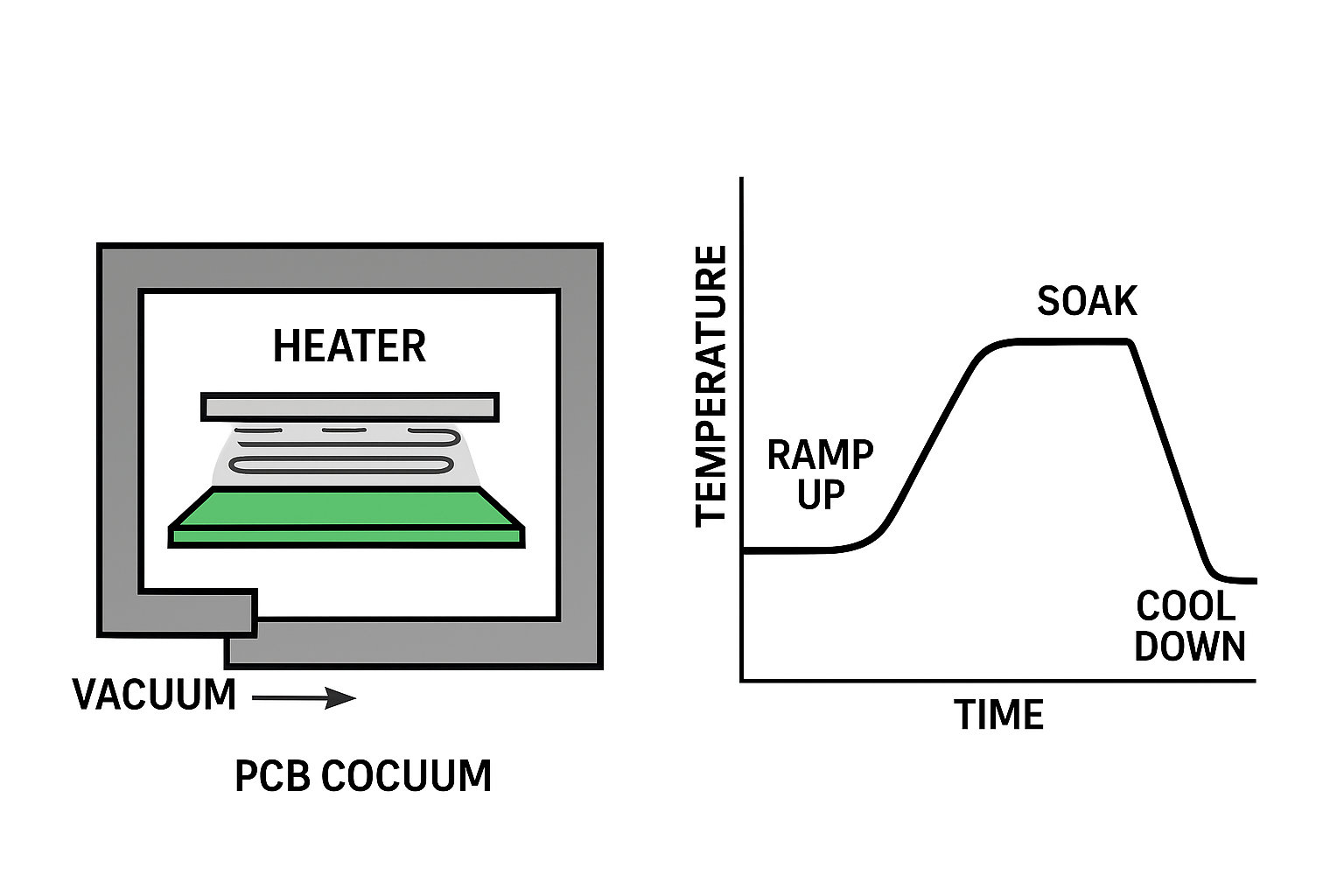
The conventional bake is 120 degrees Celsius for two to four hours, or 150 degrees Celsius for one hour, in a convection oven with good air circulation. The temperature has to be above the boiling point of water and below the point at which the resin is damaged, and the time has to be long enough for the water to diffuse out of the middle of a stack rather than only from the surface.
The equipment matters as much as the recipe. A dedicated oven rather than one that also cures other materials avoids contamination, and a rack that holds the boards vertically with space between them allows the air to move around each one. Boards stacked flat in a pile will dry slowly and unevenly, and the ones in the middle will not reach the target. The temperature has to be recorded, because a bake that claims to have happened cannot be distinguished from one that did not.
What The Bake Costs
The most significant cost is oxidation of the surface finish. A copper surface that is baked at 150 degrees for an hour grows an oxide that is thicker than one that is left alone, and the oxide reduces the wettability of the pad. On a bare copper finish, the bake has to be followed by an activation step or the finish has to be chosen to suit the process, which is one reason the organic finishes are preferred on boards that will be baked.
Other costs are the handling, the time in the oven and the risk of recontaminating the board on the way out. A board that is baked and then left in a humid room overnight absorbs moisture again, and the bake has to be followed by an immediate assembly or by a bag with desiccant. The dimensional behaviour of the laminate during a thermal excursion is described under PCB dimensional stability and expansion, and the effect of the assembly temperature itself is described under lead free versus leaded solder.
Documentation And Control
A bake is a process step and needs a record: the temperature, the time, the number of boards and the operator. Without the record, a later delamination cannot be attributed and the same problem will recur. The record also supports the decision about whether the bake was needed at all, since a shop that has never had a delamination problem with a particular product can show that from the data.
The control that matters most is storage. A board that is kept in a sealed bag with a desiccant and a humidity indicator card does not need to be baked, and the indicator card tells you whether the bag has held. Where the storage is not controlled, no amount of baking will make the process predictable. The wider sequence around assembly is described under PCBA development process.
Verification
Verification of a bake is indirect. The weight of a sample before and after gives a direct measure of the water removed, and it is the method used when a process is being qualified. In production, the temperature record and the time are the evidence, together with the absence of the defects that the bake was introduced to prevent.
The defects themselves are found by inspection after reflow. Blistering appears as a raised area of mask, delamination as a light or dark line between the layers when the board is viewed at an angle, and a pad that has been pushed away from the resin as a gap at the edge of the pad. All three are visible on a section, and the section is the evidence that the bake was insufficient rather than absent.
Vacuum Baking And Low Temperature Alternatives
A vacuum oven removes the water faster because the reduced pressure lowers the temperature at which it boils out of the resin, and it allows a lower temperature to be used for the same result. The benefit is a smaller oxide growth on the finish and less thermal stress on the laminate, and the cost is the equipment and the batch nature of the process. It is used where the finish is sensitive or where the board carries a component that has already been soldered once.
Where neither a high temperature nor a vacuum is acceptable, a dry cabinet at 40 to 45 degrees Celsius with a low relative humidity will dry a board slowly over a day or more. The method suits a small batch and a heat sensitive assembly, and it is a storage method as much as a drying one. Its disadvantage is time, which has to be planned into the schedule rather than added at the last moment.
FAQ
How long can a board stay out of its bag? That depends on the finish and on the environment, and it is measured in weeks rather than months for a bare copper finish in a humid room. The humidity indicator card is the practical guide.
Does baking damage the board? It can, through oxidation of the finish and through thermal stress if the temperature is too high. A bake within the recommended window is safe; a bake at a higher temperature to save time is not.
Is baking needed before every reflow pass? No. A board that is assembled on both sides does not need to be baked between the passes unless it has been stored for a long time, and the second pass is usually shorter and cooler than the first.