Low-Volume PCB Assembly: A Practical Guide to Prototyping, Testing, and Production
Every business aims to manufacture products efficiently, maximize profitability, and remain competitive. However, moving directly into mass production can be risky because large-scale manufacturing requires dedicated production setups, coordinated resources, optimized supply chains, and carefully planned production schedules.
For this reason, manufacturers often begin with low-volume production before committing to full-scale manufacturing. A small production run allows engineers and product owners to verify the design, evaluate manufacturing feasibility, identify potential defects, and optimize the assembly process before increasing production volume.
The same approach applies to PCB assembly. Prototypes, research and development samples, pilot runs, and customized electronic products are often manufactured in small quantities before entering mass production. Low-volume PCB assembly provides an important bridge between product development and high-volume manufacturing.
This guide explains what low-volume PCB assembly is, why it matters, the typical assembly process, important design considerations, key advantages, applications, differences between low-volume and mass production, and how to select a reliable PCB assembly manufacturer.
What Is Low-Volume PCB Assembly?
Low-volume PCB assembly refers to the production and assembly of a relatively small quantity of printed circuit board assemblies. Depending on the project, production quantities may range from several dozen units to several hundred units.
Unlike mass production, low-volume PCB assembly focuses primarily on:
- Prototype validation
- Engineering verification
- Product testing
- Design optimization
- Pilot production
- Customized electronic products
- Production feasibility evaluation
It provides manufacturers with an opportunity to identify design or manufacturing problems before committing significant resources to mass production.
For startups, research institutions, OEMs, and product developers, low-volume PCB assembly can significantly reduce development risks while providing valuable feedback for future production.
Why Is Low-Volume PCB Assembly Important?
Low-volume PCB assembly provides a cost-effective and flexible approach to developing, testing, and introducing electronic products.
From a technical perspective, it allows engineers to verify new circuit designs, evaluate component compatibility, test assembly processes, and identify potential reliability issues.
From a business perspective, it reduces the amount of capital tied up in inventory and minimizes the financial impact of design changes or production failures.
A well-managed low-volume production run can help manufacturers:
- Validate product functionality
- Identify design defects at an early stage
- Reduce engineering risks
- Evaluate manufacturing feasibility
- Optimize assembly processes
- Shorten product development cycles
- Prepare for future mass production
For these reasons, low-volume production is an essential stage between prototype development and large-scale manufacturing.
Low-Volume PCB Assembly Process
The basic PCB assembly process used for low-volume production is similar to that used for high-volume manufacturing. The primary difference lies in production scale, equipment utilization, material planning, and process flexibility.
A typical process includes the following stages.
1. PCB Design and Material Selection
A reliable PCB design is essential for successful assembly. Engineers should verify the schematic, PCB layout, component placement, electrical performance, thermal characteristics, and manufacturability before production.
Designers should also consider component availability. Standard and readily available components are generally preferred for low-volume production because customized components may involve higher costs and longer lead times.
Using commonly available components can reduce procurement risks and make future production scaling easier.
At this stage, engineers should also conduct Design for Manufacturing (DFM) and Design for Assembly (DFA) reviews to identify potential manufacturing problems before fabrication.
2. Solder Paste Printing
For surface-mount technology (SMT) assembly, solder paste is applied to the PCB using a stencil.
The accuracy of solder paste printing directly affects solder joint quality. Excessive or insufficient solder paste can lead to defects such as solder bridges, insufficient solder joints, tombstoning, and component displacement.
For low-volume production, careful stencil selection and process control are especially important because production quantities may not justify expensive dedicated tooling.
3. Component Placement
After solder paste printing, components are accurately placed onto the PCB.
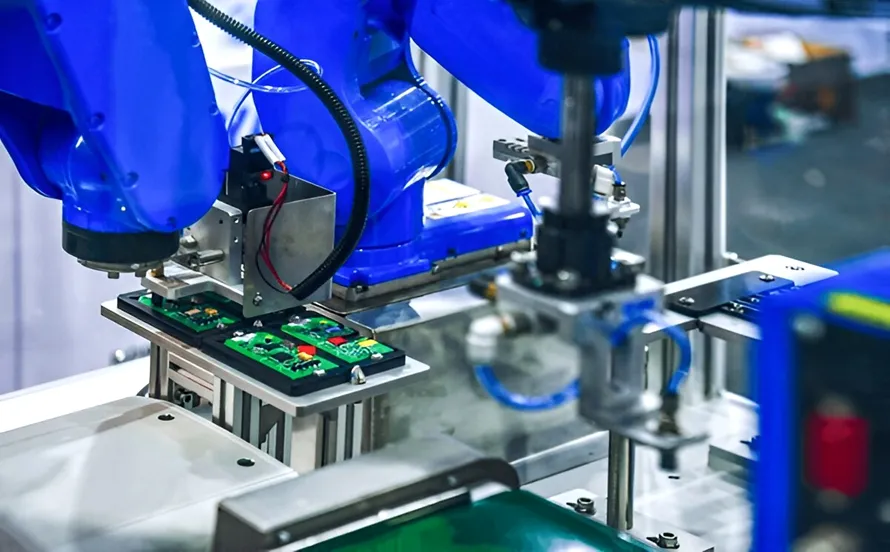
Depending on the complexity and quantity of the project, component placement may be performed using fully automated pick-and-place equipment, semi-automated systems, or manual assembly.
The appropriate approach depends on:
- Production volume
- Component density
- Component package types
- Required placement accuracy
- Project schedule
- Cost considerations
4. Reflow Soldering
For SMT assemblies, the populated PCB passes through a reflow oven. The temperature profile must be carefully controlled to ensure proper solder melting, wetting, and solidification.
A well-optimized reflow profile helps reduce defects such as:
- Cold solder joints
- Solder bridges
- Component damage
- Insufficient wetting
- Tombstoning
- Voids
5. Through-Hole Assembly
If the PCB includes through-hole components, additional assembly processes may be required.
Depending on the design, components can be installed using manual soldering, selective soldering, or wave soldering.
Through-hole technology remains important for connectors, power components, mechanical interfaces, and other components that require strong mechanical connections.
6. Inspection and Testing
Inspection and testing are particularly important in low-volume PCB production because every assembled unit may represent a significant portion of the project investment.
Typical inspection methods include:
- Automated Optical Inspection (AOI)
- X-ray inspection
- Visual inspection
- In-Circuit Testing (ICT)
- Flying-probe testing
- Functional testing
For complex or customized products, additional environmental, electrical, or reliability testing may also be required.
Design Considerations for Low-Volume PCB Assembly
Proper design preparation can significantly improve the efficiency and cost-effectiveness of low-volume PCB assembly.
Optimize PCB Layout
Engineers should optimize the PCB layout before production.
A good layout should consider:
- Component spacing
- Trace routing
- Thermal management
- Grounding
- Power distribution
- Test-point accessibility
- Component availability
- Manufacturing tolerances
Applying DFM principles helps identify potential assembly problems before production begins.
Avoiding unnecessarily complex layouts, excessive layer counts, and difficult-to-source components can also reduce manufacturing costs.
Plan for Future Mass Production
Even when the initial order is small, engineers should consider the possibility of future high-volume production.
The initial design documentation should therefore include:
- Complete Gerber files
- Bill of Materials (BOM)
- Pick-and-place files
- Assembly drawings
- Test specifications
- Revision information
- Approved component alternatives
- Manufacturing instructions
A well-documented design makes it easier to transition from low-volume production to mass manufacturing.
Consider Rework and Repair
Low-volume production may involve more manual intervention than high-volume automated manufacturing.
Therefore, the PCB layout should provide sufficient component spacing and accessible test points.
Designing for rework can make it easier to replace components, troubleshoot defects, and modify the circuit during development.
Advantages of Low-Volume PCB Assembly
1. Better Quality Control
Producing a limited number of PCB assemblies makes it easier to inspect and test individual units.
Engineers can analyze test results in detail and make design or process adjustments before scaling production.
This helps improve:
- Product reliability
- Assembly consistency
- Electrical performance
- Manufacturing yield
- Design robustness
2. Reduced Financial Risk
One of the biggest advantages of low-volume PCB production is reduced financial exposure.
Instead of purchasing large quantities of components and manufacturing thousands of boards, companies can validate the product using a smaller investment.
If a design needs to be modified, the financial impact is significantly lower.
3. Greater Manufacturing Flexibility
Low-volume production provides greater flexibility than mass production.
Manufacturers can accommodate:
- Engineering changes
- Component substitutions
- Customized configurations
- Different PCB revisions
- Small production batches
This flexibility is particularly valuable during the product development stage.
4. Faster Design Validation
Low-volume production enables engineers to quickly build physical products and evaluate them under real-world operating conditions.
This shortens the feedback loop between design and manufacturing and helps accelerate product development.
5. Easier Product Customization
Customized electronic products often do not require thousands of units.
Low-volume PCB assembly allows manufacturers to produce specialized products economically while maintaining appropriate quality standards.
Applications of Low-Volume PCB Assembly
Low-volume PCB assembly is widely used by startups, OEMs, research institutions, engineering teams, and electronics manufacturers.
1. Customized Electronics
Industrial control systems, scientific instruments, specialized communication equipment, and other customized products may require relatively small production quantities.
Low-volume assembly provides the flexibility needed for these applications.
2. PCB Prototyping
A PCB prototype allows engineers to transform a concept into a physical product.
Prototype assemblies can be tested for:
- Electrical functionality
- Mechanical compatibility
- Thermal performance
- Signal integrity
- Software-hardware integration
- Manufacturing feasibility
Design problems identified during prototyping can be corrected before mass production.
3. Pilot Production
Pilot production is an important step between prototype development and mass manufacturing.
During a pilot run, the manufacturer can replicate many aspects of the intended mass-production process while producing a limited number of units.
This allows engineers to evaluate:
- Production cycle time
- Assembly yield
- Component availability
- Process stability
- Testing efficiency
- Manufacturing costs
Pilot production therefore provides a more realistic assessment of mass-production readiness than prototype assembly alone.
4. R&D Projects
Research and development programs often require several PCB revisions during the development process.
Low-volume assembly allows engineering teams to test different versions without committing to large production quantities.
5. Medical, Industrial, and Specialized Electronics
Many specialized electronic products have relatively low production volumes but strict quality requirements.
For these applications, low-volume PCB assembly can provide the combination of flexibility, traceability, testing, and process control required for product development and controlled production.
Low-Volume PCB Assembly vs. Mass Production
Low-volume assembly and mass production serve different purposes.
| Feature | Low-Volume PCB Assembly | Mass PCB Production |
|---|---|---|
| Primary purpose | Prototypes, pilot runs, customized products | Commercial production |
| Production quantity | Dozens to hundreds | Thousands to millions |
| Unit cost | Relatively high | Lower |
| Initial investment | Lower | Higher |
| Design flexibility | High | Limited |
| Engineering changes | Relatively easy | More expensive |
| Automation level | Manual, semi-automatic, or automatic | Highly automated |
| Quality validation | Detailed unit-level validation | Process and statistical control |
| Production speed | Flexible | Optimized for throughput |
| Best suited for | R&D and product validation | Stable commercial products |
The optimal strategy is often to start with low-volume PCB assembly, validate the design and production process, and then transition to mass production when the product becomes commercially mature.
How to Choose a Low-Volume PCB Assembly Manufacturer
Choosing the right manufacturing partner is critical because low-volume production requires flexibility that not every PCB manufacturer can provide.
1. Technical Expertise
The manufacturer should understand different PCB technologies, assembly methods, component packages, and testing requirements.
A capable supplier should be able to support the project from PCB fabrication and component sourcing through assembly and final testing.
2. Quality Control and Testing Capabilities
A reliable manufacturer should have appropriate inspection and testing capabilities.
Important equipment may include:
- AOI
- X-ray inspection
- SPI
- Flying-probe testers
- ICT systems
- Functional testing equipment
A comprehensive testing strategy helps identify defects before products reach customers.
3. Component Procurement Capability
Component availability can significantly affect low-volume production schedules.
A capable manufacturer should have a reliable supply chain and be able to identify alternative components when necessary.
4. DFM and Engineering Support
Engineering support is particularly valuable during low-volume production.
The manufacturer should be able to review PCB layouts, identify manufacturability problems, recommend component alternatives, and suggest process improvements.
5. Cost Transparency
Low-volume PCB assembly generally has a higher unit cost than mass production.
However, manufacturers should provide transparent quotations covering:
- PCB fabrication
- Components
- Stencils
- Assembly
- Testing
- Engineering
- Tooling
- Packaging
- Shipping
Comparing only the assembly price can result in an inaccurate assessment of the total project cost.
How Kingda Supports Low-Volume PCB Assembly
For companies developing new electronic products, choosing a manufacturing partner capable of handling both prototypes and production can simplify the transition from engineering validation to commercial manufacturing.
Kingda can support customers with PCB manufacturing and assembly requirements across different production stages. By integrating engineering review, PCB fabrication, component sourcing, assembly, inspection, and testing, manufacturers can reduce communication gaps and improve production consistency.
For low-volume projects, an effective manufacturing workflow should focus on:
- DFM/DFA analysis
- PCB fabrication
- Component sourcing
- SMT and through-hole assembly
- AOI and X-ray inspection
- Electrical and functional testing
- Engineering change management
- Prototype and pilot production
- Production scalability
This integrated approach allows a product to move more smoothly from prototype validation toward stable production.
Tips for Reducing Low-Volume PCB Assembly Costs
Although low-volume production typically has a higher unit cost, several strategies can help control expenses.
Use Standard Components
Standard, readily available components can reduce procurement costs and lead times.
Reduce Unnecessary PCB Complexity
Avoiding unnecessarily complicated layer structures, unusual board dimensions, and excessive component varieties can lower manufacturing costs.
Optimize Component Placement
Efficient component placement can reduce assembly time and improve production yield.
Combine Similar Components
Where appropriate, reducing the number of unique component types can simplify procurement and inventory management.
Plan for Future Scaling
Designing the PCB with future mass production in mind can reduce the cost of transitioning to larger production volumes.
Frequently Asked Questions About Low-Volume PCB Assembly
1. What quantity is considered low-volume PCB assembly?
There is no universal quantity threshold. In many projects, low-volume production ranges from several dozen to several hundred PCB assemblies, although the definition varies by manufacturer and application.
2. Is low-volume PCB assembly more expensive than mass production?
Yes. The unit cost is generally higher because setup, engineering, tooling, procurement, and testing costs are distributed across fewer units.
However, the total financial risk is often much lower.
3. Can low-volume PCB assembly use automated equipment?
Yes. Depending on production volume and PCB complexity, manufacturers can use fully automated, semi-automated, or hybrid assembly processes.
4. Why is DFM important for low-volume PCB production?
DFM helps identify potential manufacturing problems before production. This reduces rework, improves yield, and makes it easier to transition to mass production.
5. What testing is recommended for low-volume PCB assemblies?
Depending on the application, recommended testing may include AOI, X-ray inspection, flying-probe testing, ICT, and functional testing.
6. Can low-volume PCB assembly support custom designs?
Yes. Flexibility is one of its major advantages. Manufacturers can support customized PCB layouts, component selections, board configurations, and engineering revisions.
7. Can a prototype PCB directly move into mass production?
Not always. A pilot production run is often recommended to verify the production process, yield, component supply, testing strategy, and manufacturing stability before full-scale production.
8. How can companies reduce low-volume PCB assembly costs?
Using standard components, optimizing PCB complexity, improving DFM, reducing unnecessary component varieties, and planning the design for future scalability can help reduce overall costs.
Conclusion
Low-volume PCB assembly is an essential manufacturing strategy for companies developing new electronic products, customized devices, prototypes, and pilot-production systems.
Although the unit cost is generally higher than mass production, low-volume manufacturing provides important advantages, including lower financial risk, greater design flexibility, faster validation, better engineering feedback, and easier implementation of design changes.
A successful low-volume production strategy should combine PCB design, DFM analysis, component sourcing, PCB fabrication, assembly, inspection, testing, and engineering support.
As electronic products become increasingly complex, manufacturers need flexible and scalable production solutions that can support the entire product development cycle. By selecting an experienced PCB manufacturing partner such as Kingda, companies can establish a smoother path from prototype development and pilot production to reliable high-volume manufacturing.