Manual PCB Assembly vs Automated PCB Assembly: Which Fits in 2026
Why the Assembly Method Matters
Choosing how to assemble your PCB affects cost, quality and time to market. For a prototype or a small batch, a manual line can be fast and flexible. For a large run, an automated SMT line delivers speed and consistency. The right answer depends on your quantity, budget and design complexity. This guide compares manual PCB assembly and automated PCB assembly in 2026 so you can pick the best path for your project.
What Is Manual PCB Assembly?
Manual PCB assembly is the process of placing and soldering components by hand rather than with automated equipment. The main steps are manual component placement, hand soldering with an iron or a hot air gun, and visual inspection by an operator. It is used for prototyping, small batches of up to a few hundred boards, complex or non standard designs and through hole components. It suits projects that need flexibility, frequent changes and a low startup cost.
What Is Automated PCB Assembly?
Automated PCB assembly relies on advanced equipment for precise, high volume production. The core technologies are a pick and place machine, a reflow oven and automated optical inspection. It is used for large runs above about 1000 boards, standard products and projects that need high consistency. It suits scaling production, stable quality and efficiency first programs.
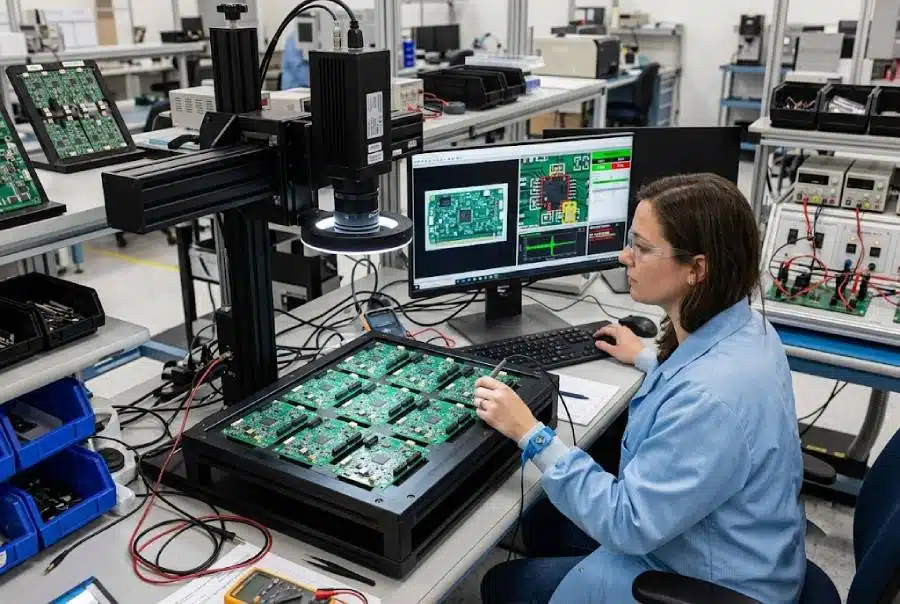
The solder quality is the biggest difference in practice. A reflow oven applies heat evenly to the whole board, so the joints form consistently. A hand soldered joint depends on the operator, the tip temperature and the dwell time, which means the quality can vary from board to board. This is why a manual line needs a careful inspection step while an automated line relies on AOI.
Core Differences Between Manual and Automated Assembly
Volume. Manual works small batch while automated works large batch. Startup cost. Manual is low cost, while automated needs a stencil and programming. Speed. Manual is slower, while automated places many parts per hour. Consistency. Manual depends on the operator, while automated is highly repeatable. Flexibility. Manual is very flexible, while automated is less adaptable to a design change. Labor. Manual needs more people, while automated needs fewer.
Advantages of Manual Assembly
It has a low startup cost because there is no stencil or program to buy, which makes it ideal for an early project. It is well suited to prototyping because a design change is easy and does not require reprogramming a machine. It handles odd shaped components and unusual layouts, and a small batch can turn around faster without waiting for setup. Manual assembly is essentially the default for research and development work.
Advantages of Automated Assembly
It produces at high efficiency, placing tens of thousands of components per hour, and the machine reduces human error so the quality is stable and consistent. At large volume the unit cost drops significantly, and automatic inspection with AOI improves reliability. When a product is standardized and needs a reproducible result, automation wins.
Limitations of Each
Manual assembly is slower, depends on operator skill and does not suit large scale production. Automated assembly has a high initial cost from the stencil and programming, is not economical for a small batch, and is less flexible when the design changes. Neither method is always better; the right choice depends on the product.
2026 Cost Comparison
As a reference, manual assembly for a prototype of 1 to 10 boards runs about 5 to 30 US dollars per board, and a small batch of 10 to 500 boards runs about 3 to 15 US dollars per board. Automated assembly has a startup cost of about 100 to over 500 US dollars for the stencil and programming, but a large run above 1000 boards drops to about 0.5 to 5 US dollars per board. The conclusion is that small batch favors manual, while large volume clearly favors automation.
When to Choose Manual Assembly
Choose manual assembly when you need a prototype or a design test, a small batch, a fast 24 to 72 hour turn, or a non standard and complex design. It is the most economical way to prove a circuit and iterate before you invest in tooling.
The stencil and the reflow profile must match the paste and the component pitch. A fine pitch part needs a thin stencil with a precise aperture, while a large power component needs a bigger opening for more solder. Getting these right is what makes automation repeatable. A supplier with process control and a well characterized reflow oven produces a board you can trust in volume.
When to Choose Automated Assembly
Choose automated assembly for a large run above about 1000 boards, a standardized product, a high consistency requirement or a tight delivery schedule. It is the path to a low cost per board and a repeatable result.
The board assembly plan should specify which parts go on the SMT line and which go through hand soldering. Some parts, such as a connector or a large electrolytic, cannot survive the reflow temperature and must be added after. Planning this in advance avoids a board that needs to be reworked and keeps the flow smooth from start to finish.
Mixed Assembly: The Best of Both
Most real products use a mixed approach. Surface mount components are placed and reflowed by the machine, while through hole parts are inserted and soldered by hand. This balances cost and efficiency, adds flexibility, and handles both standard and complex designs in one board. A mixed line is the most common solution for a board that has fine pitch ICs alongside connectors and power parts.
When the design is ready, hand it to PCB manufacturing and PCB prototype service to validate the build, then apply PCB design and manufacturing best practices to keep the assembly cost down.
How to Choose the Right Assembly Method
The key factors are production quantity, project budget, design complexity and delivery time. A simple rule of thumb is to use manual assembly up to about 500 boards, automated assembly from about 1000 boards, and a mixed approach for a design that combines both component types. A supplier that offers both will advise you on the best route.
Why Choose a One Stop Supplier
A professional supplier offers a one stop service that covers manual assembly and automated SMT placement. Fast prototyping in 24 to 72 hours, competitive 2026 pricing, small and large batch capability, AOI plus manual quality inspection and global delivery all help you move quickly. It serves hardware engineers, startup teams and OEM and ODM manufacturers.
The return and rework policy matters when you choose a supplier. Ask how they handle a defective joint and whether they can rework a board without replacing it. A good partner will show the defect rate and the inspection report so you know the quality before you ship a large order.
FAQ
Is manual PCB assembly still relevant in 2026? Yes, it is irreplaceable for prototyping and small batches.
Is automated assembly always better? No, for a small batch the cost can actually be higher.
Which is cheaper for a small batch? Manual assembly usually has the cost advantage.
Can I use both methods together? Yes, mixed assembly is the mainstream approach.