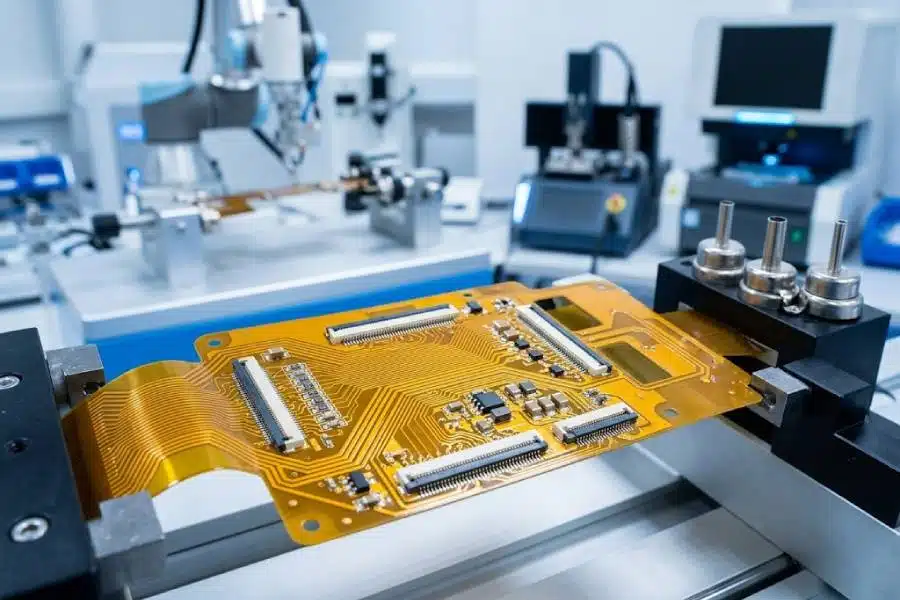
Rigid-Flex PCB Manufacturing: A Buyer’s Process Guide A rigid-flex board joins stiff FR-4 sections and thin polyimide flex tails inside one laminated structure. That single part replaces cables, connectors, and several separate boards. It also removes the assembly steps that used to join them. The benefit is real, but so…
Heavy Copper PCB Manufacturing and Design Control Heavy copper boards carry currents that standard boards cannot handle. The copper is thicker, the traces are wider, and every process step needs tighter control. A design that looks fine on paper can fail at etching, lamination, or drilling. This guide explains where…
Box Build Assembly is an advanced form of Electronics Manufacturing Services (EMS) that goes beyond conventional PCB assembly. Instead of delivering only an assembled PCB, box build manufacturing integrates the PCB, cables, wire harnesses, connectors, mechanical components, enclosure, power systems, accessories, and other components into a complete functional product. As electronic…
3D Printed Circuit Boards: Benefits, Materials, Uses A 3D printed circuit board builds conductive paths and insulating layers by additive deposition instead of etching copper from a laminate. The process can place circuitry on flat surfaces, curved housings, or molded parts, which opens design options that flat boards cannot offer.…
Fast Turn PCB Manufacturing and Rapid Prototyping Fast turn PCB manufacturing compresses fabrication into a shorter schedule than standard production allows. Engineering teams use it for prototypes, design verification, pilot builds, and urgent replacement boards. The real schedule depends on layer count, board size, material, copper weight, surface finish, drilling,…
HDI PCB Manufacturing: Build-Up, Microvias, and Control High-density interconnect boards pack more routing into less space, and that gain comes from process control rather than from a single machine. A laser drill makes the microvia, but the lamination press, the plating line and the registration system decide whether that via…
After the PCB manufacturing process is completed, the next major stage is PCB Assembly (PCBA). PCB fabrication creates the board structure, conductive layers, pads, vias, and other interconnections, while PCB assembly installs electronic components and forms the electrical and mechanical connections required for a functional electronic product. As electronic devices…
Multilayer PCB Manufacturing and Applications A multilayer board carries three or more copper layers, separated by dielectric material and joined by plated holes. Each inner layer needs its own artwork, its own etch step and its own registration check. The finished board then passes through lamination, drilling, plating and outer-layer…
Double-Sided PCB Manufacturing and Assembly Guide A double-sided PCB carries copper circuits on both the top and bottom surfaces. Plated through-holes and vias connect the two layers so signals and power can pass between them. This arrangement gives designers far more routing room than a single-sided board allows. It also…
FR4 PCB: Properties, Advantages, Types and Manufacturing FR4 is the default laminate for most rigid boards, yet the name hides real variety. Two suppliers can both quote FR4 and deliver laminates with different resin systems, glass styles and thermal limits. The differences only surface later, during drilling, lamination or reflow.…