Final Inspection Checklist For Finished Boards
Final inspection is the last opportunity to stop a defect before a board leaves the factory. It is not a search for perfection; it is a structured comparison between what the customer specified and what the panel actually contains, carried out against written criteria. Without those criteria the result depends on the inspector rather than on the product.
A useful checklist has four parts: what is inspected, what the acceptance criteria are, how many boards are checked, and what is recorded. When those four are defined, the inspection becomes repeatable and the decision to ship or hold becomes a matter of evidence.
Purpose And Scope
The scope of final inspection is defined by the drawing set and by the applicable standard. For a bare board it covers conductor width and spacing, hole size and position, solder mask registration, surface finish, marking, outline and dimensional features. For an assembled board it adds component presence and orientation, solder joint quality and cleanliness.
Everything in the scope should be inspectable and measurable. A requirement that cannot be verified with the equipment available is not really a criterion, and it tends to be skipped in practice. The checklist should list the measurement method next to each requirement.
Acceptance Criteria And Their Sources
Acceptance criteria come from three places: the customer drawing, the referenced industry standard, and any internal requirement added for a specific product. Where the three disagree, the order of precedence is stated on the drawing so that the inspector does not have to guess. Most disputes are caused by a criterion that was never given a source.
Numerical criteria are easier to apply than descriptive ones. A limit of 0.1 mm for a nick in a conductor is unambiguous, while a requirement that the surface be free of contamination needs a defined reference. Photographic reference charts bridge that gap and are widely used for visual attributes. How those criteria originate in the fabrication data is described under PCB design and fabrication.
Cosmetic Defects And Their Limits
Cosmetic defects are the attributes that do not change function but do affect appearance and sometimes long term reliability. Scratches in solder mask, discolouration of the finish, minor nicks at the board edge and flux residue fall into this group. Each one needs a limit expressed as a size, a count or an area.
The limits should reflect the product. A board that will be hidden inside an enclosure tolerates marks that a visible front panel does not, and a high voltage board needs larger creepage margins around any surface damage. Setting one cosmetic standard for the whole factory usually produces either unnecessary rejects or arguments at the customer incoming inspection.
Sampling Plan Versus Full Inspection
A sampling plan defines how many boards are inspected and what happens when a defect is found. Sampling is chosen when the attribute is covered by process control and the inspection is a verification rather than a sorting operation. Full inspection is used for safety critical attributes, for new products and for processes that have shown recent instability. The sequence of build stages the plan covers is described under PCBA development process.
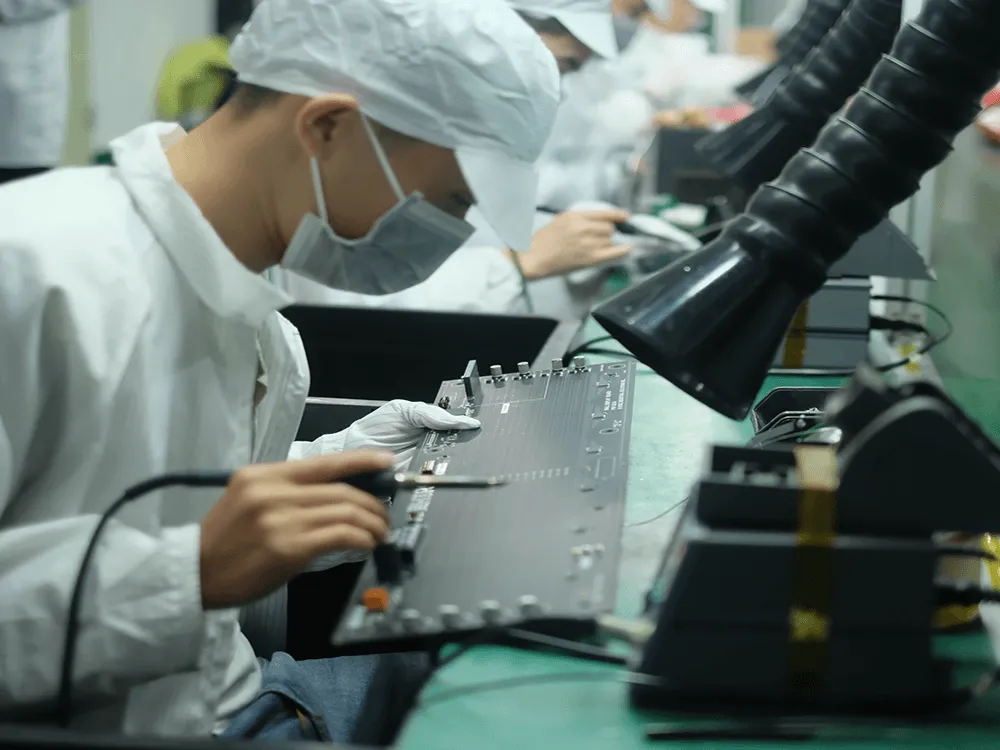
The sampling plan should state the sample size, the acceptance and rejection numbers, and the action taken on rejection. Plans drawn from a recognised standard are far easier to defend than an arbitrary rule of thumb. The plan should also define the switch back to normal inspection after a period of good results.
The Documentation Package
The documentation package accompanies the shipment and contains the drawing revision, the material and finish used, the test results, the traceability information and any deviation that was approved. It is the evidence that the boards were built as specified, and it is what the customer quality department reviews first.
Contents vary with the product and the contract, but a minimal package includes a certificate of conformance, a test report for the specified tests, and a reference to the lot identification marked on the board or the packaging. Electronic delivery has become normal, but the package still has to be retrievable years later.
Records, Nonconformance And Feedback
Inspection records make trends visible. Recording defect type and location for every rejection allows the dominant failure mode to be identified, and it turns inspection from a filter into a source of process information. A weekly review of those records is worth more than an additional inspection station.
Nonconforming boards are separated, identified and dispositioned through a documented process: rework, scrap, or use as is with approval. The disposition and its justification are recorded. Feeding the results back to design and process engineering closes the loop, as described under PCB design quality characteristics.
Process Control and Verification
On a design of this kind, documentation package is the item that decides how the rest of the board is arranged. Running a first article through the same checks as the production panel confirms that the two agree, and that comparison is the cheapest form of process control available at prototype stage. Keeping a sample from the panel turns a dispute into a measurement, because the same coupon can be re-examined by both parties without rebuilding the batch.
Reviewing the design before the data is released is cheaper than correcting it after the panel is in the tank, because every step downstream inherits the decision made at the front end. Documenting the assumption is part of the design work, and a short note on the drawing prevents a question that would otherwise arrive a day later and cost a day of schedule.
The process window is set by the narrowest step in the flow, so an improvement anywhere else shows up as margin rather than as yield until that step is addressed.
Process Control and Verification
On a design of this kind, documentation package is the item that decides how the rest of the board is arranged. Running a first article through the same checks as the production panel confirms that the two agree, and that comparison is the cheapest form of process control available at prototype stage. Keeping a sample from the panel turns a dispute into a measurement, because the same coupon can be re-examined by both parties without rebuilding the batch.
Reviewing the design before the data is released is cheaper than correcting it after the panel is in the tank, because every step downstream inherits the decision made at the front end.
Process Control and Verification
On a design of this kind, documentation package is the item that decides how the rest of the board is arranged. Running a first article through the same checks as the production panel confirms that the two agree, and that comparison is the cheapest form of process control available at prototype stage. Keeping a sample from the panel turns a dispute into a measurement, because the same coupon can be re-examined by both parties without rebuilding the batch.
A first article check confirms that the process and the drawing agree on the points listed above, and that the coupon data supports the values used in the design.
Where a measurement falls outside the expected window, the sample is retained so that the cause can be established before the balance of the batch is released.
FAQ
What is the difference between final inspection and final test? Inspection verifies physical and visual attributes against the drawing, while test verifies electrical behaviour. Both are usually required, and neither substitutes for the other.
Can cosmetic criteria be applied without a microscope? Simple size limits can be judged by eye with a reference chart at a defined viewing distance and light level. Any attribute close to its limit should be confirmed under magnification.
How long should inspection records be kept? At minimum for the product warranty or service life, and often longer in regulated industries. The retention period should be agreed with the customer and stated in the quality plan.