Ionic Contamination: Preparation, Placement and Process Control
Ionic contamination is the residue of the soldering process that remains on the board in the form of dissolved salts and flux activators. It is conductive once it absorbs moisture, and it is the raw material for leakage currents and for electrochemical migration between fine features.
Testing for it gives a single number for the whole board, which is both the strength and the weakness of the method. It is fast and cheap and it is widely used as a process monitor, but it cannot say where the contamination sits or what it consists of.
What Counts As Ionic Contamination
Flux activators, plating salts, etchant residues and handling contamination such as skin oils and fingerprints all contribute. The common factor is that they dissolve in water to produce ions, which is what makes them conductive on a humid surface.
Some of the material comes from the board itself and some from the assembly process. A bare board that was not rinsed properly leaves salts under the mask, and those can migrate to the surface during assembly and appear later as a cleanliness failure. The way a bare board is finished is described under PCB design and fabrication.
The Rosetta Test And Resistivity Of Extract
The classic method is the rosetta test, in which the assembly is washed with a measured volume of a water and alcohol mixture and the resistivity of extract is monitored as it falls. The result is expressed as an equivalent weight of sodium chloride per unit area of board.
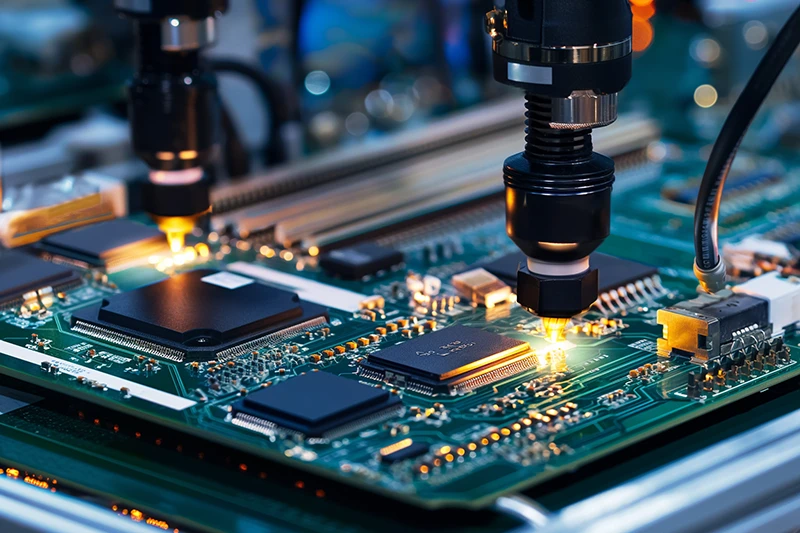
The measurement ends when the resistivity stops falling, which is taken as the point at which all soluble material has been removed. Modern instruments automate the cycle and give a pass or fail result directly, but the extraction conditions still have to be controlled.
Limits And Typical Values
Common limits are 1.56 micrograms per square centimetre for a general purpose assembly and 0.75 micrograms per square centimetre for a high reliability product. The lower value is used where the environment is humid or where the design has very fine spacing between conductors.
The limits are historical and are based on the performance of a clean process rather than on a direct calculation. They are useful as a process monitor, and a trend upward from a stable baseline is a useful warning even when the absolute number is still inside the limit.
Cleanliness Of No-Clean Assemblies
A no-clean process deliberately leaves residue on the board, and that residue is designed to be non-conductive and non-corrosive. The cleanliness test still applies, because the residue contains some ionic material and the limit defines how much of it is acceptable.
Where the test is most valuable for a no-clean process is as a check on the reflow profile. A profile that is too cool leaves activators unreacted and the reading rises, which makes the test a sensitive indicator of a change that would otherwise go unnoticed.
Sources In The Process
Fingerprints are a surprisingly large contributor. Handling a board with bare hands deposits salts and oils that survive reflow and appear in the extraction result, which is why glove and handling rules are enforced in assembly areas.
Other sources are solder paste left on the stencil for too long, water with a high mineral content used in cleaning, and workshop air near a machining operation. Each of them can be isolated by testing boards at different stages of the process.
Improvements And Verification
The first improvement is usually the cleaning process. Increasing the rinse volume, raising its temperature or adding a final deionised rinse all reduce the extracted ionic level, and the effect is measurable within a day.
Verification should track the result over time rather than rely on a single pass. A control chart of the extraction result shows drift before a limit is reached. How the cleanliness requirement is written into the process specification is described under PCBA development process.
Process Control and Verification
On a design of this kind, flux is the item that decides how the rest of the board is arranged. Running a first article through the same checks as the production panel confirms that the two agree, and that comparison is the cheapest form of process control available at prototype stage. Keeping a sample from the panel turns a dispute into a measurement, because the same coupon can be re-examined by both parties without rebuilding the batch.
Reviewing the design before the data is released is cheaper than correcting it after the panel is in the tank, because every step downstream inherits the decision made at the front end. Documenting the assumption is part of the design work, and a short note on the drawing prevents a question that would otherwise arrive a day later and cost a day of schedule.
The process window is set by the narrowest step in the flow, so an improvement anywhere else shows up as margin rather than as yield until that step is addressed. A short note on the drawing about handling, storage or packaging is often worth more than an extra decimal place on a tolerance.
Related reading: our fabrication notes, board quality and design release notes cover the same ground.
Process Control and Verification
On a design of this kind, flux is the item that decides how the rest of the board is arranged. Running a first article through the same checks as the production panel confirms that the two agree, and that comparison is the cheapest form of process control available at prototype stage. Keeping a sample from the panel turns a dispute into a measurement, because the same coupon can be re-examined by both parties without rebuilding the batch.
Reviewing the design before the data is released is cheaper than correcting it after the panel is in the tank, because every step downstream inherits the decision made at the front end. Documenting the assumption is part of the design work, and a short note on the drawing prevents a question that would otherwise arrive a day later and cost a day of schedule.
Process Control and Verification
On a design of this kind, flux is the item that decides how the rest of the board is arranged. Running a first article through the same checks as the production panel confirms that the two agree, and that comparison is the cheapest form of process control available at prototype stage. Keeping a sample from the panel turns a dispute into a measurement, because the same coupon can be re-examined by both parties without rebuilding the batch.
A first article check confirms that the process and the drawing agree on the points listed above, and that the coupon data supports the values used in the design.

Where a measurement falls outside the expected window, the sample is retained so that the cause can be established before the balance of the batch is released.
FAQ
Does a no-clean assembly need cleaning? Usually not, if the residue is proven benign and the contamination level is inside the limit. Cleaning is added when the operating environment or the circuit spacing demands it.
What does the test not tell you? It does not show where the contamination is or what it is made of. A board can pass overall while a localised area is dirty, so it is a monitor rather than a fault finder.
How often should the test be run? Commonly once per shift or per production lot, and always after a change of paste, flux or cleaning chemistry. More frequent testing is used during a process change.