Plain Circuit Board: A Complete Engineer Guide
A bare circuit board is what a printed circuit board is before anything is assembled onto it. The term is used by manufacturers to distinguish the product they ship from the assembly that the customer builds on it, and the distinction matters because the bare board and the assembled board are governed by different standards, tested by different methods and priced by different factors. Understanding what is in the bare board, and what is not, is the first step in specifying one.
What a Bare Board Contains
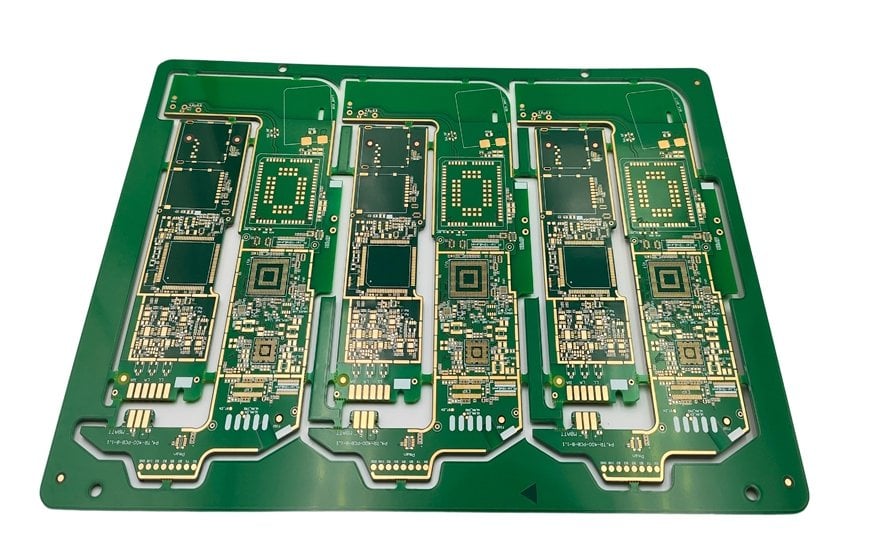
A bare board is a laminate carrying copper conductors, with plated holes where connections between layers are required, a solder mask that defines where solder may flow and a surface finish that keeps the exposed copper solderable. A silkscreen legend and a set of fabrication marks complete it. Nothing on the board is functional on its own; it becomes a circuit only when the components are placed and soldered.
What it does not contain is equally important. There are no components, no solder and no test fixtures. The board may be electrically tested at the fabricator using a fixture built for that purpose, but the test verifies continuity and isolation rather than function, and a board that passes may still not work when it is assembled, because the electrical test says nothing about impedance, about solderability after storage or about a marginal annular ring.
How a Bare Board Is Specified
The specification is a set of choices, each of which affects the price and the performance. The laminate and its glass transition temperature determine the thermal and mechanical behaviour. The layer count and the copper weight determine the current capacity and the routing density. The hole structure, whether through, blind or buried, determines how dense the board can be and how much it costs. The surface finish determines the solderability and the storage life, and the solder mask colour is a cosmetic choice that also affects inspection and, slightly, the thermal behaviour.
Beyond those, the drawing carries the tolerances: board thickness and its tolerance, the minimum line width and spacing, the impedance requirement where one exists and the acceptance class. Each of those is a cost driver, and each should be specified at the value the design needs rather than at a value that sounds impressive. Our IPC standards article describes how the acceptance class is stated and what it changes.

Testing a Bare Board
Electrical test is the main verification. A flying probe or a bed of nails fixture checks every net for continuity and every pair of adjacent nets for isolation, and it is usually performed on every board rather than on a sample. Where the board carries controlled impedance traces, coupons on the panel border are measured separately, and where the product is critical, a cross section from a coupon confirms the plating thickness and the layer registration.
Visual inspection covers what electrical test cannot see: the condition of the surface finish, the registration of the solder mask relative to the pads, the presence of scratches and the quality of the silkscreen. On a fine pitch board the mask registration is the feature most likely to affect the assembly yield, because a mask that encroaches on a pad reduces the area available for the solder joint.

Storage and Shelf Life
The surface finish is what determines how long a bare board can be stored before assembly becomes unreliable. An organic finish has the shortest life and is affected by humidity and by airborne contaminants. Immersion silver and immersion tin sit in the middle. Electroless nickel immersion gold has the longest storage life because gold does not oxidise, and it is the usual choice for a product whose assembly may be delayed or whose boards are held as spares.
Storage conditions matter as much as the finish. Boards should be kept sealed with a desiccant, away from heat and away from sources of sulphur and chlorine, which attack the surface finish even through a package. A board that has been opened and left in a workshop for months will not solder as well as one that was used promptly, and the difference appears as a scattering of poor joints rather than as an obvious failure.
Bare Board Versus Assembly
The two products have different requirements and different suppliers. A bare board is specified by its physical and electrical characteristics and is tested for continuity. An assembled board is specified by its function and is tested by operating it, and its quality depends on the solder joints as much as on the board. Many problems that appear during assembly and are blamed on the board are actually caused by a stencil aperture that does not suit the pad, or by a reflow profile that was copied from another product.
Keeping the two roles distinct makes the diagnosis easier. When an assembly fails, the first question is whether the board met its specification, and that can only be answered if the board specification and its test records exist. Our design release checklist places those records in the sequence.
Cost Factors
The price of a bare board is driven by the panel area it occupies, the layer count, the smallest feature on it and the finish. The number of drilled holes matters, because drilling is a slow operation and every hole consumes machine time. The tolerances matter, because tight tolerances mean more inspection and more rejects.
The practical consequence is that reducing the layer count or relaxing a tolerance is usually worth more than reducing the board area, up to the point where the routing can no longer be completed. A designer who understands which of the cost drivers the design is actually pushing can often reduce the price without changing the function at all.
Solder Mask, Legend and Fabrication Marks
The solder mask is not decoration. It prevents solder from bridging between adjacent pads during assembly, it protects the copper from oxidation and handling damage, and it defines the area where solder is intended to flow. Its registration relative to the pads is the parameter that matters most, because a mask that encroaches on a pad reduces the joint area and one that pulls back exposes copper that can bridge.
The legend carries the reference designators and the polarity marks that make assembly and repair possible, and the fabrication marks carry the panel identification, the date code and the revision. Together they are the reason a board can be traced and serviced, and they cost nothing beyond the space they occupy. Where the board is dense, the legend is the first thing sacrificed, and that decision usually looks worse a year later when a fault has to be diagnosed without it. Our design release checklist covers the documentation that should accompany the board.
FAQ
Is a bare board tested before it is shipped? Yes, usually electrically tested on every unit for continuity and isolation, plus coupon measurements and visual inspection. Functional testing is not possible because there are no components.
Why does the surface finish determine shelf life? Because it is what protects the copper from oxidation. Gold does not oxidise, so an ENIG board can be stored far longer than one with an organic finish.
What is the most common assembly problem caused by the bare board? Solder mask encroaching on the pads, which reduces the joint area, followed by an oxidised finish that wets poorly.