Reflow Conveyor and Support Tooling
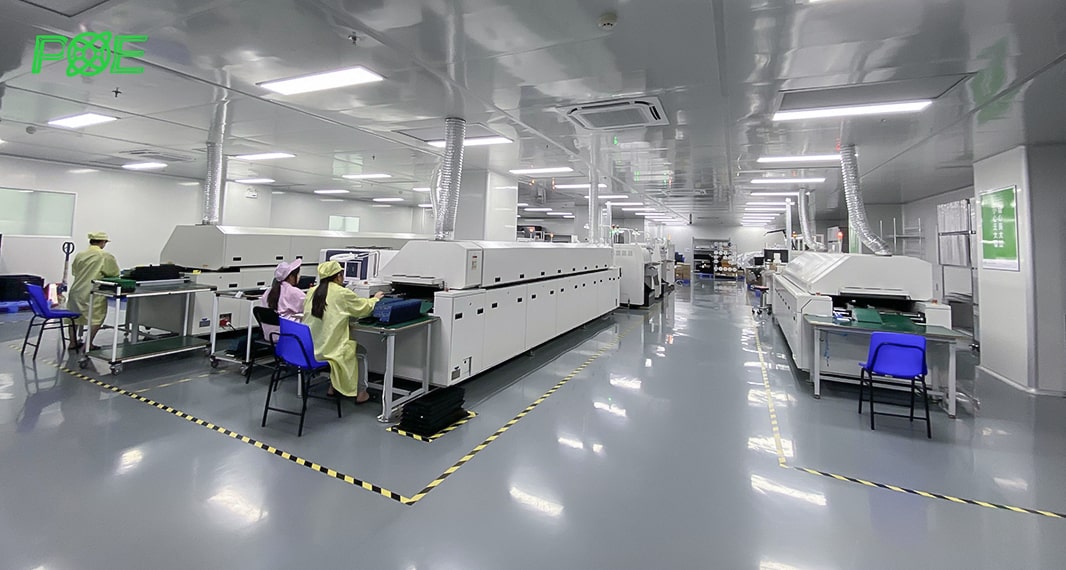
The conveyor carries the board through the oven and holds it while it is hot, and its behaviour decides whether the profile at the board matches the profile at the thermocouple. Support tooling then keeps the assembly flat while the alloy is liquid.
Both are often treated as accessories, and both change the result. A board that sags at reflow can have placement defects that no machine setting explains.
Conveyor Types
An edge conveyor holds the panel by its two long edges, which leaves the centre unsupported. A mesh belt supports the whole board, which helps a thin assembly but adds thermal mass and can leave marks.
The choice follows from the board thickness and the component height, and it interacts with the profile because the belt absorbs heat from the oven.
Edge Support and Rail Width
The rails must grip a defined strip, which is why the edge keep out exists. A rail that grips too little allows the board to move, while one that grips too much covers components.
The rail width should be confirmed for each product, and the panel layout should respect it. The same requirement appears in the rules for edge clearance.
Sag and Centre Support
A large thin board sags in the middle when it is hot, and the sag changes the placement that was correct at room temperature. Centre support pins or a support plate reduce it.
The support must be placed away from components and must not create a thermal shadow. Its positions should be defined from the layout rather than added by the operator.
Pallets and Carriers
A pallet supports the board and can also mask areas that must not be soldered, hold small boards for handling and protect the underside. It adds thermal mass, so the profile has to be re-run with the pallet in place.
The pallet material should be dimensionally stable at reflow temperature and should not shed particles. A warped pallet produces the same defects as a warped board.
Thermal Effects of Tooling
Any tooling in the oven absorbs and releases heat, which changes the thermal history of the board. A pallet that is cold at the entrance delays the heating of the assembly and shifts the effective profile.
The profile should therefore be measured with the production tooling, and the tooling should be included in the process record. A profile taken without it is a different process.
Tracking and Transfer
The transfer between conveyors and between machines should be smooth, because a board that is pushed or dropped shifts its components. The transfer height and the belt speed have to match.
Where a board is transferred at temperature, the mechanical shock matters more because the alloy is still soft. The transfer should be inspected during a run rather than assumed.
Maintenance and Cleanliness
The conveyor accumulates flux residue and particles, which can transfer to the board. Cleaning on a schedule and checking the belt tension are part of the process rather than of general maintenance.
A belt that has stretched tracks unevenly, which changes the dwell time across the width. The symptom is a defect that appears only on one side of the board.
Effect on Yield
Conveyor and tooling faults appear as placement errors, tombstoning and head in pillow defects, because all three depend on the board being flat and still while the alloy is liquid.
Where those defects appear in a pattern that follows the panel rather than the component, the tooling is the first item to check. This reasoning is the same one applied in panel yield analysis.
Records
The conveyor speed, the rail width, the pallet identity and the support positions should be recorded for each product. Where a defect is traced to tooling, those records identify the change.
They belong with the other process parameters described for manufacturing processes.
Additional Considerations for This Build
Practical attention to reflow conveyor pays for itself here, because it decides whether the finished board behaves as the drawing intended. Where the requirement is not stated on the fabrication drawing or in the assembly notes, the shop has to assume a default, and that default is rarely the value the design was simulated with. Stating reflow conveyor explicitly, together with the tolerance that applies, removes the assumption and keeps the result predictable from batch to batch.
Process Control and Verification
On a design of this kind, reflow conveyor is the item that decides how the rest of the board is arranged. Reviewing the design before the data is released is cheaper than correcting it after the panel is in the tank, because every step downstream inherits the decision made at the front end. Documenting the assumption is part of the design work, and a short note on the drawing prevents a question that would otherwise arrive a day later and cost a day of schedule.
The process window is set by the narrowest step in the flow, so an improvement anywhere else shows up as margin rather than as yield until that step is addressed. A short note on the drawing about handling, storage or packaging is often worth more than an extra decimal place on a tolerance.
Where a value sits close to a process limit, the drawing should say so, since the shop can then open the process window rather than working to a nominal figure that carries no tolerance. A stack-up that is drawn rather than described removes most of the ambiguity from a quotation, and it lets the fabricator price the board against the dielectric and copper weights that will actually be used.
Where the requirement is not written down, the shop supplies its own default, and the default is chosen for the process rather than for the design.
Process Control and Verification
On a design of this kind, reflow conveyor is the item that decides how the rest of the board is arranged. Reviewing the design before the data is released is cheaper than correcting it after the panel is in the tank, because every step downstream inherits the decision made at the front end. Documenting the assumption is part of the design work, and a short note on the drawing prevents a question that would otherwise arrive a day later and cost a day of schedule.
The process window is set by the narrowest step in the flow, so an improvement anywhere else shows up as margin rather than as yield until that step is addressed.
Process Control and Verification
On a design of this kind, reflow conveyor is the item that decides how the rest of the board is arranged. Reviewing the design before the data is released is cheaper than correcting it after the panel is in the tank, because every step downstream inherits the decision made at the front end. Documenting the assumption is part of the design work, and a short note on the drawing prevents a question that would otherwise arrive a day later and cost a day of schedule.
A first article check confirms that the process and the drawing agree on the points listed above, and that the coupon data supports the values used in the design.

Where a measurement falls outside the expected window, the sample is retained so that the cause can be established before the balance of the batch is released.
A first article check confirms that the process and the drawing agree on the points listed above, and that the coupon data supports the values used in the design.
Where a measurement falls outside the expected window, the sample is retained so that the cause can be established before the balance of the batch is released.
FAQ
Does a pallet change the profile? It does, because it adds thermal mass, so the profile should be measured with the pallet in place.
Can a mesh belt replace edge support? It supports the whole board and it adds mass and marking risk, so it is used where the board is otherwise unsupported.
Why does sag matter at reflow? Because the alloy is liquid, so any movement or slope changes the joint shape and can displace a part.
How often should the conveyor be checked? On the maintenance schedule and after any change to the product or the tooling.