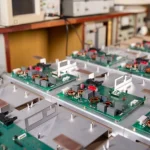
Reflow Oven Loading: 5 Rules for Even Heating
Reflow oven loading is the way boards are arranged on the belt as they enter the oven, and it changes the thermal profile of every board in the batch. A single board run alone heats faster than a full belt, and a gap in the middle of a run creates a cold pocket that the thermocouple on the reference board never sees. Loading is therefore a process setting, not a matter of operator convenience.
This guide covers five rules for reflow oven loading, the measurements that show the effect of a loading change, and the records that keep a qualified profile valid when the belt is not full.
What Reflow Oven Loading Changes
Every board in the oven absorbs heat from the same zones and gives heat back to the belt, the rails and the boards around it. A loaded belt of similar boards reaches a thermal steady state, while a single board sees more radiant heat per unit area and heats faster at the surface.
The difference shows up in the time above liquidus rather than in the peak. Peak temperature is set mostly by the zone setpoints, and the time above liquidus depends on how much heat the board can draw from its surroundings, which is exactly what loading changes.
Rule 1: Keep Board Spacing Even Along the Belt
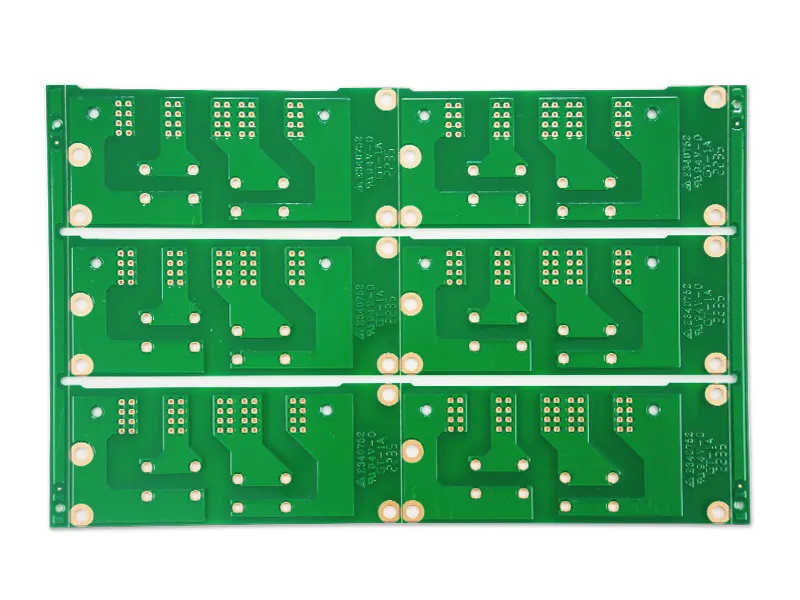
Reflow oven loading starts with board spacing, which should be constant within a run so that each board sees the same neighbours. A run that starts tightly packed and ends with gaps gives a profile that drifts from the first board to the last, and the drift is invisible on a single reference measurement.
A practical spacing is one board width or 50 mm, whichever is larger, for panels of ordinary size. Where the oven has a fixed load bar, the spacing is set by the bar pitch and the rule becomes a requirement about which pitch is used for the product.
Rule 2: Load Panels on a Consistent Edge Rail
Reflow oven loading also decides which edge rail carries the panel, and the choice changes the thermal path. A rail that runs beside a large copper plane conducts heat away from that side, so a panel loaded the other way round sees a different profile on the same board.
The loading instruction should therefore name the rail, not just the orientation of the board. Where a product is supplied in a panel with tooling strips on two edges, the same strip should always face the fixed rail, and the operator should have a marked position on the loading conveyor to check against.
Rule 3: Match Conveyor Speed to the Thermal Profile
Conveyor speed sets the time the board spends in each zone, and the qualified thermal profile is only valid at the speed it was measured at. A change in reflow oven loading without a change in speed still moves the board through the zones at the same rate, so the two settings have to be reviewed together. Raising the speed to clear a queue shortens the soak and the time above liquidus, which is a change to the process rather than an increase in throughput.
Where the line needs more capacity, the speed should be reviewed with a full thermocouple run at the new setting, not adjusted on the fly and corrected later. Our reflow profile guidance covers the measurement and the acceptance band for that run.
Rule 4: Control the Loading Pattern Across the Belt Width
Boards placed on one side of the belt leave the other side empty, and the empty side runs hotter because there is less material to absorb the heat. The result is a gradient across the belt that shows up as a difference between the left and right ends of a panel.
Loading should therefore keep the belt balanced across its width wherever the panel size allows. Where a narrow panel is run, two panels side by side are better than one, provided both are supported by the rails and the edge rail rule is satisfied for each.
Rule 5: Manage Missing and Double Loaded Boards
A missing board in a sequence is a colder gap, and the boards immediately after it see more radiant heat until the belt refills. Where the line stops and restarts, the first boards after the restart should be treated as a new thermal condition rather than as a continuation of the run.
Double loading, where two panels overlap during reflow oven loading, is worse: the overlapping edges see a shadowed zone and the profile is short. A load sensor or a simple mechanical stop that prevents overlap is worth more than any amount of operator attention.
Verifying the Load With Thermocouples
Verification should be run at the load condition the product will actually see. A profile measured on a single board and applied to a full belt is the most common falsification of a reflow process, and it is invisible unless the load is stated in the record.
A practical approach is to qualify the product in the worst case, which for most lines is a full belt, and then to confirm that a partial load stays inside the acceptance band. Our notes on reflow profile records cover the values that should be written down.
Records and Work Instructions
The work instruction should state the belt speed, the spacing, the edge rail, the number of boards per run and the loading pattern across the width. It should also state what to do when the batch is smaller than a full belt, because that case is where most loading errors happen.
Where the same oven runs several products, the loading rules should be written per product rather than as a general note, since a rule that is right for a thin board can be wrong for a heavy one. The general practice for process records of this kind is described by IPC, and the way the zones balance across the belt is covered in our notes on oven zone balance.
Verification and Records
A measurement taken at the wrong point of the process describes the wrong thing, however carefully it is made. Where the supplier and the user both measure the same property, they should agree on the method before the first delivery.
A parameter that is set once and never re verified drifts, and the drift is usually discovered by a defect rather than by the record.
FAQ
Can a single board be run on an empty belt? It can, but the profile must have been qualified at that condition. Most shops qualify at full load and treat a single board run as a deviation that needs its own measurement.
Does reflow oven loading change the peak temperature? Slightly, and it changes the time above liquidus more. The peak is set by the zone setpoints, so a loading problem usually appears as a change in wetting and voiding rather than as a peak error.
How often should a reflow oven loading rule be re-verified? After any change of panel size, belt speed, oven zone setting or throughput target, and at least once a year as part of the profile requalification.