Tin Plating on PCB: Flatness, Storage Life and Whiskers
Tin plating is one of the flat surface finishes, and it is chosen for the same reason as immersion silver or organic preservative: it produces a coplanar surface that fine-pitch assembly requires, at a cost between the cheapest organic finish and a gold deposit. It is also the finish with the most subtle process behaviour, because the tin layer reacts with the copper beneath it over time.
This article covers how the finish is applied, why the flatness matters, and the storage and whisker considerations that determine how long a plated board remains usable.
How the Finish Is Applied
Immersion tin is deposited by a chemical displacement reaction: the solution contains a tin salt and a complexing agent, and the tin displaces copper on the surface, building a layer typically 0.8 to 1.2 microns thick. Because the reaction is chemical rather than electrolytic, it deposits evenly on isolated features and inside holes without the current distribution problems that affect electroplated finishes.
The process requires clean copper and a controlled bath. Contamination, incorrect temperature or an exhausted solution all produce a thin or porous deposit, and a porous layer allows the copper beneath to oxidise, which destroys solderability even though the surface looks correct.
Why Flatness Matters
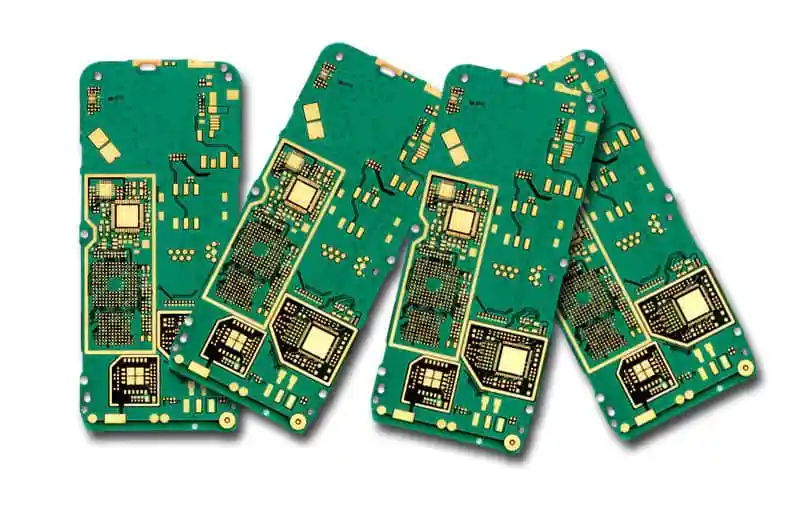
Because the finish is deposited as a thin layer rather than built up, the pad surface follows the copper underneath it. That gives excellent coplanarity, which is what a fine-pitch device needs for a reliable paste deposit and for the self-alignment that surface tension provides during reflow.
This is the property that makes the finish attractive below about 0.5 mm pitch, where a dipped finish such as hot air solder leveling cannot hold the geometry. It shares that advantage with immersion silver and with organic preservative, and the choice between them comes down to storage life, cost and the assembly process. The pad geometry itself should follow standard pad design conventions, because the finish does not compensate for a pad that is too small or too close to its neighbour.
Intermetallic Growth and Storage Life
Tin and copper react to form an intermetallic compound at the interface, and that reaction continues at room temperature. The compound itself is not a problem, but it consumes the tin layer, and once the tin is exhausted the exposed intermetallic oxidises and becomes difficult to solder.
This is why immersion tin has a defined shelf life, typically six to twelve months in controlled storage. The growth rate roughly doubles for every ten degrees of temperature, so a board stored in a hot environment loses its solderability much sooner than the datasheet figure suggests. Storage in a dry, cool place and a sealed bag with desiccant is the practical measure.
Whisker Risk
Tin deposits can grow conductive filaments, and a whisker that bridges two adjacent pads creates a failure that is intermittent at first and permanent later. The risk depends on the deposit structure: a large-grained, matte deposit grows whiskers far more readily than a fine-grained one, and mechanical stress in the deposit increases the growth rate.
The standard mitigation for a tin finish is a thin reflow, which melts the deposit and converts it into an alloy with the copper beneath, relieving the stress and changing the grain structure. Where the finish is not reflowed, the whisker risk remains and should be considered in the context of the pad spacing and the criticality of the circuit.
Process Control
The parameters that decide the result are the copper surface condition, the bath chemistry and the deposition time. Copper that has oxidised before plating produces a deposit that adheres poorly and may be porous, so the surface preparation and the transfer time between steps matter as much as the plating itself.
The bath has to be analysed regularly, because the tin concentration, the complexing agent and the copper content all drift as boards are processed. A bath that is running low produces a thin deposit that looks acceptable and fails after a few weeks of storage, which is one of the more difficult failure modes to trace back to its cause.
Where Immersion Tin Fits
It suits boards with fine pitch and a defined assembly window, where the flatness advantage is worth the storage discipline. It is also useful where an organic finish would be damaged by the number of reflow cycles, since the tin layer survives multiple passes better than an organic preservative.
It is a poor choice where the board will be stored for a long time before assembly, or where the assembly process includes handling that abrades the surface. In those cases a nickel-gold finish, which does not react with the copper beneath it, is more forgiving despite the cost. The comparison of lead-free and leaded soldering also matters, because the assembly temperature affects how much intermetallic growth occurs in a single pass.
Comparing With Other Flat Finishes
Immersion silver is similar in flatness and lower in cost, but it tarnishes and its solderability degrades in the presence of sulphur compounds, which are common in industrial environments. Organic preservative is the cheapest and gives the best coplanarity, but it tolerates very few reflow cycles before it decomposes.
Electroless nickel immersion gold is the most expensive of the flat finishes and the most robust, with a shelf life measured in years rather than months. Where the product is assembled soon after fabrication, tin or silver is a reasonable choice; where the boards sit in stores or travel between sites, the gold finish usually pays for itself in reduced scrap. The overall design rules for manufacturability apply regardless of the finish chosen.
Assembly Behaviour and Verification
A tin finish wets readily with both leaded and lead-free alloys, and it dissolves into the solder joint during reflow rather than remaining as a distinct layer. That is normal and does no harm, but it means the joint composition is not simply the paste composition, which matters where an alloy is specified for a reliability reason.
Verification is best done before assembly rather than after. A wetting balance test on a sample coupon, or a simple solderability check on a test pad, tells you whether the deposit is still active and whether the storage has been adequate. Waiting until the boards reach the assembly line means a batch that fails the check has already consumed the production slot, and the re-plating or replacement lead time becomes the critical path of the whole build.
FAQ
Does immersion tin need a reflow to be safe? A reflow converts the deposit into an alloy and greatly reduces the whisker risk. Where the finish is left as deposited, the risk remains and should be assessed against the pad spacing and the reliability requirement of the product.
How long can plated boards be stored? Typically six to twelve months in a sealed bag with desiccant at room temperature. Warmer storage shortens that considerably, and boards that have been stored too long usually need to be re-plated or scrapped.
Can immersion tin be used on a board with gold fingers? Yes, with selective finishing. The two processes cover different areas, and the tin is applied where solderability is required while the gold is applied to the mating surface, with each masked from the other.