The continuous advancement of electronic technology has driven the demand for smaller, faster, and more reliable electronic products. From smartphones and automotive electronics to industrial automation systems and medical equipment, modern devices rely heavily on advanced PCB Assembly technologies to achieve high performance and long-term reliability.
During the PCB manufacturing and assembly process, the terms SMD and SMT are frequently used interchangeably, which often causes confusion among engineers, product designers, purchasing teams, and electronics manufacturers.
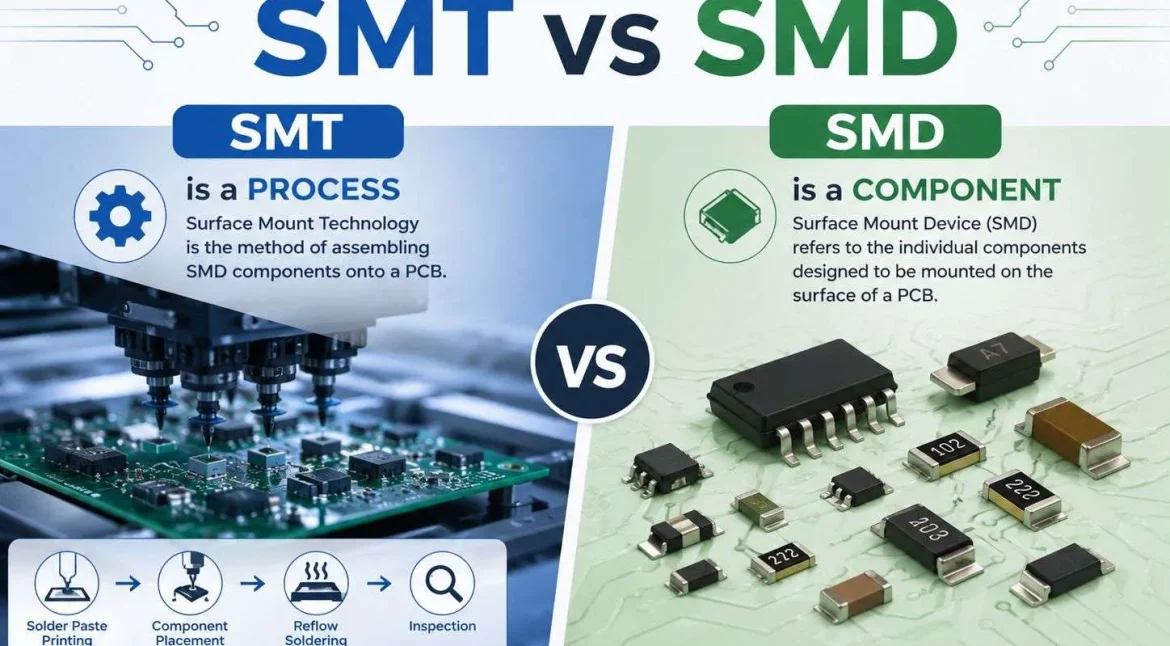
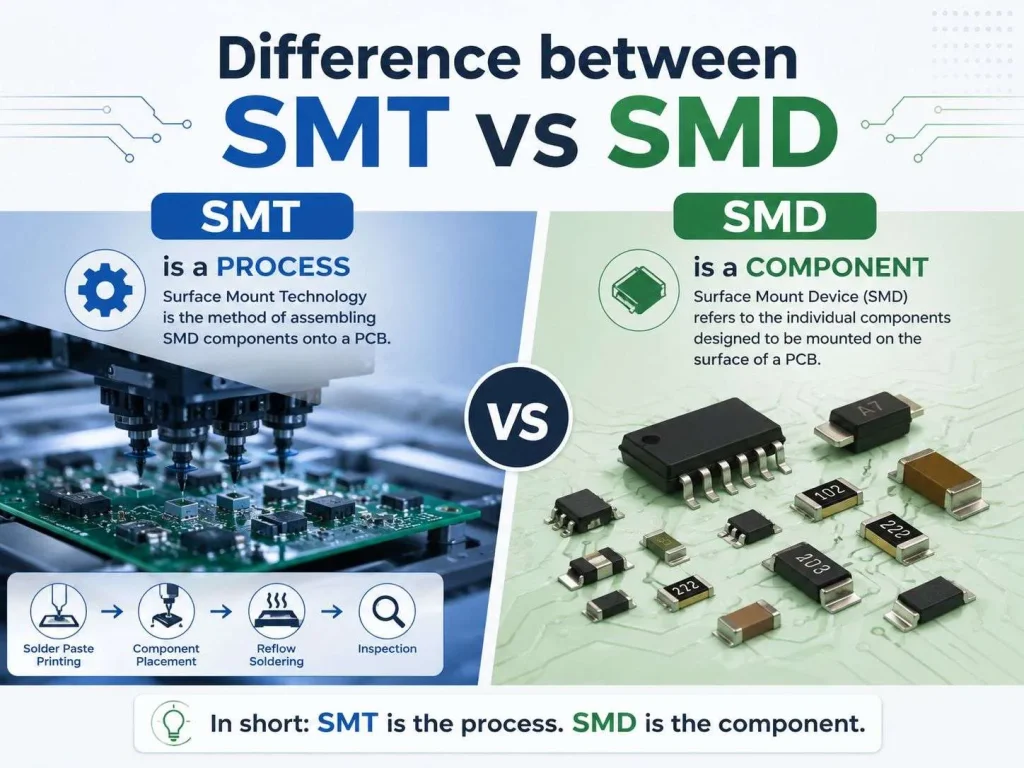
Although SMD and SMT are closely related, they represent two different concepts. SMD (Surface Mount Device) refers to the electronic components installed on a PCB, while SMT (Surface Mount Technology) refers to the manufacturing process used to place and solder these components onto the circuit board.
Understanding the difference between SMD vs SMT helps companies make better decisions when selecting a reliable PCB Assembly Manufacturer and developing high-quality electronic products.
In this guide, we will explain what SMD and SMT are, their differences, how they work together, their advantages in modern SMT PCB Assembly, and why choosing an experienced manufacturing partner like Kingda is essential for successful electronics production.
What is SMD in Electronics?
SMD (Surface Mount Device) refers to electronic components that are mounted directly onto the surface of a printed circuit board without requiring traditional through-hole mounting.
Unlike traditional components that require wire leads inserted into drilled PCB holes, SMD components are designed with compact terminals or pads that can be directly soldered onto the PCB surface.
Common types of SMD components include:
- SMD Resistors
- SMD Capacitors
- Integrated Circuits (ICs)
- LED Components
- Diodes
- Transistors
- Connectors
- Microcontrollers and semiconductor devices
The compact structure of Surface Mount Devices allows engineers to design smaller, lighter, and more powerful electronic products while maintaining excellent electrical performance.
Today, almost all modern electronic products use SMD components because they provide:
- Higher component density
- Reduced PCB size
- Improved electrical performance
- Lower manufacturing cost
- Better compatibility with automated production
When discussing SMD vs SMT, it is important to understand that SMD represents the physical electronic components, not the manufacturing process.
What is SMT in Electronics?
SMT (Surface Mount Technology) is an advanced automated manufacturing process used to assemble SMD components onto printed circuit boards.
The purpose of SMT Assembly is to accurately place, solder, inspect, and test electronic components using highly automated production equipment.
A typical SMT PCB Assembly process includes the following stages:
1. PCB Preparation
The bare PCB is prepared according to design specifications, including board inspection and surface preparation.
2. Solder Paste Printing
A precision stencil printer applies solder paste onto specific PCB pads where components will be mounted.
3. Automated Component Placement
High-speed pick and place machines accurately position thousands of SMD components onto the PCB every hour.
4. Reflow Soldering
The assembled PCB passes through a controlled reflow oven, where the solder paste melts and creates strong electrical connections between components and the PCB.
5. Automated Optical Inspection (AOI)
Advanced AOI inspection systems check component placement accuracy, solder quality, and potential assembly defects.
6. X-Ray Inspection
For complex assemblies such as BGAs and hidden solder joints, X-ray inspection is used to verify internal solder connections.
7. Functional Testing
Completed PCB assemblies undergo electrical and functional testing to ensure performance and reliability.
Modern SMT production lines use advanced automation technology to achieve high accuracy, consistent quality, and efficient mass production.
Simply explained:
- SMD = The electronic components
- SMT = The technology used to assemble those components
SMD vs SMT: Key Differences
Understanding the difference between SMD and SMT helps engineers, purchasing teams, and manufacturers communicate more effectively during product development and production.
| Feature | SMD (Surface Mount Device) | SMT (Surface Mount Technology) |
|---|---|---|
| Definition | Electronic components mounted on PCB surfaces | Manufacturing technology used for PCB assembly |
| Category | Hardware component | Assembly process |
| Main Purpose | Provides electrical functions | Installs components onto PCB |
| Examples | Resistors, capacitors, ICs, LEDs | Solder paste printing, placement, reflow soldering |
| Role in PCB Assembly | Installed onto the circuit board | Manufactures the completed assembly |
| Application | Component selection and design | Production and manufacturing process |
The discussion of SMD vs SMT is not about choosing one over the other. They are complementary technologies that work together to create reliable electronic assemblies.
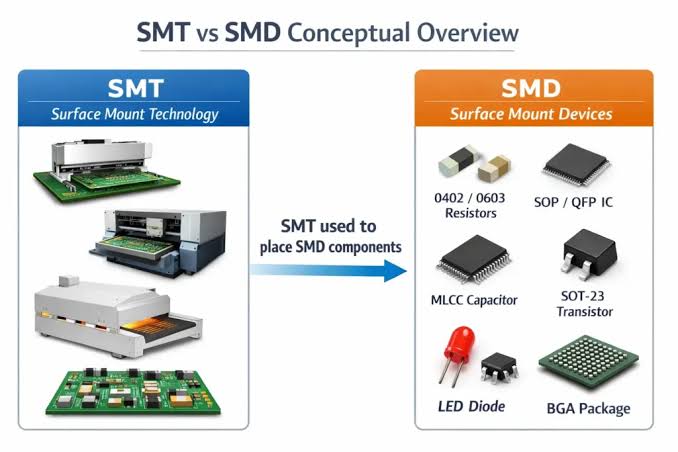
How SMD and SMT Work Together in PCB Assembly
Modern electronics manufacturing depends on the combination of SMD components and SMT Assembly technology.
The process begins with PCB fabrication, followed by solder paste application. Automated placement equipment then installs thousands of SMD components with extremely high precision.
After component placement, the PCB enters the reflow soldering process, where controlled temperature profiles permanently bond components to the circuit board.
The final assembly goes through inspection and testing procedures to ensure product quality before delivery.
Without SMT technology, manufacturers would not be able to efficiently produce modern electronic products using miniature SMD components.
At the same time, without SMD components, SMT production lines would have no components to assemble.
Therefore, SMD and SMT are not competing technologies — they are essential parts of the same PCB Assembly process.
Advantages of SMD and SMT in PCB Assembly
The combination of SMD components and SMT manufacturing technology has completely transformed the electronics industry.
1. Smaller and More Compact Product Designs
Because SMD components require significantly less space than traditional through-hole components, manufacturers can develop smaller and lighter electronic products.
This is especially important for:
- Consumer electronics
- Wearable devices
- Medical equipment
- Automotive electronics
- IoT products
2. Faster Manufacturing Efficiency
Automated SMT Assembly lines equipped with advanced pick-and-place machines can install thousands of components per hour.
This provides:
- Shorter production cycles
- Faster delivery times
- Improved manufacturing efficiency
- Higher production capacity
3. Higher Product Reliability
Advanced SMT PCB Assembly reduces human errors through automated placement and inspection processes.
Benefits include:
- More consistent solder joints
- Reduced assembly defects
- Improved product lifespan
- Stable electrical performance
4. Improved Electrical Performance
Because SMD components create shorter electrical connections, PCB designs can achieve:
- Faster signal transmission
- Lower parasitic effects
- Reduced electromagnetic interference
- Better high-frequency performance
5. Lower Manufacturing Costs
Automation in SMT manufacturing reduces labor requirements while improving production consistency.
This helps manufacturers achieve:
- Lower assembly costs
- Reduced material waste
- Better production efficiency
6. Higher Component Density
Modern electronic products require more functions in smaller spaces.
Using advanced SMD technology, manufacturers can install more components on smaller PCB layouts, supporting complex and high-performance electronic designs.
Why Choose Kingda for SMT PCB Assembly?
Selecting the right PCB Assembly Partner is one of the most important decisions affecting product quality, reliability, and production success.
Kingda provides professional PCB Assembly and SMT manufacturing services designed to support customers from prototype development to large-scale production.
Kingda’s Key Advantages Include:
Advanced SMT Manufacturing Capability
Kingda utilizes modern SMT production equipment, including high-precision component placement machines, automated solder paste printing systems, and advanced inspection equipment.
This ensures:
- Accurate component placement
- Stable production quality
- High manufacturing efficiency
Complete PCB Assembly Solutions
Kingda supports customers throughout the entire production cycle:
- PCB prototype assembly
- Low-volume production
- Medium-volume manufacturing
- High-volume PCB assembly
- Customized electronic manufacturing services
Strong Engineering Support
Kingda provides professional engineering assistance including:
- DFM (Design for Manufacturing)
- DFT (Design for Testing)
- DFX optimization
- Production process improvement
Our engineering team helps identify potential manufacturing issues before production, reducing development risks and improving product reliability.
Strict Quality Control System
Quality is a critical factor in electronics manufacturing.
Kingda applies comprehensive inspection and testing processes, including:
- AOI inspection
- X-ray inspection
- Electrical testing
- Functional testing
- Process quality monitoring
These quality control measures ensure every PCB assembly meets customer requirements and industry standards.
Reliable Supply Chain Management
Kingda maintains professional component sourcing and supply chain management capabilities to help customers reduce risks related to:
- Component availability
- Production delays
- Market fluctuations
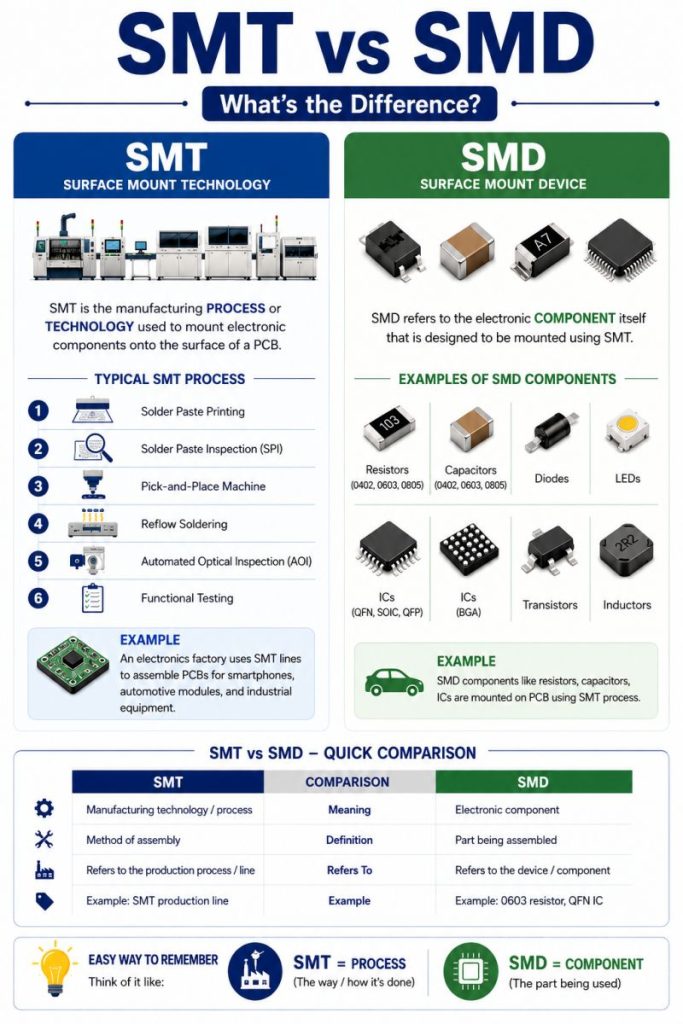
Conclusion: Understanding SMD vs SMT in PCB Assembly
Understanding the difference between SMD and SMT is essential for anyone involved in electronics design and manufacturing.
SMD (Surface Mount Device) refers to the electronic components installed on a PCB, while SMT (Surface Mount Technology) refers to the manufacturing process used to assemble those components.
When comparing SMD vs SMT, remember:
- SMD is the component
- SMT is the assembly technology
Both technologies work together to enable smaller, faster, and more reliable electronic products.
As electronics continue to evolve, advanced SMT PCB Assembly remains the preferred manufacturing solution because of its speed, accuracy, reliability, and cost efficiency.
With advanced equipment, experienced engineers, strict quality control, and complete manufacturing capabilities, Kingda provides dependable PCB Assembly solutions from prototype development to full-scale production.