SMT vs THT Assembly Capability: How to Choose in 2026
Why Assembly Capability Decides the Outcome
The way you assemble a PCB shapes its performance, cost and scalability. In 2026, products keep getting denser, smaller and more reliable, so the choice between SMT and THT assembly has become a key decision for engineers and buyers. SMT places components on the surface for high density and low cost at volume, while THT inserts leads through the board for strength and power handling. This guide compares the two from an assembly capability point of view.
What Is SMT Assembly?
Surface mount technology places components directly on the pads on the surface of the board and connects them through reflow soldering. The process prints solder paste, places parts with a high speed pick and place machine and then reflows the board. SMT gives high density routing, suits miniaturized products, is highly automated and efficient, and lowers the cost at large volume. It also works well for high frequency and high speed circuits. The limits are lower mechanical strength, harder manual rework and sensitivity to thermal stress.
What Is THT Assembly?
Through hole technology inserts component leads into plated holes in the board and solders them on the back. The process drills and plates the holes, inserts the parts by hand or by an auto inserter, then wave solders or hand solders them. THT gives high mechanical strength and good vibration resistance, suits high power and high current parts and has reliable connections. The limits are lower production efficiency, higher labor cost and lower layout density.
Process Flow in Detail
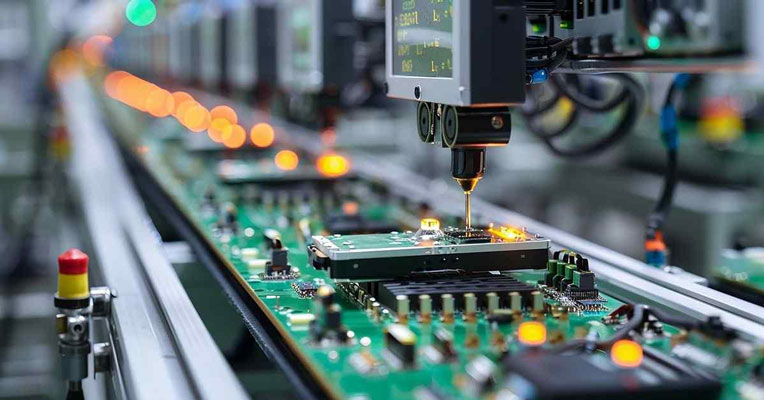
A surface mount line follows a defined sequence. First the board is cleaned and solder paste is printed onto the pads with a stencil. A pick and place machine then places the components at high speed and with tight accuracy, and the board passes through a reflow oven where the paste melts and forms the joint. Finally an automated optical inspection and an X ray check verify the solder joints. The whole flow is fast, repeatable and easy to scale.
A through hole line follows a different route. The board is drilled with plated holes, components are inserted either by an axial or radial inserter or by hand, and the board is wave soldered so the solder fills the hole and forms a strong physical joint. The process is slower because the insertion and soldering take more time, but the joint holds the component firmly and endures vibration and thermal cycling better than a surface mount joint.
Component Types and Compatibility
SMT is the natural choice for small passive components, ICs, resistors, capacitors and fine pitch packages such as 0402, 0201 and QFN. It fits anything with hundreds or thousands of parts on a small board. THT is better for a through hole connector, a large electrolytic capacitor, a transformer, a relay, a power transistor and any part that must withstand a mechanical pull. Many components are available in both formats, so the real decision is driven by the assembly line you plan to use.
Core Comparison of SMT and THT Capability
Mounting. SMT mounts on the surface while THT mounts through a hole. Efficiency. SMT is fast and automated, while THT is slower. Volume cost. SMT is low cost at scale, while THT is higher. Mechanical strength. SMT is medium, while THT is high. Component density. SMT is high, while THT is low. Repairability. SMT is harder to rework, while THT is easier. Typical use. SMT fits consumer electronics, while THT fits industrial and power equipment.
When to Use SMT Assembly
Choose SMT when you need a high density, miniaturized PCB, a large production run, strong cost sensitivity or a high speed and radio frequency circuit. Typical products are smartphones and wearables, IoT devices, communication modules and laptops. SMT is the default for anything that must be small and cheap in volume.
When to Use THT Assembly
Choose THT when the product needs high mechanical strength against vibration and shock, handles high voltage or high current, or uses a critical connector or a large component. Typical applications are industrial controls, automotive electronics, power modules and military and aerospace equipment. THT remains essential where the joint must physically hold.
Hybrid Assembly
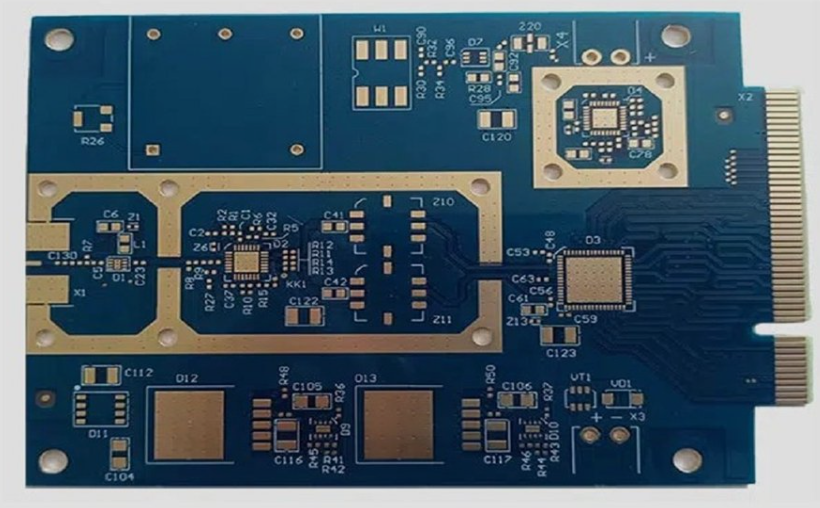
Many real products use a hybrid process that combines SMT and THT. This brings together high density and high strength, optimizes the overall cost structure and improves reliability. On the same board, ICs and resistors use SMT while connectors and transformers use THT. The SMT parts are reflowed first, then the through hole parts are inserted and wave soldered or hand soldered. A supplier with both lines produces a robust, high reliability result.
Key Decision Factors
Application. Consumer electronics favors SMT, while industrial equipment favors THT or hybrid. Budget. SMT lowers cost at scale, while THT has a higher labor cost. Quantity. A small batch gives more flexibility, while a large batch favors SMT. Reliability. A high reliability product uses THT or hybrid, while a standard product uses SMT. Complexity. A dense complex design uses SMT, while a simple circuit can use THT.
Signal integrity is another factor. A surface mount component has a shorter lead, so the parasitic inductance is lower and the high frequency performance is better. This is why RF and high speed digital designs almost always use SMT. A through hole lead adds a small amount of inductance, but that is usually acceptable for power and low frequency circuits.
Quality and Inspection
On a serious line the inspection step is non negotiable. AOI finds a missing, shifted or unaligned component, a bridging solder joint and an insufficient wetting defect. X ray inspection reveals voids under a ball grid array and helps confirm the solder fills a through hole. A quality supplier reports the defect rate and provides the inspection result, so you know the board matches the design before it ships.
2026 Assembly Trends
SMT automation and AI based inspection keep raising efficiency. AOI and X ray inspection are now standard on a quality line, lead free processes are common, and products keep shrinking. SMT is still the mainstream, but THT remains irreplaceable in high reliability and high power applications. The trend is toward a flexible line that can run both.
How to Choose a Supplier
Look for a complete SMT and THT assembly capability, ISO and IPC standards, a one stop PCBA service that includes component sourcing and assembly, and fast delivery. A supplier that supports fine pitch SMT such as 0201, runs a dedicated THT insertion line and offers a hybrid solution gives you the flexibility to build the right board. Confirm 24 to 72 hour fast turn for a prototype.
Hand the design to PCB manufacturing with a PCB prototype service to validate the assembly, and follow PCB design and manufacturing best practices to keep both processes in tolerance.
2026 Cost Analysis
As a reference, SMT placement cost is about 0.003 to 0.01 US dollars per point, with a setup fee of about 50 to 200 US dollars and a stencil cost of about 30 to 100 US dollars. THT insertion is about 0.02 to 0.08 US dollars per point because the labor cost is high and the wave soldering adds expense. The conclusion is that SMT wins at high volume and low cost, while THT wins where reliability and strength matter.
For a small prototype the math often flips. A stencil and a program can cost more than the boards themselves, so a small batch may be cheaper on a manual or THT line. As the quantity grows, the machine setup is paid back quickly and the per board price falls fast. Always ask for a quote at your target quantity instead of reading a single price per point.
Summary
Choose SMT for efficiency, low cost and small size. Choose THT for strength and high reliability. Choose hybrid for the best balance of performance and cost. Most electronics in 2026 run on SMT, but THT is still essential for high power and mechanically demanding parts.
FAQ
Is SMT always cheaper than THT? Yes, at high volume production SMT costs less.
Can SMT completely replace THT? No, high power and mechanical parts still need THT.
Which process is better for a prototype? SMT is more common, but it depends on the design.
Is a hybrid assembly more expensive? Slightly, but the overall performance is better.
Which is more reliable? THT has higher mechanical reliability, while SMT suits most applications.