Surface Mount Adhesive: 6 Rules for Cure and Dots
Surface mount adhesive is the material that holds bottom side components in place before wave soldering, and it is the only thing keeping them there when the board passes over the molten wave. It is dispensed as small dots between the pads, cured, then loaded with parts that must survive the thermal and mechanical abuse of the wave.
The process looks simple and fails in specific ways. A dot that is too small lets the part float off, a dot that is too large pushes the part up, and an adhesive cure that is incomplete leaves a tacky deposit that comes loose in the flux or the wash. Each failure has a measurement behind it.
Where Surface Mount Adhesive Is Used on a Board
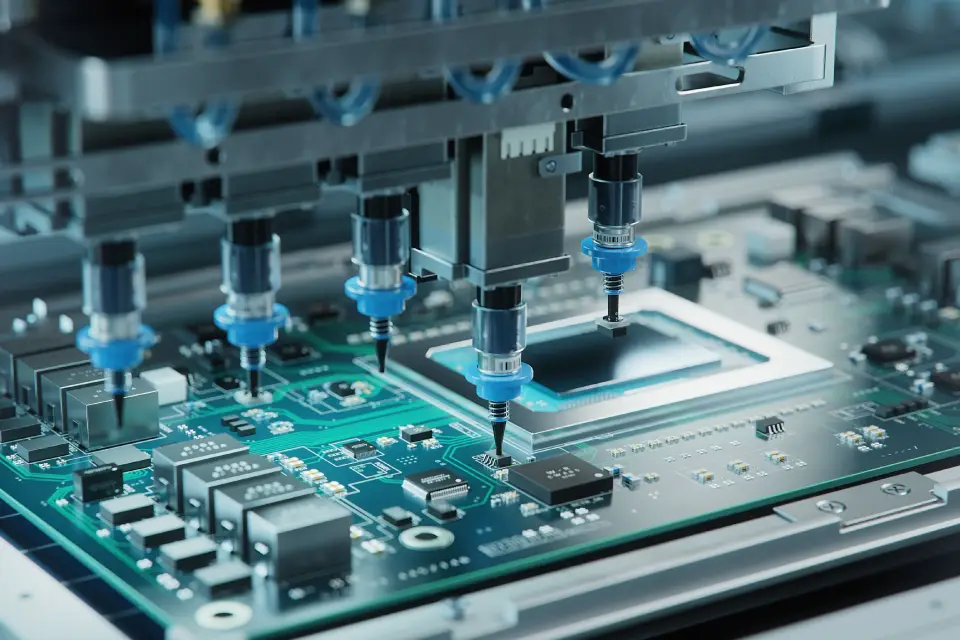
Surface mount adhesive is used on mixed technology boards where surface mount parts sit on the side that will meet the wave. It is also used on boards that pass through more than one reflow or that are handled before soldering, and where a component has to be held while another process runs.
The alternative is to solder all components in one reflow pass, which many designs now do. Where the wave is still used, adhesive is the mechanism that allows both technologies to share a single panel, and the wave soldering notes explain the interaction with the wave itself.
Dot Size and Placement Between Pads
A dot of surface mount adhesive is sized by the component mass and the pad geometry. A small chip resistor needs a dot of about 0.3 to 0.5 mm diameter, while a larger package needs a bigger dot or two dots placed symmetrically so that the part cannot rotate as it is placed.
Placement has to keep adhesive off the pads. A dot that touches a pad contaminates the joint and can block wetting, and one that sits too far from the centre gives the component a pivot point. The dot pattern belongs on the stencil or dispense drawing, not in the operator’s memory.
Dispensing Methods and Valve Choice
Pin transfer is fast and suits high volume, but it requires a stencil or a pin plate and its dots are limited in size. Jet dispensing is flexible and handles small dots without contact, while a screw or time pressure valve is the traditional choice for medium dots.
The valve has to be maintained to keep dot size consistent, because the failure mode is drift rather than a step change. The care routines in dispensing valve maintenance apply to adhesive as well as to paste, and the needle selection rules used for dispensing needles translate directly.
Adhesive Cure and the Reflow Profile
The adhesive cure is a heat driven reaction, and it can be completed in a dedicated oven or during the reflow profile that solders the top side. Curing during reflow saves a pass but ties the adhesive to a profile that was designed for the paste, so the adhesive has to cure within that window.
Under curing leaves the dot soft, and the component then shifts during placement of the following side or during the wave. Over curing makes the adhesive brittle, so the joint between component and board cracks under thermal expansion. Both are visible in a pull test, which is why the cure profile should be confirmed rather than assumed.
Adhesive Under Wave Soldering Conditions
The adhesive sees the preheat, the flux, the wave and the flux wash. It has to hold the component through all of them and still release nothing into the process. Some adhesives absorb flux and swell, and others soften at wave preheat and let the part drift a few tenths of a millimetre.
The dot profile that matters is the cured height of the surface mount adhesive, not the height as dispensed. A dot that is flattened during placement has a different holding area than one that was cured in place, and the difference shows up as a shift rate that changes with the placement force setting.
Wet Strength, Green Strength and Retention
Placement happens while the adhesive is still wet, so the material needs enough green strength to hold the component against the nozzle lift and the conveyor movement before curing. An adhesive with low green strength lets parts slide between the dispenser and the oven.
The measurement is simple: place a panel, run it to cure and inspect the component positions against the pad geometry. A repeatable offset in one direction points to conveyor or placement handling rather than to the adhesive itself.
Defects: Squeeze Out, Voids and Missing Dots
Squeeze out appears when too much adhesive is dispensed and the component presses it onto the pad, where it can interfere with wetting. Voids form inside a dot when the dispense is interrupted, and they reduce the holding force without being visible from the top.
Missing dots are the most damaging failure, because nothing holds the part. Detection depends on inspection before the wave, either by vision or by an operator with a defined sampling plan, and the same quality discipline applied to solder joints should apply here.
Inspection, Sampling and Pull Testing
Inspection after cure should check dot presence, position and colour, since a bead of surface mount adhesive that is under cured often looks different from one that is fully reacted. Sampling should be frequent enough to catch a drift in the valve, and the sample plan should be tied to the dot size tolerance rather than to a fixed count.
Pull testing destroys the sample, so it is usually done on a coupon or on the first article. Record the force and the failure mode, because a dot that peels cleanly off the board is a different problem from one that tears and leaves residue on both surfaces.
Storage, Pot Life and Changeover Notes
Surface mount adhesive has a shelf life, a pot life once opened and a working time in the syringe or the reservoir. All three should be on the label and in the record, because adhesive that has thickened will dispense a smaller dot at the same valve setting and the change may not be noticed for a shift.
Changeover between adhesives should include a purge of the valve and a fresh dot size check. The routines in line changeover cover the sequence, and the SMTA process literature is a useful cross reference for dot size limits against component mass.
FAQ
Can surface mount adhesive replace solder for mechanical strength? No. It only holds the component until the wave or the reflow makes the joint, and it is not a structural attachment. Where a component needs mechanical support, a bracket or a staked joint is the correct answer.
What happens if the adhesive is only partly cured? The dot stays soft, so the component can shift during the wave or during handling of the second side. It can also absorb flux and cleaning chemistry, which then releases slowly and affects the finished assembly.
How is dot size verified in production? By measuring a sample dot on a coupon or a scrap panel at the start of the run and at intervals after, and by inspection of the dispensed pattern before components are placed. Vision systems that measure dot diameter automatically make that check reliable.