Wave Solder Pallet: Design Rules and Process Limits
Wave soldering a board with parts on the solder side usually means a pallet. The pallet holds the assembly, masks the areas that must stay dry and carries the board through preheat, the wave and cooling as a rigid unit. Because it touches the board everywhere it matters, its design decides a large share of the process window.
What the Pallet Has to Do
A pallet has four jobs: locate the board repeatably, protect the parts and the surface that must not be wetted, present the joints to the wave in a controlled way, and survive thousands of thermal cycles without warping.
Each job has a tolerance attached. Registration sets where the mask openings fall, flatness sets how the wave contacts the joints, and material stability sets how long the tool can be trusted before it is remeasured.
Material Choice
Composite pallets made from glass filled resin are the common choice because they are stiff, light and bad conductors of heat. Aluminium and other metals are more stable but conduct heat away from the joints and add thermal mass that the preheat zones must overcome.
The material also sets the maximum temperature and the number of passes the tool can take before it bows. Where the board is heavy or the board count is high, the pallet is a consumable with a defined life, and treating it as permanent equipment is a common source of drift.
Registration and Fixturing
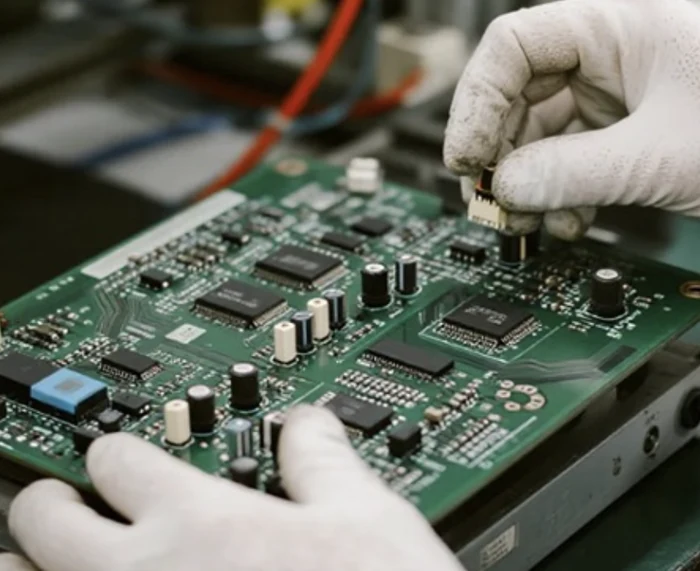
The board should be located by tooling holes rather than by its outline, because the outline tolerance is much wider than the hole position tolerance. Pins, edge stops and clamps each have a place, and the combination should remove all six degrees of freedom.
Where a board has no tooling holes, a pallet can locate on the routed edges and use a vacuum or a spring clamp to hold the board flat. Our article on tooling holes and registration describes how the datum should be defined on the drawing.
Masking Openings and Webbing
The openings in the pallet define which joints see the wave, and the webbing between them has to be wide enough to stay rigid and thin enough not to block a joint. A common failure is a web that is stiff at room temperature but bows when hot, lifting the board away from the wave.
Masking also has to allow the wave to break away cleanly. Openings that are too tight trap alloy and produce icicles, while openings that are too wide let solder reach parts that should have stayed dry.
Thermal Behaviour of the Assembly
The pallet changes the thermal profile of the board, because it shields the solder side from preheat and adds mass that must be heated. A profile that worked without a pallet is not automatically correct with one.
Where the board mixes heavy and light copper areas, the pallet can be designed with relief slots to let heat through. The principles are the same as those in our article on mixed thermal mass, applied to a different furnace.

Defect Signatures Tied to the Pallet
Incomplete fill on one edge of the board usually points to the pallet not sitting flat, so the board lifts away from the wave on the high side. Bridging across a connector often points to an opening that is too large or to webbing that has lost its edge.
Solder balls around masked areas come from flux that has been trapped and then spattered, and they are frequently the first sign that the pallet needs cleaning rather than redesigning. The general diagnostic route is set out in our article on wave solder defect troubleshooting.
Maintenance and Life
A pallet should be measured at a defined interval for flatness and for opening position, and the tool should be retired when the measurements leave the tolerance. Cleaning matters too, because flux builds up in the corners and gradually changes how the board seats.
The record should tie the pallet to the products it can run. A tool that has drifted is a silent cause of variation across a shift, and the defect is usually attributed to the machine until the pallet is measured.
Design Review Points
Before release, the pallet drawing should show the datums, the openings, the relief features and the material, and it should state the flatness and registration tolerances. It should also state which side of the board is up and which parts the tool is expected to mask.
Reviewing these points against the assembly drawing is cheap, and it prevents the situation where a pallet hides a joint that has to be inspected or masks a part that later needs a rework step.
Verification and Records
On a design of this kind, thermal mass is the item that decides how the rest of the board is arranged. A change that is not recorded is a change that cannot be explained when the result moves, which is why the record is part of the process. The checks that matter are the ones performed on the product rather than on a sample kept for the purpose, because a coupon that travels with the panel is the only evidence about that panel.
Where an operation cannot be verified afterwards, it has to be controlled during the operation, and that control has to be visible in the record. Consumables have a life measured in cycles, and the replacement point should come from the measurement rather than from a failure.
The sequence of operations is part of the specification, because a different order produces a different result from the same steps. Where the process window is narrow, the measurement resolution has to be better than the window, or the data cannot distinguish a good part from a marginal one.
Where two operations share a tolerance, the allocation between them should be explicit rather than left to whichever is measured first.
Points to Confirm at First Article
On a design of this kind, thermal mass is the item that decides how the rest of the board is arranged. The cost of verification is small compared with the cost of a field failure, and it is paid at a point where the product can still be corrected. A parameter that is set once and never re verified drifts, and the drift is usually discovered by a defect rather than by the record.
A measurement taken at the wrong point of the process describes the wrong thing, however carefully it is made.
Documented Process Control
On a design of this kind, thermal mass is the item that decides how the rest of the board is arranged. Documentation exists so that a person who was not present can reproduce the work and reach the same conclusion. Handling between operations is part of the process, and the damage it causes is often attributed to the operation that preceded it.
FAQ
Does every wave soldered board need a pallet? No. A board with through hole parts on the top side only can often run bare, and adding a pallet then only adds cost, mass and a set of new tolerances to control.
How long does a pallet last? Until its flatness or opening positions leave tolerance, which depends on the material, the temperature and the board count. Measuring on a schedule is the only way to know.
Can a metal pallet be used for better stability? It can, but it conducts heat away from the joints and needs more preheat. Composite tools are usually the better compromise for a mixed product.