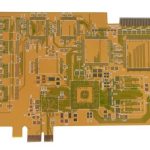
10-Layer Buried Via PCB: Cost Drivers and Quote Levels
A ten layer board is expensive on its own. Add buried vias and the price can double, because buried vias require the board to be built in stages, with inner layer pairs laminated, drilled and plated before the outer layers are added. Each stage is another chance for registration to drift and another yield loss to absorb. This article explains where the money goes on a 10-layer buried via PCB and what a realistic quotation looks like at each quantity.
What Makes This Structure Different
A ten layer through via board is built with a single lamination cycle and drilled once at the end. A buried via design divides the board into sub-assemblies: two or more cores are processed, drilled and plated, then laminated together with the remaining layers. The buried via connects inner layers only and is never exposed to the final drilling operation, which is exactly why it saves routing space and improves signal integrity.
The cost consequence is that the number of blind and buried via stages, not the layer count alone, drives the price. A ten layer board with one buried via stage is a very different product from a ten layer board with three sequential stages, and the second one can easily cost twice as much for the same outline and the same number of nets.
Quote Levels by Quantity
Prototype quantities of one to ten boards typically quote at 120 to 250 dollars per board. A small production batch of fifty to a hundred boards falls to 60 to 90 dollars, and volumes above five hundred boards reach 30 to 80 dollars. A representative quotation for a five piece run of a ten layer ENIG board on FR-4 at 1.6 mm built to IPC Class 2 comes in around 145 dollars per board.
The curve is steep at the start. Moving past a hundred pieces usually reduces the unit price by more than half, because tooling, engineering, drilling programmes and the first article inspection are spread across the run. A design change after that point costs the full tooling and engineering load again, which is why the last prototype revision should be the final one.

Lamination Cycles and Via Structure
Each additional lamination cycle adds roughly 20 to 40 dollars per board. A ten layer board without buried vias typically quotes 80 to 110 dollars, while adding buried vias pushes the same board to 120 to 250 dollars. Most of that increase is the extra cycles, with the remainder accounted for by the additional drilling, plating and inspection operations.
The via structure itself adds on top. A basic buried via connecting two adjacent inner layers adds 15 to 35 dollars per board. Deep buried vias that span several layers cost more, because the aspect ratio, meaning the drilled depth divided by the hole diameter, rises and the plating process has to produce a reliable wall over a longer distance. Keeping the aspect ratio moderate is the cheapest way to avoid plating problems and the rework that follows them.
Via-in-Pad and Laser Drilling
Placing a via inside a component pad saves routing space, which on a ten layer board can mean the difference between fitting the design and adding two more layers. It also adds 25 to 60 dollars per board, because the via must be filled and plated over so that the pad remains flat enough for assembly. The trade-off between adding layers and adding via-in-pad depends on the design, and the options are compared in via-in-pad or plated through.
Laser drilling is priced per hole rather than per board. Expect roughly 10 to 20 dollars per thousand holes, which sounds small until a high density design with several thousand microvias is considered. Mechanical drilling remains cheaper for larger holes, so the decision is usually made per via class rather than for the board as a whole.
Material Choice
Material moves the price as much as structure does on a high layer count board. Ordinary FR-4 costs about 10 to 15 dollars per square metre, high Tg FR-4 costs 20 to 30 dollars, a low loss laminate costs 60 to 120 dollars and a high frequency material such as a ceramic filled PTFE can reach 100 to 150 dollars. Upgrading a ten layer design from standard FR-4 to a low loss laminate adds roughly 45 to 70 dollars per board.
Because a ten layer board uses a large area of material, the laminate premium is multiplied by the layer count. That is why a hybrid stackup, with the expensive material confined to the signal layers that actually carry high speed nets, is the standard approach. It preserves the electrical performance of the critical nets while avoiding the cost of using the same laminate for power and ground layers.

Size, Panel Utilisation and Finish
Board size drives cost through panel utilisation. A 100 by 100 mm board quotes around 120 to 140 dollars per board, while a 200 by 150 mm board of the same layer count rises to 160 to 220 dollars. Irregular outlines that tile poorly add a further 10 to 25 dollars per board, because the unused material on the panel has already been paid for.
Surface finish is a smaller but consistent add. ENIG adds 20 to 40 dollars per square metre and is the usual choice for high reliability work. Immersion silver adds 10 to 20 dollars and performs well at high frequency, while an organic finish adds 5 to 10 dollars but has a short storage life. Medical and aerospace programs almost always specify ENIG for its stability through repeated assembly cycles.
Hidden Costs to Budget For
Several items are frequently excluded from a headline price. Engineering and tooling charges, impedance coupon testing where high speed nets are present, first article inspection, X-ray of the buried via stages, and fixture costs for electrical test all appear as separate lines. Testing is more significant on this class of board because a fault in a buried via cannot be reworked once the outer layers are laminated.
Design rules also carry cost. Clearance between vias and traces affects how many layers are needed, and the spacing rules in via to trace clearance in multilayer boards determine whether a design fits the intended stackup or needs another pair of layers. A fabrication partner such as gopcb can model the stackup and the via stages together and confirm which combination gives the lowest total cost rather than the lowest quotation.
FAQ
Why do buried vias cost so much more than through vias? Because the board must be laminated, drilled and plated in stages. Each stage adds process steps, handling and yield risk that a single lamination with final drilling does not have.
How much does quantity reduce the price? Substantially. Prototype boards at 120 to 250 dollars each can fall to 30 to 80 dollars above five hundred pieces, because tooling and engineering are amortised across the run.
Should I use via-in-pad to reduce layer count? It is worth evaluating. Via-in-pad adds 25 to 60 dollars per board, but if it removes two layers, it is usually cheaper than the extra lamination cycles those layers would require.