15 Leading Aluminum PCB Manufacturers in 2026: Complete Selection Guide
As electronic products become more powerful, compact, and thermally demanding, thermal management, reliability, and efficient product design have become increasingly important. This trend is driving strong demand for aluminum PCBs in LED lighting, automotive electronics, telecommunications, medical equipment, industrial controls, power supplies, and other high-power applications.
Choosing the right aluminum PCB manufacturer is therefore an important engineering and procurement decision. The right supplier can help control thermal resistance, improve manufacturing consistency, reduce field failures, and support a smoother transition from prototype production to volume manufacturing.
This guide explains what an aluminum PCB is, how aluminum metal-core PCBs work, their main advantages and applications, and 15 leading aluminum PCB manufacturers and suppliers to consider in 2026. It also explains the most important factors to evaluate when selecting an aluminum PCB manufacturer, including thermal performance, materials, manufacturing capability, certifications, engineering support, PCB assembly, lead time, and total cost.
Important note: The companies below should be viewed as a practical 2026 industry shortlist rather than a strict audited ranking from 1 to 15. Capabilities, facilities, certifications, and product offerings can vary by manufacturing site and application. Buyers should confirm current aluminum/metal-core PCB capability directly with each supplier before placing an order.
What Is an Aluminum PCB?
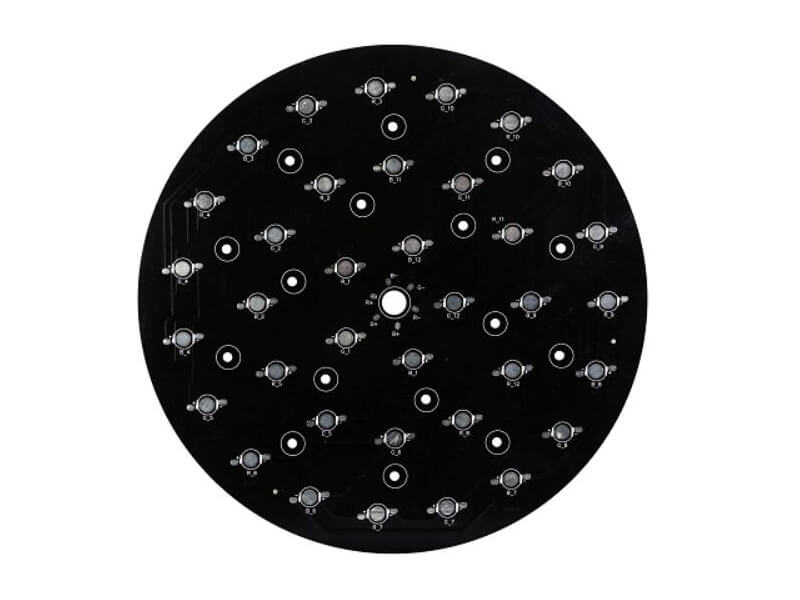
An aluminum PCB, also called an aluminum metal-core PCB (MCPCB) or aluminum-backed PCB, is a printed circuit board that incorporates an aluminum metal layer as its mechanical and thermal base.
Unlike conventional FR-4 PCBs, which rely primarily on glass-reinforced epoxy laminate, an aluminum PCB uses a metal substrate to provide an efficient path for transferring heat away from heat-generating components.
A typical single-layer aluminum PCB consists of three primary functional layers:
- Copper circuit layer – carries electrical signals and current and provides the mounting surface for components.
- Thermally conductive dielectric layer – electrically isolates the copper circuit from the aluminum substrate while allowing heat to pass through.
- Aluminum substrate – spreads and dissipates heat away from the circuit.
The thermal performance of an aluminum PCB depends not simply on the aluminum itself but on the complete thermal stack-up. Important factors include dielectric thermal conductivity, dielectric thickness, copper thickness, aluminum thickness, component-to-board thermal interfaces, and the external heatsink or enclosure.
This makes material selection and thermal design particularly important when developing high-power electronics.
How Does an Aluminum PCB Work?
The fundamental purpose of an aluminum PCB is to provide a shorter and more effective thermal path.
When a power LED, MOSFET, regulator, transistor, or other heat-generating component operates, heat travels from the component into the copper circuit layer. The heat then passes through the thermally conductive dielectric layer and reaches the aluminum substrate.
The aluminum spreads the heat across a larger surface area, where it can be transferred to the surrounding air, chassis, heatsink, or other thermal interface.
This architecture can significantly reduce thermal resistance compared with a conventional PCB structure when the design is properly engineered.
However, aluminum itself is not an electrical conductor that can simply replace the dielectric layer. The insulating dielectric between the copper circuitry and aluminum core is essential for maintaining electrical isolation.
Common Types of Aluminum PCBs
1. Single-Sided Aluminum PCB
Single-sided aluminum PCBs are the most common configuration.
Components and copper circuitry are primarily located on one side, while the aluminum substrate provides mechanical support and thermal dissipation.
Typical applications include:
- LED lighting
- LED street lights
- Automotive lighting
- Power supplies
- Motor controllers
- DC-DC converters
- Industrial power electronics
Single-sided construction is relatively simple and can provide an excellent balance between thermal performance and manufacturing cost.
2. Double-Sided Aluminum PCB
Double-sided aluminum PCBs provide conductive patterns on both sides of the board.
They are useful when the circuit requires greater routing density or additional component placement. However, the thermal architecture becomes more complicated because designers must carefully consider electrical isolation, vias, thermal paths, and the metal-core structure.
Double-sided metal-core designs are particularly useful when compactness and power density are important.
3. Multilayer Aluminum PCB
Multilayer aluminum PCBs are designed for more complex electronic systems requiring additional routing layers, power distribution, grounding, and signal management.
Multilayer metal-core construction is more challenging than conventional FR-4 PCB manufacturing because the stack-up must satisfy both electrical and thermal requirements.
These boards can be appropriate for:
- High-power industrial equipment
- Automotive power electronics
- Advanced LED systems
- Motor drives
- Power conversion systems
- High-density control electronics
When using multilayer aluminum PCB technology, designers should evaluate thermal vias, layer-to-layer heat transfer, dielectric thickness, copper distribution, impedance requirements, and mechanical constraints together.
Materials Used in Aluminum PCB Manufacturing
The choice of materials directly affects the electrical, thermal, mechanical, and cost characteristics of an aluminum PCB.
Aluminum Substrate
Different aluminum alloys can be selected according to mechanical strength, machinability, weight, corrosion resistance, and application requirements.
Common aluminum materials may include:
- 5052 aluminum alloy
- 6061 aluminum alloy
- Other application-specific aluminum grades
The exact alloy should be selected according to the manufacturer’s material portfolio and the application’s thermal and mechanical requirements.
Thermally Conductive Dielectric
The dielectric layer is one of the most important parts of an aluminum PCB.
It must simultaneously provide:
- Electrical insulation
- Adequate breakdown voltage
- Mechanical bonding
- Low thermal resistance
- Reliable thermal cycling performance
Higher thermal conductivity does not automatically mean a better PCB. Designers should evaluate thermal conductivity together with dielectric thickness, dielectric strength, glass transition characteristics, thermal expansion behavior, and manufacturing reliability.
Copper Layer
Copper thickness determines current-carrying capability and influences heat spreading.
Standard copper thickness may be sufficient for LED applications, while power electronics can require heavier copper.
The appropriate copper weight should therefore be determined from current requirements, temperature rise, trace geometry, manufacturability, and cost.
Why Are Aluminum PCBs Widely Used?
Excellent Thermal Management
The most important advantage of an aluminum PCB is its ability to provide an effective thermal path.
Compared with a conventional PCB structure, the metal substrate can spread heat away from hot components and reduce localized temperature accumulation.
This is particularly important for high-power LEDs, power semiconductors, motor controllers, and power conversion equipment.
Longer Component Life
High operating temperatures accelerate many electronic failure mechanisms.
By improving thermal management, an aluminum PCB can help maintain a lower and more stable operating temperature. This can contribute to longer component life and improved system reliability.
The actual improvement depends on the entire thermal system rather than the PCB alone.
Strong Mechanical Structure
Aluminum provides excellent mechanical rigidity and durability.
An aluminum-core board can offer greater structural strength than some conventional laminate constructions, making it useful in applications exposed to vibration, mechanical stress, or demanding operating environments.
Lightweight Metal-Core Construction
Aluminum provides a useful combination of low density, thermal conductivity, mechanical strength, and recyclability.
This makes aluminum-based PCB solutions attractive for applications where weight and thermal performance must be balanced.
Improved Power Handling
Aluminum PCBs are especially useful for circuits that generate substantial heat.
When properly designed, they can support power electronics by providing improved thermal spreading and helping designers control component temperatures.
Improved System Reliability
Temperature is a major factor affecting electronic reliability.
A better thermal path can reduce thermal stress on components and solder joints, improve operating stability, and contribute to longer product service life.
Recyclable Material
Aluminum is widely recyclable and can be recovered at the end of a product’s life.
This makes aluminum an attractive substrate material for manufacturers seeking to improve material efficiency and sustainability.
However, the environmental impact of the complete PCB should be evaluated, including copper, dielectric materials, surface finishes, manufacturing processes, and end-of-life recycling.
15 Leading Aluminum PCB Manufacturers and Suppliers in 2026
The following companies represent a practical shortlist of established PCB manufacturers, metal-core PCB specialists, PCB material suppliers, and global PCB sourcing organizations that may be relevant when evaluating aluminum PCB production.
Because capabilities can vary by facility, product configuration, and region, customers should request current technical capability information and qualification documentation before selecting a supplier.
1. TTM Technologies
TTM Technologies is a major global PCB manufacturer serving automotive, aerospace and defense, medical, industrial, networking, and computing markets.
Its PCB portfolio includes conventional, HDI, flexible, rigid-flex, RF/microwave, and thermal-management solutions. TTM specifically identifies metal core, metal-backed multilayer boards, copper coins, thermal vias, and other thermal-management technologies within its PCB capabilities.
This makes TTM particularly relevant to customers developing complex high-reliability electronics where thermal management must be considered alongside signal integrity and mechanical design.
Key strengths:
- Advanced PCB engineering
- Metal-core and thermal-management technologies
- High-reliability manufacturing
- Strong automotive, medical, industrial, and aerospace experience
- Global manufacturing footprint
- Advanced PCB assembly and engineering support
TTM is especially suitable for demanding applications where thermal performance must be integrated with sophisticated electrical and mechanical requirements.
2. Unimicron Technology
Unimicron Technology is a major Taiwan-based PCB and semiconductor substrate manufacturer with extensive experience in high-density interconnect technology, multilayer PCB production, and advanced electronic packaging.
Its broad technology portfolio makes it relevant to customers requiring sophisticated PCB manufacturing and high-density electronic integration.
For aluminum or metal-core requirements, customers should confirm the specific product structure, material availability, and manufacturing site during the quotation process.
Key strengths:
- Advanced PCB manufacturing
- High-density interconnect expertise
- Multilayer technology
- Semiconductor substrate capabilities
- Large-scale production
- Strong electronics industry experience
3. Kingboard Holdings
Kingboard Holdings is a major Asian electronics-materials and PCB group with vertically integrated capabilities across PCB-related materials and manufacturing.
Its vertically integrated business model can provide advantages in material supply, production coordination, and supply-chain management.
For customers considering aluminum PCB projects, the exact metal-core PCB configuration and manufacturing capability should be confirmed based on the required design.
Key strengths:
- Vertical integration
- Large-scale manufacturing
- PCB material expertise
- Supply-chain control
- Competitive production economics
- Experience serving high-volume electronics markets
4. Kingda
For customers seeking a flexible aluminum PCB manufacturer with engineering support, prototype capability, PCB fabrication, and assembly integration, Kingda can be considered as a practical supplier option.
Kingda can position its aluminum PCB solutions around applications where thermal management, reliable manufacturing, customization, and production flexibility are important.
Typical target applications include:
- LED lighting
- Automotive electronics
- Industrial control
- Power electronics
- Communication equipment
- Medical electronics
- Consumer electronics
Key strengths:
- Custom aluminum PCB manufacturing
- Engineering support
- Prototype and production services
- Thermal-management-focused PCB solutions
- PCB assembly integration
- Flexible manufacturing support
For projects with strict thermal requirements, customers should provide component power data, expected operating temperature, board dimensions, copper thickness, dielectric requirements, and heatsink/interface information during the quotation process.
5. JLCPCB
JLCPCB is widely known for online PCB ordering, rapid prototyping, and scalable PCB manufacturing services.
Its online quotation model can be particularly useful for engineers, startups, product developers, and small-to-medium production projects that need rapid feedback on PCB manufacturing cost and lead time.
Key strengths:
- Convenient online ordering
- Rapid prototyping
- Competitive manufacturing prices
- Automated quotation workflow
- PCB assembly options
- Suitable for development and production projects
When ordering an aluminum PCB, designers should verify available substrate specifications, thermal dielectric options, copper thickness, board dimensions, and assembly compatibility.
6. PCBWay
PCBWay provides PCB fabrication, PCB assembly, flexible PCB, rigid-flex PCB, and other custom manufacturing services.
Its engineering-oriented production model makes it useful for customers developing customized boards with different materials, dimensions, and manufacturing requirements.
Key strengths:
- Custom PCB manufacturing
- Aluminum and metal-core PCB options
- PCB assembly
- Prototype production
- Flexible order quantities
- Engineering support
PCBWay can be particularly useful for projects that need a combination of PCB fabrication, assembly, and other manufacturing services.
7. AT&S
AT&S is an Austrian high-end PCB and semiconductor-substrate manufacturer with extensive expertise in advanced interconnect technologies.
The company is particularly well known for high-density, high-performance, and high-reliability electronic applications.
Key strengths:
- Advanced PCB technology
- High-density interconnect
- High-reliability manufacturing
- Automotive electronics experience
- Semiconductor substrate expertise
- Strong European engineering capabilities
For aluminum or metal-core requirements, customers should confirm the specific thermal-management construction available for their application.
8. Shenzhen South Circuit (Shennan Circuits)
Shennan Circuits is a major Chinese PCB manufacturer serving telecommunications, automotive, industrial, aerospace, and other advanced electronics markets.
Its manufacturing portfolio includes multilayer PCBs, high-frequency boards, HDI technologies, and semiconductor packaging substrates.
Key strengths:
- High-volume manufacturing
- Multilayer PCB technology
- High-frequency PCB expertise
- Strong telecommunications experience
- Automotive and industrial applications
- Advanced packaging technologies
For aluminum PCB projects, buyers should confirm the exact metal-core capability and qualified production site.
9. Meiko Electronics
Meiko Electronics is a Japanese PCB manufacturer with experience in automotive, industrial, and other demanding electronics applications.
The company has publicly discussed aluminum-base heat-dissipation PCBs, making it relevant to customers evaluating metal-core PCB technologies.
Key strengths:
- Automotive PCB experience
- Precision manufacturing
- Aluminum-base heat-dissipation PCB technology
- High-reliability production
- Advanced PCB engineering
10. Tripod Technology
Tripod Technology is a major Taiwan-based PCB manufacturer with strong capabilities in multilayer and high-density PCB production.
The company serves a broad range of electronics applications and is known for large-scale PCB manufacturing.
Key strengths:
- High-volume manufacturing
- Automated production
- Multilayer PCB capability
- High-density PCB technology
- Strong industrial manufacturing experience
Customers considering aluminum or metal-core products should verify the applicable product structure and manufacturing site.
11. NCAB Group
NCAB Group operates differently from a conventional PCB factory. It provides PCB sourcing, supplier management, engineering support, quality assurance, and logistics services through a global network of manufacturing partners.
This model can be useful for companies that need assistance managing PCB suppliers across different geographic markets.
Key strengths:
- Global PCB sourcing
- Supplier qualification
- Engineering support
- Quality management
- International logistics
- Supply-chain risk management
For aluminum PCB projects, NCAB can be relevant when supplier qualification and international supply-chain management are as important as fabrication itself.
12. Amitron
Amitron is a U.S.-based PCB manufacturer with capabilities covering several PCB technologies, including aluminum PCBs.
Its published materials specifically identify aluminum PCBs among its manufacturing capabilities and list applications including LED, automotive, aerospace, military, medical, and industrial electronics.
Key strengths:
- Aluminum PCB manufacturing
- Prototype production
- Low- and medium-volume manufacturing
- U.S.-based production
- PCB engineering
- Multiple PCB material options
Amitron can be an attractive option for North American customers seeking domestic PCB manufacturing and aluminum PCB capability.
13. RayMing Technology
RayMing Technology provides custom PCB fabrication and assembly services for a range of electronics applications.
Its product portfolio can include metal-core and aluminum PCB solutions alongside conventional multilayer, HDI, rigid-flex, and other PCB technologies.
Key strengths:
- Custom PCB manufacturing
- Aluminum PCB capability
- PCB assembly
- Prototype services
- Engineering support
- Flexible production options
Customers should confirm current certifications, material specifications, production capacity, and lead times for the specific aluminum PCB configuration required.
14. Multek
Multek is an established PCB manufacturing brand with experience serving automotive, telecommunications, industrial, and other demanding electronics markets.
Its broader PCB technology portfolio makes it relevant to customers seeking advanced interconnect solutions and high-reliability manufacturing.
Key strengths:
- High-reliability PCB manufacturing
- Automotive experience
- Advanced PCB technology
- Multilayer capability
- Global customer support
As with other large PCB suppliers, customers should verify current aluminum/metal-core production availability for the specific facility and application.
15. Ventec International Group
Ventec is different from many companies on this list because its core strength is PCB materials and thermal-management materials, rather than simply acting as a conventional PCB fabrication house.
Ventec’s published corporate information identifies aluminum-based laminates as part of its portfolio. These materials are used across applications including automotive electronics, LED lighting, telecommunications, aerospace, defense, and other advanced electronics.
Key strengths:
- Aluminum-based laminate technology
- Thermal-management materials
- Copper-clad laminate expertise
- Materials R&D
- Global technical support
- Automotive and aerospace applications
Ventec can therefore be particularly valuable when material selection and thermal performance are critical parts of the PCB development process.
Key Capabilities of Leading Aluminum PCB Manufacturers
Not every PCB factory can produce high-quality aluminum PCBs. A supplier should demonstrate technical competence across materials, thermal management, manufacturing, testing, and assembly.
Advanced Thermal Management
The primary reason for choosing an aluminum PCB is thermal performance.
A qualified supplier should be able to discuss:
- Dielectric thermal conductivity
- Thermal resistance
- Dielectric thickness
- Aluminum thickness
- Copper thickness
- Thermal spreading
- Thermal vias
- Heatsink integration
- Thermal interface materials
- Operating temperature
A manufacturer that simply offers “aluminum PCB” without providing meaningful thermal data may not be suitable for demanding power electronics.
Precision PCB Manufacturing
Manufacturing accuracy directly affects PCB reliability.
Important capabilities include:
- Controlled copper etching
- Precision drilling
- Controlled dielectric thickness
- Accurate board routing
- Surface-finish control
- Solder-mask registration
- Dimensional control
- Copper thickness control
- Electrical testing
For high-current boards, copper distribution and trace geometry should also be evaluated carefully.
PCB Assembly Capability
An integrated PCB assembly service can simplify the supply chain.
A complete supplier may provide:
- SMT assembly
- Through-hole assembly
- Component sourcing
- Stencil manufacturing
- Reflow soldering
- Selective soldering
- Functional testing
- AOI
- X-ray inspection
- Final assembly
This allows PCB fabrication, component placement, soldering, inspection, and testing to be coordinated through fewer suppliers.
Quality Certifications
Depending on the application, buyers may consider standards and certifications such as:
- ISO 9001
- IATF 16949
- ISO 14001
- UL recognition
- IPC-A-600
- IPC-A-610
- RoHS
- REACH
- AS9100 for relevant aerospace applications
Certification alone does not guarantee product quality. Buyers should also evaluate process controls, inspection procedures, traceability, test reports, and quality history.
Material Engineering Support
A technically capable supplier should help customers select:
- Aluminum alloy
- Copper thickness
- Aluminum thickness
- Dielectric thickness
- Dielectric thermal conductivity
- Dielectric breakdown voltage
- Surface finish
- Solder mask
- Thermal interface materials
The best supplier is not necessarily the one offering the highest thermal conductivity. The correct material must balance thermal performance, electrical isolation, mechanical reliability, cost, and manufacturability.
How to Choose the Best Aluminum PCB Manufacturer
Selecting an aluminum PCB supplier should involve more than comparing quotations.
1. Evaluate Aluminum PCB Manufacturing Experience
Choose a manufacturer with demonstrated experience in aluminum PCB manufacturing, rather than a supplier that has only recently added metal-core boards to its product catalog.
Ask for examples of comparable applications and technical specifications.
For high-power projects, experience with similar power density and operating temperature is particularly valuable.
2. Check Production Capacity
A good supplier should support your entire product lifecycle.
Ideally, the manufacturer should be able to handle:
Prototype → EVT → DVT → PVT → Mass Production
This reduces the risk of having to transfer the design to a completely different supplier when production volume increases.
3. Audit Quality Certifications
Verify relevant certifications and confirm whether they apply to the actual production facility manufacturing your PCB.
Do not rely solely on certification logos displayed on a website.
Request:
- Current certificates
- Scope of certification
- Manufacturing-site information
- Quality-control procedures
- Inspection reports
- Traceability information
4. Evaluate Thermal Performance
Thermal performance should be one of the most important selection criteria.
Ask the supplier for:
- Dielectric thermal conductivity
- Thermal resistance data
- Breakdown voltage
- Dielectric thickness
- Aluminum thickness
- Copper thickness
- Recommended operating temperature
- Thermal cycling information
For demanding applications, consider asking for thermal simulation or thermal testing data.
5. Compare Lead Times
Lead time can have a major impact on product development.
Ask manufacturers to quote separately for:
- Prototype lead time
- Sample production
- Engineering validation
- Mass production
- PCB assembly
- Component procurement
A low PCB price is not useful if long lead times delay the entire product launch.
6. Analyze Engineering Support
Strong engineering support can prevent expensive design problems.
A capable supplier should be able to assist with:
- DFM review
- Stack-up optimization
- Material selection
- Copper thickness
- Thermal design
- Hole and routing limitations
- Assembly considerations
- Thermal interface design
This is especially important when developing a high-power aluminum PCB for the first time.
7. Review PCB Assembly Capability
If the project requires components to be mounted on the board, consider an integrated aluminum PCB assembly supplier.
Using one supplier for fabrication and assembly can simplify:
- Logistics
- Quality management
- Engineering communication
- Production scheduling
- Traceability
- Warranty responsibility
8. Compare Total Cost Rather Than Unit Price
The cheapest quotation is not necessarily the lowest-cost solution.
Evaluate the total cost of ownership, including:
- PCB price
- Tooling
- Shipping
- Assembly
- Component sourcing
- Testing
- Rework
- Scrap
- Engineering changes
- Warranty risk
- Inventory
- Lead-time costs
A slightly more expensive PCB with better thermal performance and higher production consistency may provide significantly greater long-term value.
Aluminum PCB Design Considerations
Choosing a good manufacturer is important, but the PCB design itself also determines thermal performance.
Thermal Path Design
Designers should create the shortest practical path from the heat-generating component to the metal substrate.
Thermal performance can be improved through:
- Larger copper areas
- Thermal vias where applicable
- Optimized dielectric thickness
- High-thermal-conductivity dielectric materials
- Direct thermal connections
- Appropriate aluminum thickness
- Proper heatsink integration
Copper Thickness
Higher-current applications may require heavier copper.
However, increasing copper thickness can affect:
- Etching
- Trace spacing
- Manufacturing cost
- Board weight
- Thermal distribution
- Minimum feature size
Copper thickness should therefore be selected based on actual current and temperature requirements.
Dielectric Thickness
A thinner dielectric layer can reduce thermal resistance, but it must still satisfy the electrical isolation and reliability requirements of the application.
Designers should never optimize thermal conductivity at the expense of dielectric breakdown performance.
Thermal Expansion
Aluminum and PCB materials have different coefficients of thermal expansion.
Repeated heating and cooling can create mechanical stress between materials.
For products exposed to substantial thermal cycling, the PCB manufacturer should evaluate:
- CTE compatibility
- Solder-joint reliability
- Dielectric adhesion
- Thermal cycling
- Board warpage
- Component stress
Aluminum PCB Applications
Aluminum PCBs are used across many industries where heat dissipation is important.
LED Lighting
LED lighting remains one of the most common applications.
Typical products include:
- LED bulbs
- Street lights
- Floodlights
- Automotive lighting
- Architectural lighting
- Industrial lighting
- High-power LED modules
Automotive Electronics
Automotive systems increasingly require compact, high-power electronics.
Aluminum PCBs can be used in:
- Automotive lighting
- Power conversion
- Motor control
- Battery-related electronics
- Thermal control modules
- Vehicle control systems
For safety-critical automotive products, the supplier’s automotive quality system and process traceability are particularly important.
Power Electronics
Power conversion generates substantial heat.
Applications include:
- AC-DC converters
- DC-DC converters
- Power supplies
- Motor drives
- Inverters
- Industrial controllers
- Battery systems
Telecommunications
Telecommunications equipment can require high power density and reliable thermal management.
Metal-core PCB technology can be useful when compact construction and thermal control are required.
Industrial Automation
Industrial systems often operate continuously and may be exposed to vibration, heat, dust, and other demanding conditions.
Aluminum PCBs can provide mechanical strength and thermal management for:
- Motor controllers
- Industrial power supplies
- Control systems
- Drives
- Sensors
- Automation equipment
Medical Electronics
Medical equipment requires high reliability and stable performance.
Aluminum PCB technology can be useful for medical power supplies, LED illumination systems, imaging-related electronics, and other applications where thermal stability is important.
Aluminum PCB vs. FR-4 PCB
| Feature | Aluminum PCB | FR-4 PCB |
|---|---|---|
| Thermal management | Excellent for metal-core designs | Moderate |
| Mechanical strength | High | Good |
| Weight | Relatively low for a metal substrate | Low |
| High-power applications | Excellent | Application-dependent |
| Thermal spreading | Excellent | Limited |
| Electrical isolation | Provided by dielectric layer | Provided by laminate |
| Cost | Usually higher | Generally lower |
| Typical applications | LED, power, automotive, industrial | General electronics |
| Multilayer complexity | More challenging | Highly mature |
| Design flexibility | Application-dependent | Very high |
The choice should be based on application requirements rather than assuming that aluminum is always better.
For low-power digital electronics, conventional FR-4 may be more economical and easier to manufacture. For high-power thermal applications, an aluminum PCB can provide a significant advantage.
Future Trends in Aluminum PCB Manufacturing
The aluminum PCB industry is expected to continue evolving as electronic systems become smaller and more powerful.
Growth of Electric Vehicles
Electric vehicles require efficient thermal management across power electronics, lighting, charging systems, motor control, and other subsystems.
This creates opportunities for advanced metal-core PCB technologies.
Expansion of LED Lighting
LED technology continues to emphasize higher power density and compact thermal designs.
Aluminum PCBs remain an important solution for transferring heat away from high-power LED components.
Higher-Thermal-Conductivity Dielectrics
PCB material suppliers are developing dielectric systems designed to provide improved thermal conductivity while maintaining electrical isolation.
The long-term goal is to reduce thermal resistance without sacrificing dielectric strength and reliability.
Greater Power Density
Modern power electronics are becoming smaller while handling greater current.
This trend is increasing demand for:
- Heavy copper
- Metal-core PCBs
- Thermal vias
- Advanced dielectric materials
- Copper coins
- Integrated heatsinks
- Thermal interface materials
Integration of PCB and Thermal Structures
Future PCB designs will increasingly treat electrical and thermal engineering as one integrated design problem.
Rather than designing the circuit first and adding a heatsink afterward, engineers are increasingly considering the PCB, thermal interface, enclosure, and heatsink as a complete thermal system.
Frequently Asked Questions About Aluminum PCBs
What is an aluminum PCB?
An aluminum PCB is a printed circuit board that uses an aluminum metal substrate to improve heat spreading and mechanical strength. It typically consists of a copper circuit layer, thermally conductive dielectric layer, and aluminum substrate.
Are aluminum PCBs better than FR-4 PCBs?
Not in every application. Aluminum PCBs are generally advantageous for applications that generate significant heat, while FR-4 remains an excellent choice for many general-purpose electronic systems.
What is the main advantage of an aluminum PCB?
The primary advantage is improved thermal management. The aluminum substrate provides an efficient path for spreading heat away from heat-generating components.
Can aluminum PCBs be used for LED lighting?
Yes. LED lighting is one of the most common applications for aluminum metal-core PCBs because high-power LEDs can generate significant heat.
Can aluminum PCBs be multilayer?
Yes, although multilayer aluminum PCB construction is more complex than standard FR-4 multilayer PCB manufacturing. The exact construction depends on the supplier’s technology and the application’s thermal and electrical requirements.
How do I select an aluminum PCB manufacturer?
Evaluate the supplier’s aluminum PCB experience, thermal materials, manufacturing capacity, quality system, certifications, engineering support, assembly capability, lead time, testing capability, and total cost.
What thermal conductivity should an aluminum PCB have?
There is no single value that is ideal for every application. The required thermal performance depends on component power, operating temperature, dielectric thickness, copper layout, aluminum thickness, heatsink design, airflow, and the overall thermal resistance of the system.
Does aluminum PCB manufacturing require special materials?
Yes. The dielectric layer must provide both electrical insulation and efficient heat transfer. The aluminum substrate and copper layer must also be selected according to mechanical, electrical, thermal, and manufacturing requirements.
Key Takeaways
A high-quality aluminum PCB can provide an effective solution for electronic products that require efficient heat dissipation, mechanical durability, and reliable operation.
The most important factors when selecting an aluminum PCB supplier include:
- Thermal performance
- Dielectric material quality
- Aluminum substrate quality
- Copper thickness
- Manufacturing precision
- Quality certifications
- Engineering support
- PCB assembly capability
- Production capacity
- Lead time
- Total cost of ownership
Companies such as TTM Technologies, Unimicron, Kingboard, JLCPCB, PCBWay, AT&S, Shennan Circuits, Meiko Electronics, Tripod Technology, NCAB Group, Amitron, RayMing, Multek, and Ventec represent different segments of the global PCB ecosystem, from high-reliability PCB manufacturing to online prototyping, materials technology, and supply-chain management. Their suitability depends heavily on the required board construction and application.
For companies looking for a flexible supplier, Kingda can be positioned as an aluminum PCB manufacturing and assembly option for applications where thermal management, customization, engineering support, and production flexibility are important.
Ultimately, the best aluminum PCB manufacturer is not necessarily the company with the lowest quotation or the largest factory. It is the supplier that can consistently deliver the required thermal performance, electrical reliability, dimensional accuracy, quality, lead time, and lifecycle support at a commercially sustainable cost.