PCB Contamination Control: Why Fingerprints Matter
A fingerprint looks harmless. On a printed circuit board it is a deposit of skin oils, salts, and fatty acids, and in a fabrication line it is a defect source that shows up several process steps later as oxidation, poor adhesion, or a plating artifact. Contamination control is therefore not a housekeeping matter; it is a process parameter, and on flexible circuits, where the substrate is thin and the handling is frequent, it can be the difference between a healthy yield and a rework queue.
What Skin Contact Actually Leaves Behind
Sebum and sweat contain salts, fatty acids, and triglycerides. All three matter. The salts are hygroscopic and ionic, so they create a conductive path where there should be none. The fats are hydrophobic, which means they resist the aqueous chemistry of plating and cleaning and stay on the surface instead of rinsing away. And because the deposit is invisible, the operator has no feedback that anything has happened.
Copper is the surface most affected. A clean copper surface oxidises slowly; a copper surface under a fingerprint oxidises quickly, because the salt layer promotes the electrochemical reaction and the fatty layer holds moisture against the metal.
Where the Damage Appears
The symptoms are not visible at the moment of contact, which is what makes the problem expensive. Several failure modes are well documented.
Oxidation of the copper under the print becomes visible after plating as a fingerprint-shaped mark, with a surface that does not take the deposit evenly. On a finished board that reads as an appearance failure, and on a plated surface it can mean a thickness or adhesion defect of the kind catalogued under copper plating defects.
Adhesion loss is the second and more serious symptom. Solder mask applied over a contaminated surface bonds to the contamination rather than to the copper or the laminate. Ink rheology and solder mask ink thixotropy control how the ink flows, but no formulation compensates for an oily substrate. The result passes inspection and then lifts during thermal cycling or during a subsequent process step, exposing the conductor underneath.
Wettability loss is the third. On an immersion gold finish, bare-hand contact between mask curing and packing leaves an oily film that survives mild cleaning, and the pad no longer wets properly at assembly. This is a particularly frustrating defect because the board looks perfect and the problem appears at the customer line as poor solder joints.
Photoresist problems are the fourth. Dry film and wet film both need a clean substrate to adhere, and traces of oil under the film cause lifting and underplating during etching or plating. The visible result after plating is a streak or a colour variation across the panel.
Why Flexible Circuits Are More Sensitive
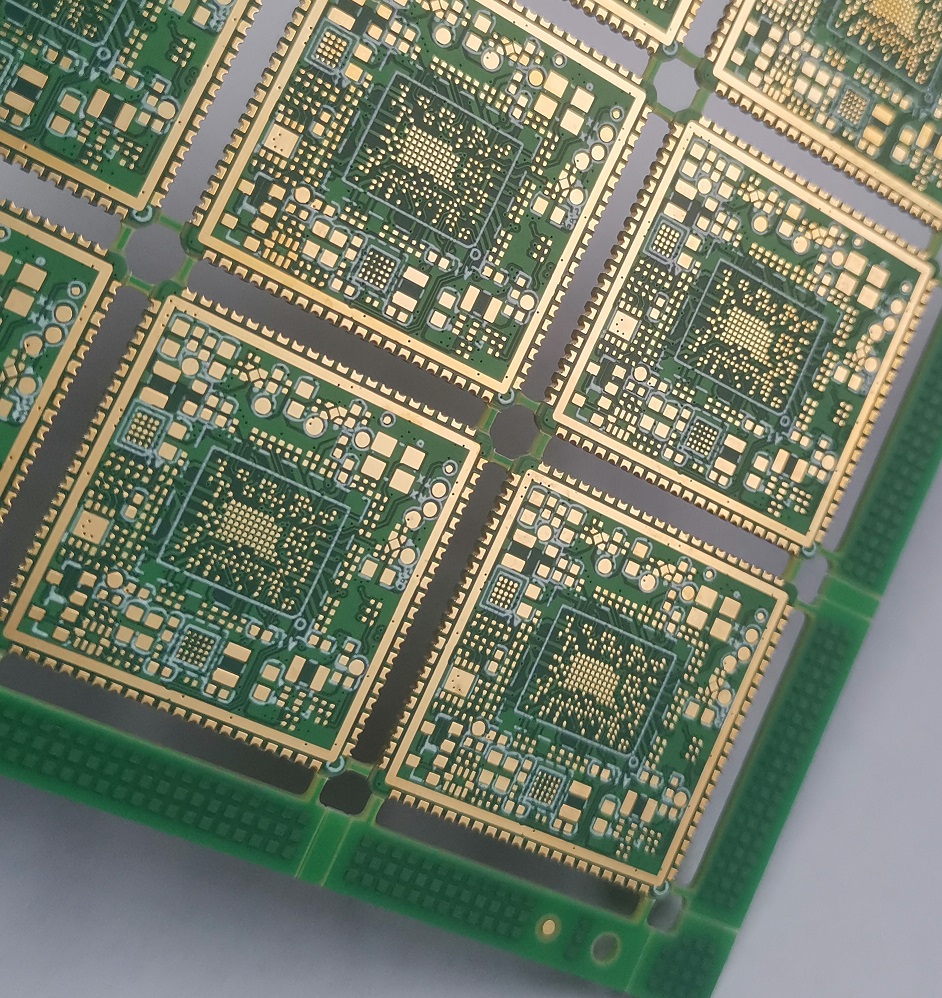
The same contamination affects rigid boards, but flexible circuits give it more opportunity. A flexible panel is handled repeatedly during imaging, etching, plating, and coverlay lamination, and its substrate is far thinner than a rigid core, so there is less material to absorb mechanical handling and more surface area exposed per unit of stiffness. Flexible boards also involve more manual operations, and manual operations are where gloves come off.
The practical consequence is that a flexible circuit shop has to enforce handling discipline more strictly than a rigid shop, not because the chemistry differs, but because the process gives contamination more chances to occur.
The Controls That Work
Cleanroom gloves or finger cots are the first control and the cheapest. The requirement is not just that they are worn but that they are worn for the right tasks and changed often enough not to become a transfer mechanism themselves. A glove that has touched the outside of a cassette is a contamination source when it then handles a panel.
Surface preparation is the second. An acid clean immediately before a critical step such as plating or mask lamination removes both the oxide and the organic film, provided the cleaning is done after the last manual handling. Cleaning and then touching the board wastes the cleaning.
Process sequence is the third and most effective. Where handling is unavoidable, it should be pushed to steps where contamination does no harm: before imaging rather than before plating, and before solder mask rather than after. Designing the route so that critical surfaces are touched as little as possible removes the problem rather than mitigating it.
Verification is the fourth. Water break testing, contact angle measurement, and surface energy checks give an indication of cleanliness before the next process step, which turns an invisible defect into a measurable one.
Extending the Discipline Beyond the Line
The same reasoning applies after fabrication. Bare boards stored without protection accumulate contamination and oxide, and boards that are handled during assembly introduce flux and oils that have their own consequences. Cleaning before conformal coating matters for exactly the same reason: a coating applied over an oily surface adheres to the oil rather than to the board, and the failure appears later as a lifted coating in service.
Storage practice is part of the same picture. Sealed packaging with desiccant, vacuum packing for high-reliability work, and a defined shelf life before a bake is required all reduce the chance that a board enters assembly with a surface that has already begun to change.
Measuring and Auditing
Contamination control is only as good as its verification. Useful checks include water break testing on cleaned copper, contact angle measurement with a portable instrument, and periodic surface insulation resistance testing on finished assemblies. Ion chromatography, where available, quantifies the ionic residue rather than just detecting it, and it is the standard method for high-reliability programs that need a number rather than a pass or fail.
An audit that watches the handling steps is equally informative. Where do bare hands touch a panel, and at which process stage? The answer usually identifies one or two steps where a small change in tooling, such as adding a handling tab or a fixture, removes most of the exposure.
Preventing It at the Source
The most durable fix is to remove the need to touch the board at all. Panel handling tabs, edge rails that are removed after plating, and fixtures that grip the panel outside the active area all move contact away from critical surfaces. Where a panel must be picked up by hand, a designated handling zone printed on the panel artwork gives operators a place to touch that does not matter. Both changes cost nothing at design time and remove a category of defect that no amount of cleaning discipline fully controls. Mask adhesion and plating quality then depend on the chemistry rather than on who was carrying the panel that day.
FAQ
Why is a fingerprint worse than a general smudge? Because skin oils carry salts as well as fats. The salts are ionic and hygroscopic, and the fats resist the aqueous chemistry that would otherwise clean the surface.
Which defect does contamination cause most often? Loss of adhesion, particularly of solder mask and photoresist, because the coating bonds to the contamination instead of the board.
Is cleaning enough to recover a contaminated panel? Usually, if the cleaning happens after the last manual handling and before the critical step. Cleaning and then handling again simply reintroduces the problem.
Do gloves solve it completely? No, but they remove the largest single source. Gloves that are not changed regularly, or that have touched contaminated surfaces, become a transfer mechanism themselves.