High Precision PCB Base Material: What HDI Really Needs
A high precision pcb is defined by its geometry rather than by their marketing: fine lines and spaces, small microvias and a construction that can support them. The base material is what makes that geometry possible, and the parameters that matter are not the ones quoted on a general purpose datasheet.
What High Precision Means in Practice
The practical threshold is a circuit with line and space dimensions of about 0.11 mm or below, connected by microvias no larger than 0.15 mm. A board that meets both conditions is generally described as high density interconnect, and it is built by sequential lamination rather than in a single press.
The distinction matters because the process changes completely. A conventional multilayer board is laminated once with through holes connecting the layers, while an HDI board is built up layer by layer with microvias between adjacent layers, as described in the general HDI method.
Glass Transition Temperature
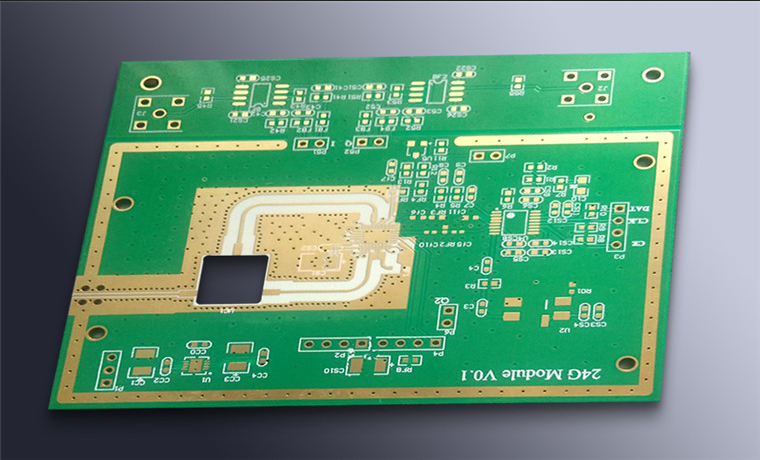
The glass transition temperature is the point at which the resin softens and its mechanical and electrical behaviour changes. Lead-free assembly exposes the board to higher temperatures than the older tin-lead processes, so the material has to remain rigid and dimensionally stable through the whole reflow cycle.
A moderate transition temperature is adequate for a simple board with generous features, but fine lines distort more readily when the resin moves. Thinner laminates for portable products typically use materials with a transition temperature in the region of 160 degrees Celsius or above, and the requirement rises with layer count.
Coefficient of Thermal Expansion
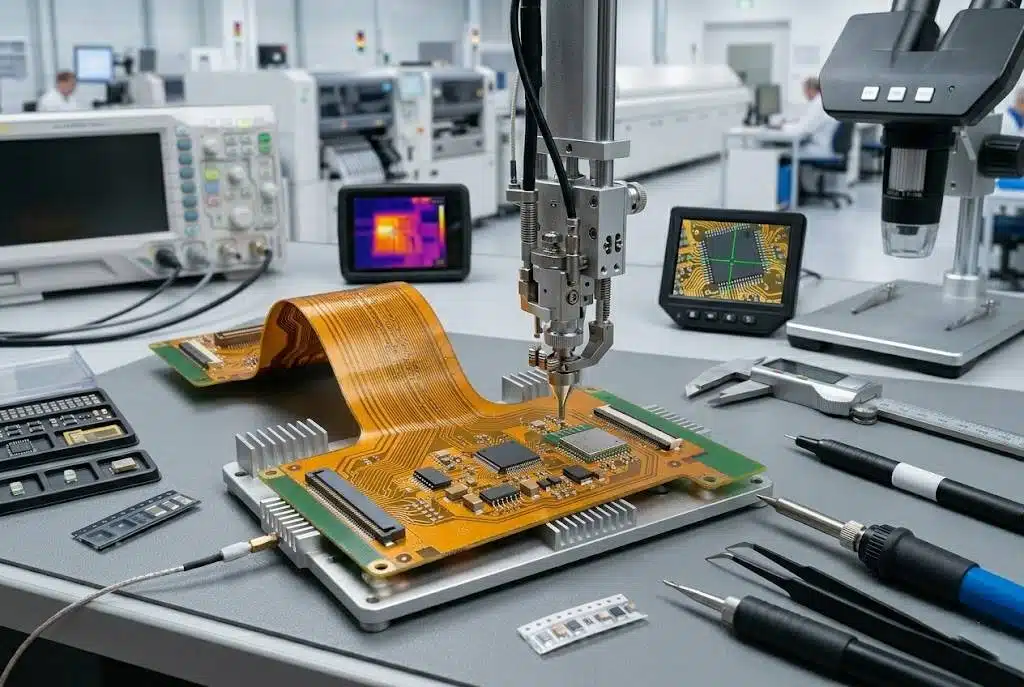
The coefficient of thermal expansion describes how much the material grows as it heats. A laminate expands far more in the vertical direction than the copper it is bonded to, and that mismatch puts stress on the walls of a plated hole every time the assembly is heated.
Materials are therefore characterised in three directions rather than one, and the through-thickness value is the one that governs barrel reliability. A low expansion in that direction, achieved with higher filler content, is what allows a small hole in a thick board to survive repeated thermal cycles.
Decomposition Temperature and Thermal Stability
The decomposition temperature indicates how long the material tolerates processing heat before the resin begins to break down. It sets the limit on multiple lamination cycles and on the number of rework passes a board can accept before the laminate is degraded.
An HDI board is exposed to several lamination cycles by construction, so the material has to tolerate them without measurable loss of properties. The number of build-up cycles should be matched to the material rating rather than assumed from the layer count.
Electrical Properties
Dielectric constant and loss tangent determine how fast a signal travels and how much energy the material absorbs. At the frequencies used by modern interfaces, those two parameters decide whether a channel meets its budget, and they also affect the impedance of every controlled trace on the board.
For fine line work the property that matters most is consistency. A laminate whose dielectric constant varies across a panel produces traces with different impedances, and the resulting variation is impossible to correct at the routing stage, which is why the high frequency grade is specified by tolerance rather than by typical value.
Moisture Absorption and CAF
Every laminate absorbs some moisture, and absorbed water changes the dielectric constant, weakens the bond between resin and glass and lowers the temperature at which the material can be processed. Thinner boards with many layers are more susceptible because there is less volume to absorb the same quantity of water.
Conductive anodic filament growth is the long term consequence. Under bias and humidity, a conductive path can grow along the glass fibre bundle between two holes, and it is the failure mode that ends the life of a densely drilled board. Resistance to CAF is specified through the resin chemistry and the weave, and it is verified by test rather than by assumption.
Copper Foil Choice
The copper also has a specification. Rolled annealed foil is smooth and highly ductile, which suits fine lines, high bend cycles and flexible circuits, while electrodeposited foil is rougher and cheaper and is used where the mechanical demands are lower.
Thickness follows the current and the impedance target, and on fine line work the profile of the foil matters as much as its weight because the etching has to reproduce a narrow conductor with a predictable cross section. The filling process used for microvias is chosen to suit both.
Flexible and Rigid-Flex Materials
Flexible constructions use different substrates. Polyester is inexpensive and performs acceptably in benign environments, but its limited heat resistance restricts it to simple circuits without soldered components.
Polyimide costs more and tolerates immersion in solder at around 260 degrees for twenty seconds, which is why it is used wherever the board carries components or must survive assembly. It absorbs more moisture, so drying before assembly is part of the process, and it is usually paired with rolled copper for bending.
Selection and System Cost
Choosing a material is a system decision rather than a datasheet comparison. A higher performance laminate allows finer features and more layers in the same thickness, which may reduce the board size and the assembly cost by more than the material premium.
The reverse is also true. Specifying a material with a high transition temperature and low expansion for a simple four layer board adds cost without changing the outcome, and the dimensional stability figures should be reviewed against the actual feature sizes before the premium is accepted.
Feature Size and Registration Tolerance
Fine features are only useful if they can be registered accurately. Each layer has to align with the one beneath it within a few microns, and the accumulated error across a build-up construction decides whether the smallest via lands inside its pad.
Material behaviour feeds directly into that budget. A laminate that moves during lamination or during drilling moves the features with it, so a low expansion material reduces the correction the process has to apply and widens the window in which the design can be built.
Process Compatibility
The material has to suit the process as well as the design. Laser drilling depends on the resin and the glass weave, desmear chemistry has to be compatible with the filler system, and plating has to fill a microvia without voids.
That interaction is why a material change is never a simple substitution. A grade that is electrically equivalent can behave differently in drilling and plating, and the qualification of a new laminate should follow the same route as a new process rather than being treated as a purchase decision.
Documenting the Choice
The stackup drawing should state the laminate grade, the glass transition temperature, the copper weight and the dielectric thickness for every layer, together with any restriction on the supplier or the weave style.
Where an equivalent material is acceptable, the drawing should say so and describe what makes it equivalent. That single paragraph prevents a substitution that meets the electrical specification and fails in the press.
FAQ
Is a high Tg laminate always better? No. It helps where the assembly or the service environment is hot, but it costs more and matters little on a simple board that is processed once and used at room temperature.
What limits the number of HDI layers? The thermal stability of the laminate and the accumulated registration tolerance. Each build-up cycle adds heat history, and the material has to tolerate the total without degrading.
Why does CAF matter more on dense boards? Because it grows between holes along the glass bundles, and denser boards have more holes closer together. The failure is a short that develops slowly and is often missed at final test.