PCB Panel Coupon Design And Placement
A panel coupon is a small pattern placed on the panel, outside the product boards, that is used to measure a property of the process. Because it travels through every step with the product, it is the only way to obtain a measurement that would otherwise require destroying a board.
This article covers what a coupon is for, the common types, how placement affects the result, and how coupons are handled.
What A Coupon Is For
A coupon exists because most of the important properties of a board cannot be measured non destructively on the board itself. Plating thickness in a hole, the adhesion of the mask, the impedance of a trace and the result of a thermal stress test are all destructive or require access that the product does not provide. The coupon duplicates the structure in a location that can be sacrificed.
The value of the coupon depends entirely on its similarity to the product. It has to be built from the same laminate, drilled with the same programme, plated in the same bath and etched in the same process. A coupon that differs in any of those respects measures a different process, and the result is worse than no coupon, because it gives false confidence. The process window that the coupons are used to hold is described under multilayer prototype requirements.
Coupon Types
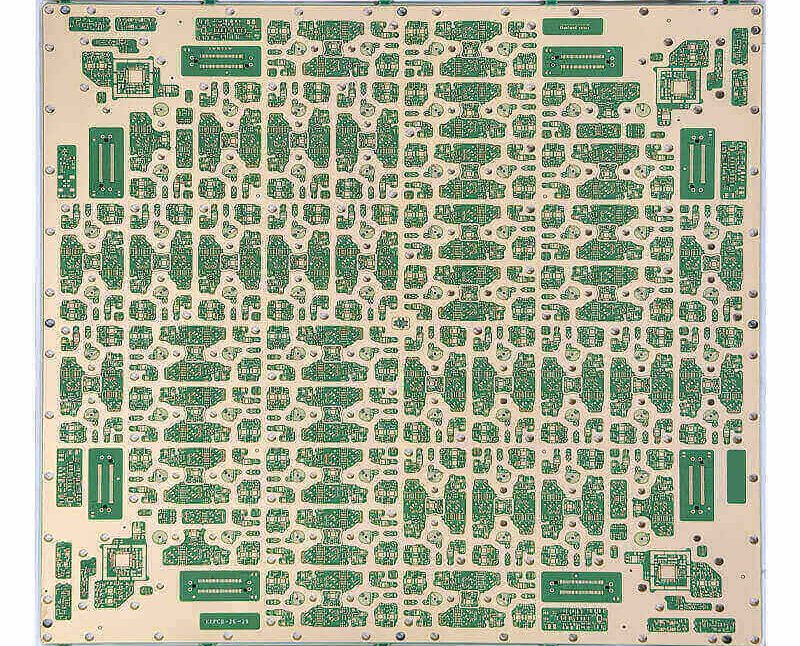
The plating thickness coupon carries holes of the product’s smallest and largest diameters, arranged so that they can be microsectioned to measure the barrel copper and the surface plating. The impedance coupon carries traces of the product geometry, with probe access at both ends, arranged to be measured by time domain reflectometry. The solder mask coupon carries a pattern of pads and dams at the product’s finest pitch, used for adhesion tests and for a check that the ink clears the gaps.
A thermal stress or resistance chain coupon carries a chain of plated holes connected in series, used to detect a barrel that opens under thermal cycling. A surface finish coupon carries isolated pads for a solderability test after storage. Each of these measures a different property, and a panel that carries a demanding product normally carries several of them. The distinction between a plating coupon and a solderability coupon matters when a defect appears, because the two point at different process steps. The defects one of these coupons is designed to detect are described under copper plating defects prevention.
<img src="https://www.gopcba.com/wp-content/uploads/2026/08/1783933913008.jpg" alt="Coupon patterns in a panel border” />
Placement And Copper Density
Where a coupon sits on the panel changes what it measures. Etching and plating both depend on the local copper density, so a coupon placed in an empty corner of the panel etches differently from a trace of the same width in a dense part of a product board. The result is a coupon that passes while the product is marginal, which is the failure mode that makes coupon placement a design decision rather than a leftover.
The remedy is to place the coupon so that its surroundings resemble the product area it represents. Where the panel has an empty region, thieving can be added around the coupon to bring the local density closer to the product’s. For an impedance coupon the effect is large enough that the coupon is often designed with a surrounding copper pattern that duplicates the product, rather than being treated as an isolated test structure.
Coupons In The Border
The border is the natural place for a coupon, because it is removed after assembly and it surrounds the boards. A coupon in the border sees the same lamination, the same drilling and the same plating as the boards next to it, and it is easy to cut out for a destructive test. The border also has room for a chain of holes or a set of traces that would not fit between the boards.
The constraint is the border width, which is set by the tooling and the handling requirements rather than by the coupon. Where the border is narrow, the coupon is placed inside the panel in an area that would otherwise be unused, or between two boards. Both alternatives have their own density considerations, and both are stated on the panel drawing so that the fabricator does not remove them to save material. The overall layout of a panel is described under PCB design and fabrication.
Handling And Retention
A coupon that is cut from the panel at the fabricator is of no use to a customer that wants to verify the boards. For that reason the coupon is often left attached to the panel and cut off by the customer, or a separate coupon panel is supplied with the shipment. The retention requirement should be stated explicitly, because a coupon that has been measured and discarded at the shop leaves no evidence for anyone else.
Where the coupon is retained, it has to be identified. The panel number and the date are marked on the panel or on the coupon itself, and the measurement results are recorded against that identity. Without the marking, a coupon that shows a problem cannot be related to the panels it came with, and a shipment that contains a suspect board cannot be narrowed down.
Coupons And The Specification
The fabrication drawing should state which coupons are required, where they are to be placed, what each is to be used to measure, and whether they are to be supplied with the shipment. It should also state the acceptance values, because a coupon that is measured against no limit produces a number rather than a decision.
A coupon is only as good as its correspondence to the product, and that correspondence is a property of the design rather than of the fabricator. Specifying the type and the location, and reviewing both against the product, is what makes the measurements meaningful. Where a customer performs its own incoming inspection, the same coupons can be used, provided the procedure and the equipment are compatible with the ones used at the fabricator.
Additional Considerations for This Build
Practical attention to test coupon pays for itself here, because it decides whether the finished board behaves as the drawing intended. Where the requirement is not stated on the fabrication drawing or in the assembly notes, the shop has to assume a default, and that default is rarely the value the design was simulated with. Stating test coupon explicitly, together with the tolerance that applies, removes the assumption and keeps the result predictable from batch to batch.
Process Control and Verification
On a design of this kind, border is the item that decides how the rest of the board is arranged. Keeping a sample from the panel turns a dispute into a measurement, because the same coupon can be re-examined by both parties without rebuilding the batch. Reviewing the design before the data is released is cheaper than correcting it after the panel is in the tank, because every step downstream inherits the decision made at the front end.
FAQ
Can one coupon serve several measurements? It can, and a combined coupon is common, but each measurement needs its own structure and its own access. A single structure that is asked to do too much usually measures none of them well.
Why does the coupon sometimes pass while the product fails? Usually because the coupon sits in an area of different copper density, or because it has a different hole size or trace width from the product. The coupon has to duplicate the geometry it represents.
Should coupons be supplied with the boards? Where the customer needs evidence of the process, yes, and the requirement should be stated on the drawing. Otherwise the coupon is measured at the fabricator and the record is all that remains.