Reflow Oven Zone Balance And Profile Control
A reflow oven is a series of heated zones along a conveyor, each holding a set temperature with its own airflow. The board absorbs heat as it passes, so the zones do not act independently. They interact through the thermal mass of the assembly and the speed of the belt. Zone balance is the practice of setting those zones so the solder paste experiences the intended thermal profile instead of whatever a single zone happens to deliver.
Balance matters because solder paste follows a schedule. The flux must activate, the volatiles must escape, the powder must coalesce, and the alloy must wet the pads before it freezes. A profile that runs too fast traps flux; one that runs too slowly burns the flux away before the joint forms. Zone set points, belt speed and airflow are the three controls that shape that schedule.
The Four Profile Phases
Every profile is described in four phases: preheat, soak, reflow and cooling. Preheat brings the assembly from room temperature to roughly 150 C at a controlled rate, usually between 1 and 3 C per second. The ramp must be gentle enough to avoid thermal shock in ceramic capacitors and to prevent paste slump, yet fast enough that the process stays economical.
The soak then holds the board on a plateau, typically between 150 and 200 C, for sixty to ninety seconds. During the soak the flux becomes active, the paste dries, and the temperature difference between a heavy connector and a small chip resistor shrinks. Peak temperature and time above liquidus follow, and cooling closes the cycle.
Role Of The Soak
The soak is the phase where reflow profiles are most often tuned, and it is also where most zone balance work happens. A long, well-controlled soak allows the flux to reduce surface oxides and lets the whole assembly approach a common temperature. Without it, small parts reach peak temperature early and sit above liquidus for too long, which dulls the fillet and thickens the intermetallic layer.
A soak that is too aggressive consumes the activators before the alloy melts. The result is poor wetting, small dewetted areas and a joint that looks acceptable but performs badly under thermal cycling. Setting the soak correctly means matching the flux chemistry to the board mass and to the throughput target, not copying a profile from another product. The link between alloy choice and the profile window is described under lead-free versus leaded solder.
Measuring With A Profiler
The only reliable way to set zone balance is to measure. A profiler with thermocouples attached to representative joints is run through the oven at production speed. Thermocouples should be placed on the largest thermal mass, on the smallest component, and on the board surface near the centre and near an edge, so the spread across the assembly becomes visible.
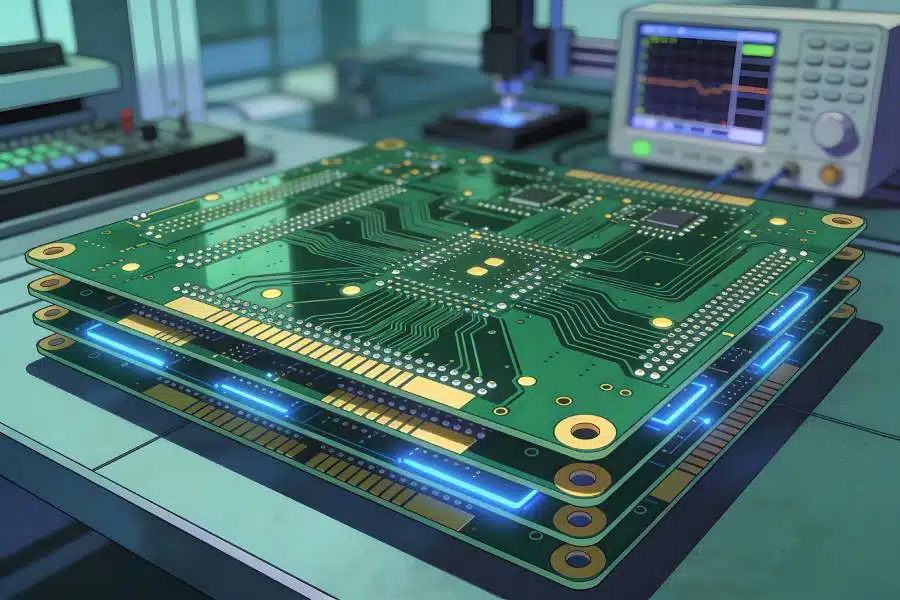
The resulting curves are compared against the paste supplier’s recommended window. If the peak temperature is low, the last zones are raised; if the soak is short, the middle zones are raised or the belt is slowed. Airflow is adjusted afterwards, because increasing airflow changes the heat transfer coefficient and shifts every curve at once.
Common Zone Balance Problems
A frequent problem is a profile that looks correct on the profiler board but fails on a dense production board. The profiler is often run on a bare or lightly populated panel, which heats far faster than a fully loaded one. The delta between the two can reach fifteen degrees, enough to push the peak temperature out of window on the real product.
Another is the edge effect. Boards travelling near the rail lose heat to the conveyor, so the outer rows run cooler than the centre. Widening the preheat zones or adding a thermal barrier on the rail side reduces the difference. Uneven loading on the belt also changes the oven ambient, so boards should be spaced consistently. The defects that follow a badly balanced oven are described under SMT component shift causes.
Nitrogen And Airflow Effects
Nitrogen reduces oxidation during reflow and improves wetting, but it also changes heat transfer. A nitrogen atmosphere with the same zones and airflow usually produces a slightly different profile, so the oven must be re-profiled when the atmosphere is switched. The oxygen level is normally held below 1000 ppm, and lower levels improve wetting further at higher gas cost.
Airflow is the variable that is most often ignored. High airflow makes the assembly follow the zone set point closely, which shortens the effective soak and can cause tombstoning on small chip parts. Low airflow makes the board lag, which extends the soak but may keep the peak temperature from being reached on heavy boards.

Setting And Documenting The Profile
Once a profile is accepted it becomes a controlled document. Zone set points, belt speed, airflow settings, nitrogen level and the measured curves are recorded together with the date, the oven and the paste batch. Every change of paste, board or oven requires a fresh profile, because the thermal profile is a property of the whole system rather than of the oven alone.
Production then monitors the process rather than the curve. Periodic profiler runs verify that the oven still matches the recorded conditions, and the results are kept with the build records. Drifting zone balance appears as a slow change in peak temperature or soak length, and it can be corrected before it turns into a soldering defect. How the profile is filed with the rest of the build records is described under PCB design and fabrication.
Process Control and Verification
On a design of this kind, soak is the item that decides how the rest of the board is arranged. A short note on the drawing about handling, storage or packaging is often worth more than an extra decimal place on a tolerance. Where a value sits close to a process limit, the drawing should say so, since the shop can then open the process window rather than working to a nominal figure that carries no tolerance.
A stack-up that is drawn rather than described removes most of the ambiguity from a quotation, and it lets the fabricator price the board against the dielectric and copper weights that will actually be used.
Process Control and Verification
On a design of this kind, soak is the item that decides how the rest of the board is arranged. A short note on the drawing about handling, storage or packaging is often worth more than an extra decimal place on a tolerance. Where a value sits close to a process limit, the drawing should say so, since the shop can then open the process window rather than working to a nominal figure that carries no tolerance.
FAQ
How often should a reflow profile be re-measured? At minimum at the start of every production run, after any change of paste or board, and whenever an oven element, thermocouple or fan is replaced. A weekly verification run is a reasonable baseline on a stable line.
Does a longer soak always improve quality? No. A soak that exceeds the flux activation window depletes the activators before the alloy melts, which reduces wetting. The soak should be long enough to equalise the assembly and no longer than the chemistry allows.
What peak temperature is typical for SAC305? Most processes target a peak between 235 and 245 C with sixty to ninety seconds above the 217 C liquidus, but the final window comes from the paste supplier and should always be confirmed by measurement.