Aluminum Clad PCB Price: Thermal, Copper and Volume
An aluminum clad PCB is one of the few board constructions where the substrate is chosen for a property other than electricity. The aluminum plate carries heat away from the components and adds mechanical stiffness at the same time, while a thin thermally conductive dielectric insulates the circuit from the metal. Because that dielectric is the expensive and technically sensitive part of the structure, most of the price variation traces back to it.
What the Structure Costs and Why
The board is built from three layers: the aluminum base, a thermally conductive dielectric and the copper circuit. The dielectric must conduct heat while withstanding the working voltage, and it is supplied in grades defined by thermal conductivity. The aluminum base itself is a commodity and contributes little to the price compared with the dielectric above it. A standard 1.0 W/mK grade costs about 0.80 to 1.20 dollars per board, a 1.5 to 2.0 W/mK grade 1.20 to 2.20 dollars, and a 3.0 W/mK or better grade for industrial and high power work 2.50 to 4.50 dollars.
That progression is steep, and it is the most common source of unnecessary cost. Many designs specify a high conductivity dielectric without checking whether the standard grade would hold junction temperature within its limit. A thermal calculation performed before the specification is written usually removes 20 to 40 percent of the material cost on a lighting or power board.
Copper Weight and Conductor Geometry
Copper weight sets current capacity and, indirectly, the minimum trace width that can be etched reliably. One ounce copper is the standard configuration and is included in the base price. Two ounces adds 0.30 to 0.80 dollars per board, and three ounces or more adds up to 1.20 dollars. The current that a given width can carry is a calculation rather than a rule of thumb, and the relationship is set out in trace width current calculation.
Heavier copper interacts with the dielectric requirement. A wide, thick trace carries heat away from the component as well as current, so a design with generous copper can sometimes use a lower grade dielectric and still meet the thermal target. That substitution is worth testing during the design phase, because the saving is larger than the cost of the extra copper.
Board Size, Shape and Yield
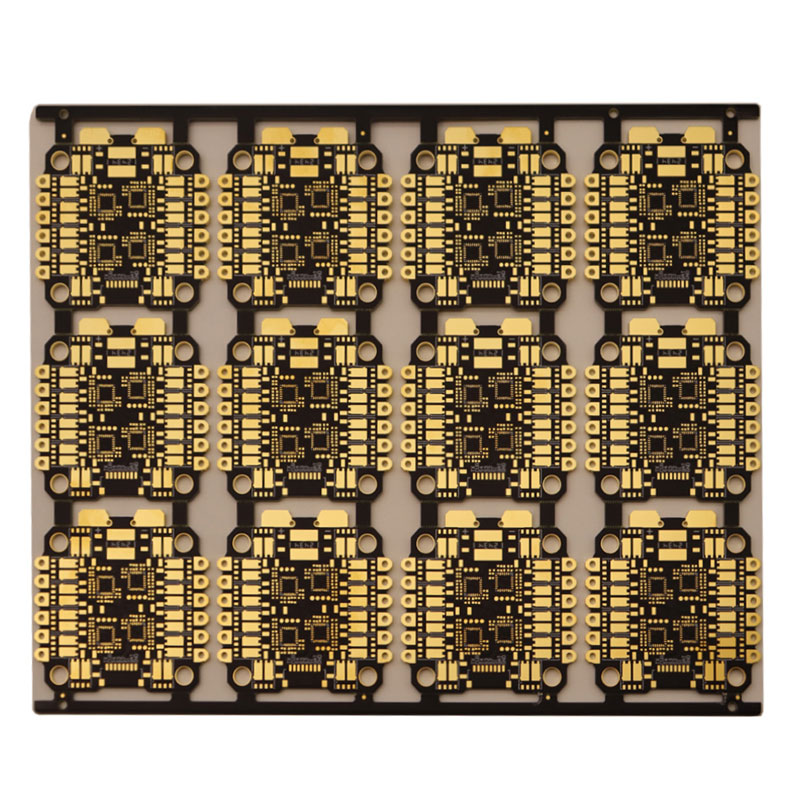
Size affects price through panel utilisation rather than through material alone. A small board of 50 mm square or less costs 0.60 to 1.00 dollars per unit, a 100 mm square board 1.00 to 2.50 dollars, and a large or irregular shape 2.50 to 5.00 dollars and above. The reason is straightforward: aluminum panels are cut to size, so any area not occupied by circuits has already been paid for.
Shape matters as much as area. Circuits that tile efficiently on the standard panel cost less per unit than the same number of circuits cut from an outline that leaves large gaps. Adjusting the board outline or accepting a shared panel layout is often the single largest saving available, and the mounting and outline considerations are reviewed in board outline and mounting design.
Surface Finish Options
Finishing an aluminum board is inexpensive compared with the dielectric, but the differences are still worth knowing. An organic solderability preservative adds about 0.05 to 0.10 dollars per board and is the cheapest option, though its storage life is short. Hot air solder levelling adds 0.08 to 0.15 dollars and tolerates longer storage. Electroless nickel immersion gold adds 0.20 to 0.60 dollars and is chosen for high reliability products or where fine pitch assembly is involved.
Finish choice also affects how the boards store before assembly, which matters on long programs. Where the assembly will operate outdoors or in a humid environment, protection beyond the finish is usually needed. The options and their limitations are described in conformal coating for board protection, and on an aluminum board the coating also helps protect the dielectric edge from contamination and moisture ingress.

Volume Pricing
Quantity changes the price more than any technical parameter, because the aluminum substrate itself is inexpensive and the fixed costs dominate small orders. A ten piece prototype run typically quotes 4.00 to 8.00 dollars per board. A hundred piece batch falls to 1.50 to 3.00 dollars, and volumes above a thousand boards reach 0.80 to 1.80 dollars.
A representative example shows how the factors combine. A single sided board of 100 by 100 mm with one ounce copper, a 1.5 W/mK dielectric and an organic finish, ordered in a quantity of five hundred, lands at roughly 0.90 to 1.50 dollars per board. The same board with two ounce copper, a 2.0 W/mK dielectric and ENIG finish, ordered in a quantity of one hundred, costs roughly 2.20 to 3.80 dollars per board. Doubling the order quantity usually moves the price further down the curve than any specification change, and that saving is available without touching the design.
Hidden Costs and Regional Differences
Several items are commonly excluded from a headline price. Tooling and set up charges on a new outline, non recurring engineering for a first article, packing suitable for a heavy panel and freight all add to the landed cost. Testing is usually limited to continuity and visual inspection, with thermal performance verified by material certificate rather than by measurement on the finished board.
Regional pricing follows the pattern seen in other board categories, with Asian suppliers offering the lowest unit cost and short lead times, United States suppliers charging a premium for proximity and local compliance, and European suppliers higher again, particularly for automotive and medical programs that require specific approvals. Comparing landed cost per good board, rather than the unit price alone, is the only comparison that reflects what the order actually costs.
Reducing Cost Without Losing Thermal Performance
Four levers do most of the work. Match the dielectric grade to a calculated thermal requirement rather than to a habit. Keep copper at one ounce unless the current demands more. Improve panel utilisation by adjusting the outline or the number of circuits per panel. And choose the cheapest finish that the assembly process and storage period allow.
A partner such as gopcb can review the dielectric grade, the copper weight and the outline together and identify where the specification is more conservative than the application requires. That review costs nothing before tooling is cut and can remove a large fraction of the unit price on a high volume lighting or power product.
FAQ
Why does the dielectric grade dominate the price? Because it is the technically demanding layer, required to conduct heat while insulating the circuit from the metal base. Higher conductivity grades are more expensive to manufacture and are the main variable in the material cost.
Can an aluminum clad PCB be multilayer? Yes, but each additional layer raises the price sharply. Most designs use a single circuit layer or a double sided construction, and only use more layers where routing density genuinely demands it.
How does volume affect price? Strongly. A ten piece prototype may cost 4.00 to 8.00 dollars per board, while the same design above a thousand pieces falls to 0.80 to 1.80 dollars because tooling and set up are amortised.