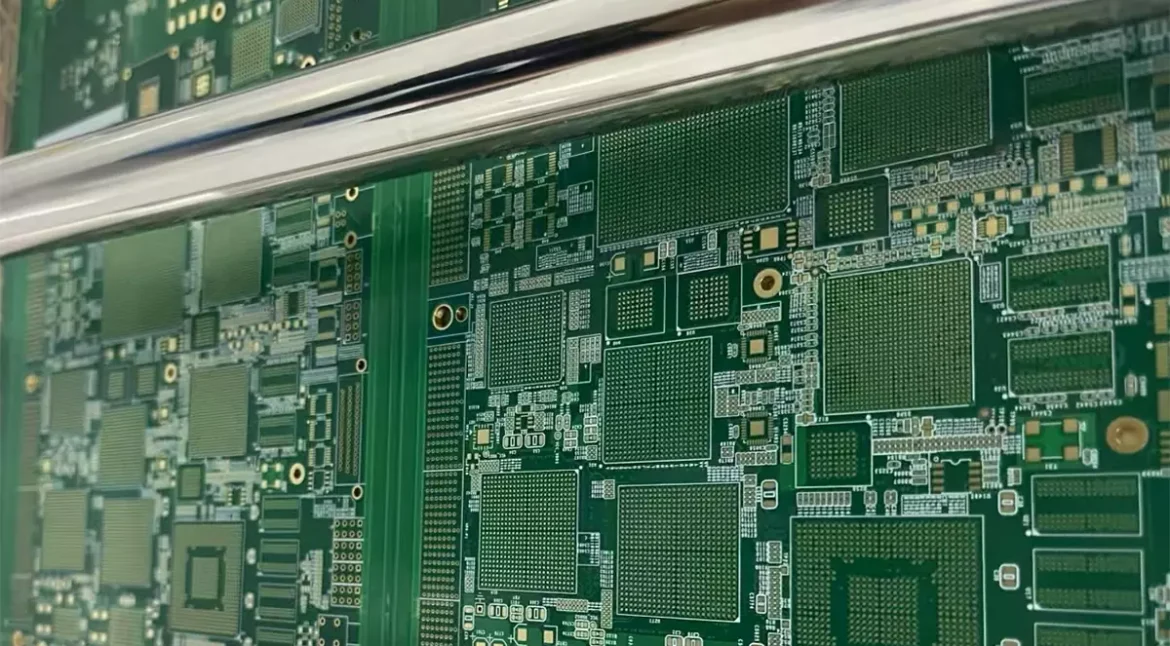
Gas Pitting in Electroplated Copper: Causes and Detection A gas pit is a small rounded depression in an electroplated deposit, left where a bubble of gas clung to the surface while the copper was growing around it. The deposit beneath the bubble is thinner or absent, and the pit is…

Laser Ablation for Solder Mask Openings: Depth and Edge Quality Laser ablation removes solder mask from a defined area with a focused beam, without a phototool and without a development step. It is used to open windows on a finished board, to repair a mask that has covered a pad,…
Book Layup in Multilayer Lamination: The Sequence The book is the stack of inner layers, prepreg and foil that is assembled before the press closes. It is built by hand or by machine, one layer at a time, and the sequence in which the layers are placed and the condition…
Fillet Lifting in Wave Soldered Joints: Why It Happens Fillet lifting is the separation of the solder fillet from the wall of a plated through-hole during wave soldering, as the joint solidifies. The joint looks complete from above and it is electrically continuous, which is why it is usually found…
Panel Thickness Measurement After Lamination Panel thickness after lamination is one of the few characteristics that is set by a mechanical process rather than by a chemical one, and it is measured on every lot because everything downstream depends on it. The press closes to a defined gap, the prepreg…
Selective Soldering Nozzle Wear and Flow Rate Drift A selective soldering nozzle is a small fountain that delivers a defined column of molten solder to one joint at a time, and its internal geometry decides how much solder arrives and how fast. Nozzle wear is therefore a process variable rather…
Solder Mask Over Bare Copper: SMOBC Process Control Solder mask over bare copper describes a fabrication sequence in which the mask is printed directly onto the copper of the finished circuitry and the metallic finish is applied afterwards, only to the pads that will be soldered. The structure replaced the…
Stencil Mesh Count and Tension in Solder Paste Printing Mesh count is the number of threads per inch in the woven fabric that carries a stencil, and on a mesh-mounted stencil it works together with thread diameter, emulsion thickness and stencil tension to decide how much paste the aperture actually…
Peelable Solder Mask: Application, Cure and Peeling A peelable solder mask is a temporary coating applied before soldering and stripped away afterwards, and it exists so that features which must remain solderable never meet the wave, the flux or the cleaning chemistry. Gold fingers on an edge connector, press-fit holes,…
Solder Paste Metal Load Control in Stencil Printing Metal load is the share of a solder paste by mass that is solder alloy rather than flux, and it is the number that links the chemistry of the paste to the volume of the joint it forms. A no-clean paste for…