Electrical Overstress and Latch-up Investigation A device that fails with no sign of mechanical damage has usually been taken beyond its ratings, and the question is which rating and for how long. The damage is often invisible, which is why the investigation begins with the circuit rather than with the…
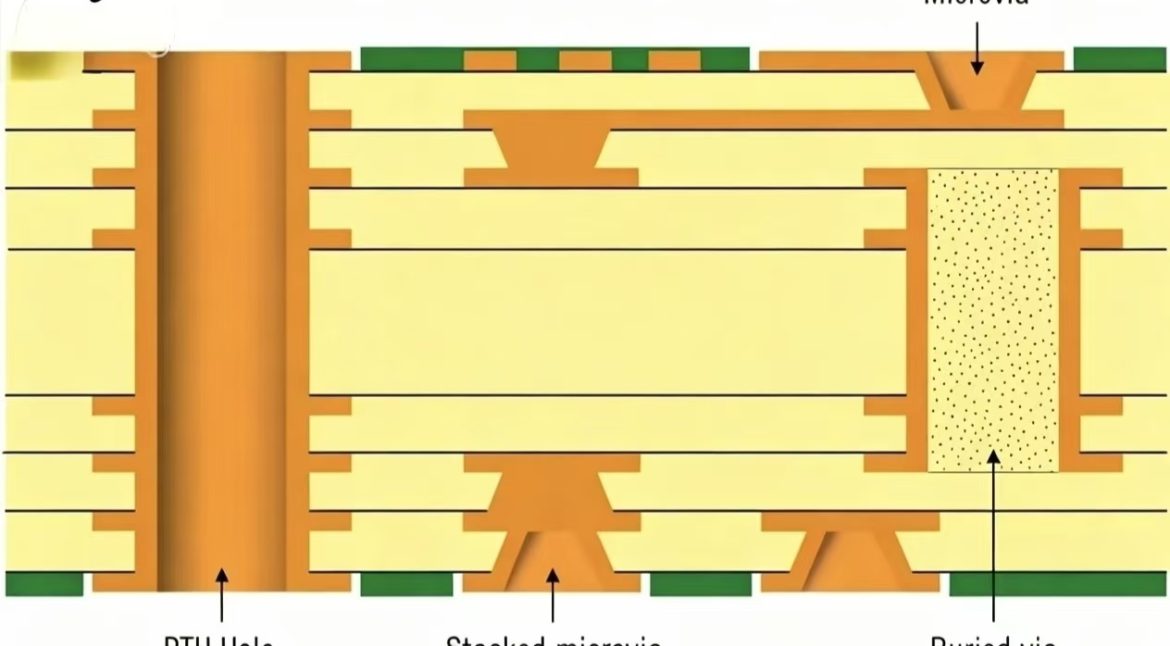
Via Filling and Planarization for Stacked Via Designs An unfilled via is a hole with copper on its walls and nothing in the middle. That is perfectly acceptable on an ordinary board, but it becomes a problem the moment a designer wants to place a pad directly above it, or…
NTC Thermistor Linearization Circuit Design An NTC thermistor is one of the cheapest and most accurate ways to measure temperature, and its output is one of the least convenient. The resistance falls steeply and non linearly as the temperature rises, so the circuit and the firmware both have to work…
Flex Circuit Stiffener Design A flexible circuit is thin, and thinness is what allows it to bend but also what makes it difficult to attach a connector or to mount a component. A stiffener is a piece of rigid material bonded to a defined area of the flex, which restores…
Strain Gauge Bridge Completion Circuit Design Measuring strain with a single gauge means completing the bridge with fixed resistors on the board, and that simple statement hides most of the practical difficulty. The completion arms must match the gauge in resistance and in temperature behaviour, and the wiring to the…
Plated Copper Ductility and Elongation Testing Methods A plated through hole has to survive the expansion and contraction of the board around it, and that means the copper in the barrel has to stretch without breaking. Ductility is the property that allows it, and it is not the same as…
Thermal Cycling Test Design and Interpretation A thermal cycling test is not a single test. The ramp rate, the dwell time, the temperature extremes and the number of cycles each change the mechanism that the test exercises, and a test that does not match the application can pass a design…
Solder Balling: Design Rules and Process Limits Solder balls are small spheres of solder left on the board surface beside a joint. They are not part of any connection, and a ball that is large enough or loose enough can bridge two conductors or roll into a sensitive area. The…
Solder Mask Thickness Control for Dense PCB Layouts Solder mask thickness is not one number. It is a distribution that depends on the copper underneath, the application method, the cure and the geometry of the pattern, and on a dense board that distribution becomes wide. A mask that is thick…
Wave Solder Pallet Design And Use A wave soldering process brings the board into contact with a standing wave of molten solder. For a board that carries surface mount parts on one side and through hole parts on the other, the fixture that carries the board is what makes the…