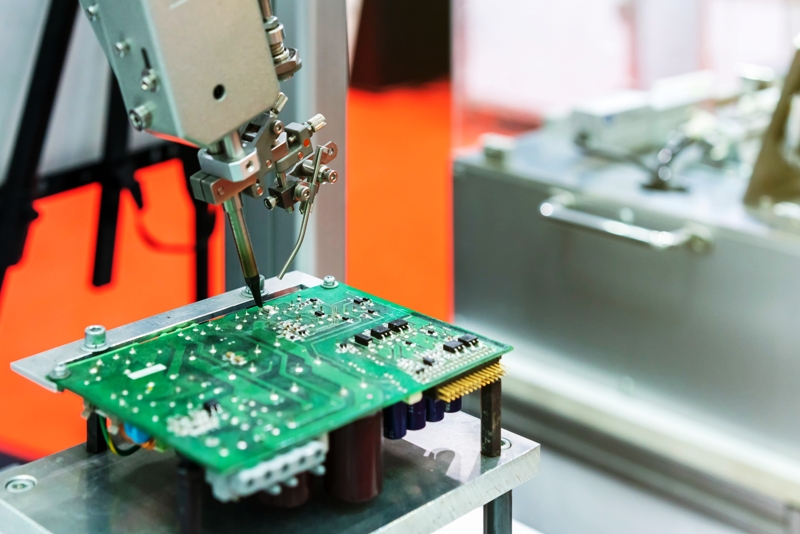
Flying Probe Versus Bed of Nails Testing on PCB Assemblies Electrical test is the last chance to catch a defect before a board reaches assembly, and the two dominant methods take opposite approaches. Bed of nails presses a dedicated fixture onto the board and tests everything at once; flying probe…
Via Plugging and Filling for Via-in-Pad PCB Designs Routing density in modern designs pushes vias into the pads they serve, and that creates a surface problem: a hole under a solder land traps flux, wicks alloy away from the joint, and leaves a void right where the thermal path should…
Amplifier PCB Design: Gain, Noise and Thermal Control An amplifier pcb is built around a simple task, which is to make a small signal larger without changing it in any other way. Everything difficult about the design follows from the second half of that sentence. Gain is easy to obtain;…
Bring-Up Procedure: Design Rules and Process Limits Bring-up is the process of turning a newly assembled board into a known-good unit, and the difference between a smooth bring-up and a difficult one is almost entirely decided by the layout. The provisions that make it smooth are cheap and they are…
Lost Steps: Preparation, Placement and Process Control A machine tool cutting an irregular arc, a depth of cut that varies from pass to pass, and edges that look rough rather than machined: the symptoms point at the motion control system, and the first response is usually to replace the driver…
Conductive Foam Gasket: Preparation, Placement and Process Control A conductive foam gasket is specified from a datasheet that quotes a shielding effectiveness of eighty decibels or more, and after assembly the product measures ten decibels worse. The natural reaction is to suspect the material and to look for a better…
Implantable Pcb: Design Rules and Process Limits An implantable PCB is a different class of product from the boards used in consumer electronics. It works inside the human body, often for a decade or more, and it cannot be serviced after it is implanted. That combination of requirements drives every…
Depaneling: Burrs, Chipping And Edge Quality Depaneling, the operation that separates boards from a panel, is the last mechanical step a board undergoes before assembly, and it is the operation most likely to damage it. A routed edge that is rough, a laminated board that cracks between the layers, a…
Vapour Phase and Vacuum Reflow Soldering Explained Convection reflow through a multi-zone oven is the default for most assemblies, but it has limits where voiding must be controlled or where the thermal mass across a board is uneven. Vapour phase and vacuum reflow address those problems with different physics rather…
What Makes A PCB Design High Speed The label high speed is applied to boards, interfaces and design teams, and it rarely means the same thing twice. For a layout engineer it usually describes a set of constraints; for a component vendor it describes a data rate; for a test…