Implantable Pcb: Design Rules and Process Limits
An implantable PCB is a different class of product from the boards used in consumer electronics. It works inside the human body, often for a decade or more, and it cannot be serviced after it is implanted. That combination of requirements drives every material and process decision, from the base laminate through to the final hermetic seal. This guide covers what those requirements are and what they mean for the supply chain.
What Makes an Implantable PCB Different
The board carries the electronics of a device such as a pacemaker, a cochlear implant, a neurostimulator or an implanted drug pump. It provides the electrical interconnect, manages energy from a battery or a wireless link, and routes signals between sensors, processing and stimulation outputs.
What separates it from an ordinary board is not the circuit topology but the environment. The assembly must be biocompatible, must survive constant moisture and body temperature, and must not fail silently. Every choice is made with a service life measured in years rather than hours of operation.
Biocompatible Materials
Substrates for these boards are usually polyimide, ceramic or a thin rigid material with an additional polymer coating. The conductive layers are medical grade, with gold and platinum appearing where corrosion resistance matters more than cost, and copper used where it can be protected completely.
The board is rarely the only barrier. A coating such as Parylene or a silicone encapsulation covers the assembly, and the enclosure seals it from the body. Material selection therefore has to be considered together with the coating and the conformal coating process, not as separate decisions.
Hermetic Sealing and Moisture Control
Moisture is the primary long-term threat. Even a small leak allows body fluid to reach the circuitry, where it causes electrochemical corrosion and eventually an open circuit or a short. Hermetic packages with welded or soldered lids are common for the most critical devices.
Where a full hermetic can is not practical, the assembly relies on a combination of coatings and a sealed polymer enclosure. In both cases the feedthroughs that carry stimulation or sensing electrodes out of the package are the weakest points and receive the most attention.
Miniaturisation and HDI Techniques
Miniaturization is the constraint that shapes the whole package. Space inside the body is limited, so these boards use high density interconnect techniques: fine lines, small vias, thin dielectrics and sometimes stacked microvias. The routing density that a wearable product takes for granted becomes a hard constraint when the package cannot grow.
Miniaturisation has a cost beyond fabrication. Finer features reduce the mechanical robustness of the assembly and narrow the process window at every step, so HDI tooling has to be qualified rather than assumed to be available.
Thermal Limits Inside the Body
Power dissipation is constrained by biology rather than by the electronics. Tissue damage begins at modest temperature rises above normal body temperature, so the device is designed for a total loss budget of a small fraction of a watt, spread across an area large enough to keep the surface temperature acceptable.
The layout contributes directly. Placing dissipating components away from the skin-facing surface, spreading copper and avoiding hot spots are design decisions with clinical consequences, and they have to be evaluated under the worst-case load rather than the typical one.
Reliability and Testing Requirements
Accelerated life testing is used to compress years of operation into a manageable test period: thermal cycling, humidity soak, mechanical flexing and electrical stress. The results feed back into the design assumptions, and a failure in test usually means a change to the material set rather than to the circuit.
Traceability is part of the requirement. Because a defective unit cannot be recalled in the field, the process records, material lots and inspection data must be retained, and the quality characteristics of each batch have to be documented rather than summarised.
Manufacturing and Cleanliness
The boards are built in controlled environments because ionic contamination left on the surface becomes a leakage path once moisture is present. Cleaning, handling and packaging are specified steps rather than best practice, and they are audited along with the electrical tests.
Plating quality matters for the same reason. Vias must be filled and capped so that no void traps process chemistry, and the via filling step is verified by cross section rather than by visual inspection.
Cost Structure and Certification
Unit prices for these boards commonly fall in a range from tens to several hundred dollars, driven by layer count, material selection, test coverage and quantity. The dominant cost is not the raw material but the qualification and documentation that surrounds it.
Suppliers are expected to operate a medical quality system such as ISO 13485 and to support regulatory submissions. Selecting a partner is therefore a compliance exercise as much as a procurement one, and the ability to reproduce a build years later is worth more than a lower quotation today.
Where the Technology Is Heading
Flexible and stretchable substrates are being developed so that implants can conform to tissue rather than sit in a rigid package. Wireless power and wireless data links reduce the need for batteries and feedthroughs, which removes two of the least reliable elements at once.
Integration is progressing as well, with sensing, processing and stimulation moving onto increasingly compact substrates. Each of those steps raises the density requirement again, which is why the manufacturing partner is chosen early in the project rather than at the end.
Sterilisation and Handling
An implantable assembly has to survive the sterilisation method chosen for the device. Ethylene oxide, gamma irradiation and steam each stress materials differently, and the board, the coating and the adhesive have to be qualified together against the process that will actually be used.
Handling follows the same logic. Static control, cleanliness and ESD protection are specified throughout build and packaging, because a latent defect introduced during assembly may not appear until the device has been in service for years, long after any opportunity to correct it has passed.
Choosing a Manufacturing Partner
Experience with medical work is the first filter, and a medical pcb supplier should be able to show which implantable or Class III programmes it has supported. A supplier that already builds implantable or Class III assemblies will have the process controls, the inspection methods and the documentation habits that the project needs, and will recognise the questions that a general fabricator does not even ask.
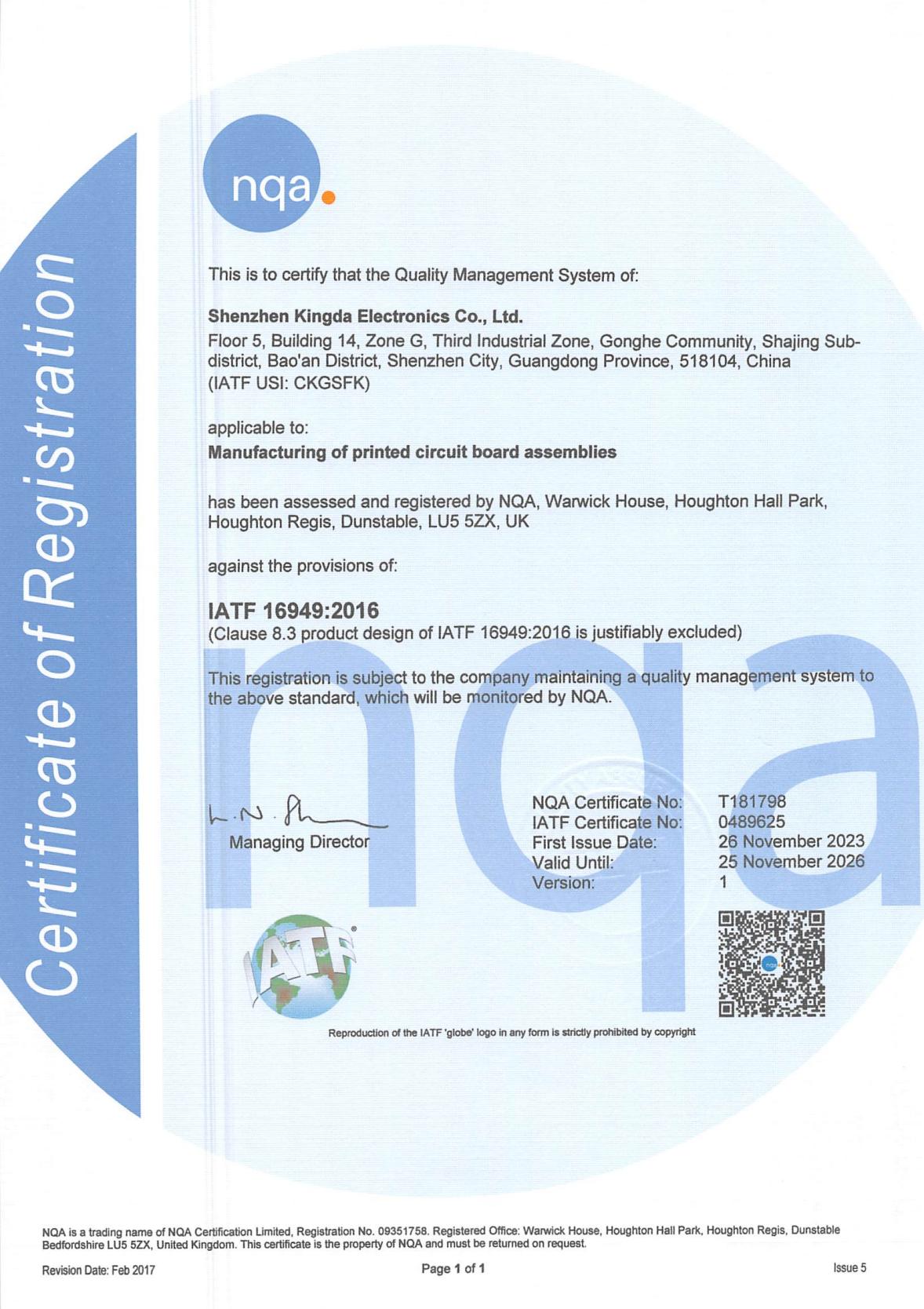
Confirm which certifications are held and which are in scope for the specific site that will build the boards. Then confirm the reproducibility commitment: the same stackup, the same materials and the same test plan, available again years later, with the records to prove it.
Reliability data should travel with the boards. A supplier that can show historical test results for the same material set, and that can reproduce the process years after the original build, removes a risk that no inspection step at delivery can address.
FAQ
How long does an implantable PCB have to last? Five to twenty years is typical, depending on the device. The design and the test programme are built around that figure rather than around a warranty period.
Which materials are used for the substrate? Polyimide, ceramic and thin rigid laminates are common, often combined with a polymer coating such as Parylene to provide the first barrier against moisture.
Why is an implantable PCB so expensive? Because qualification, traceability and test coverage dominate the cost. The fabrication itself is a small part of the total compared with the documentation a medical device requires.