Sterilization Equipment PCB: Design Requirements Sterilization equipment is designed to destroy microorganisms, and it does so using agents that are equally hostile to electronics. Steam at a hundred and thirty four degrees under pressure, hydrogen peroxide vapour, ethylene oxide or ionising radiation are all used, and a board that works…
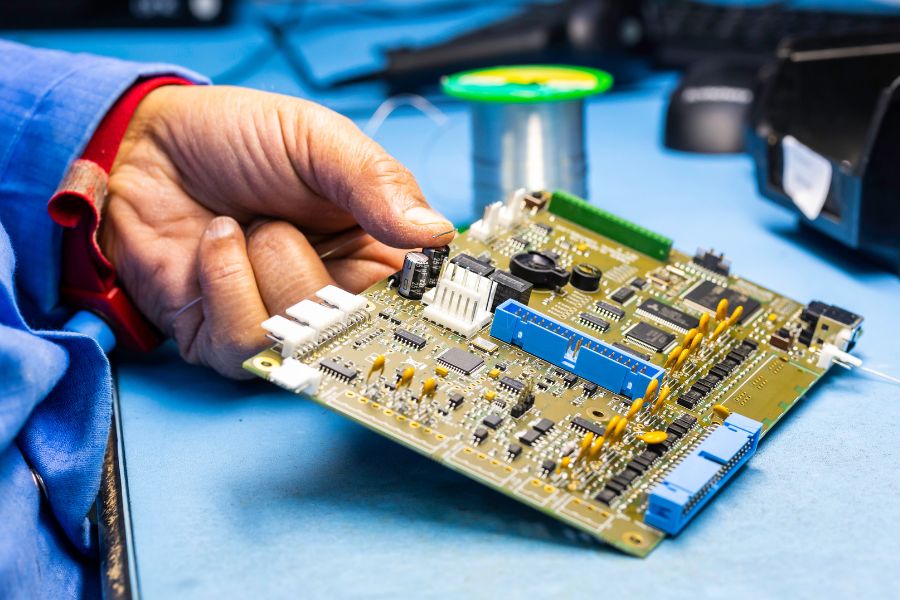
Camera Module PCB Design: Signal Integrity and Miniaturisation A camera module is one of the harder boards to design well, because it compresses a high speed interface, an extremely sensitive analogue front end, a power supply and a mechanical alignment requirement into a board the size of a fingernail. A…
Smart Door Lock PCB: Architecture and Design Points A smart door lock is a battery powered device that must work every day for a year on a set of cells, operate a motor that draws more current than anything else in the product, and remain secure while doing it. The…
IGBT Control Board Design for Induction Heating An induction heating power supply is a switching converter that happens to drive a coil instead of a transformer, and the board that generates the switching pattern is the heart of it. An IGBT control board has to produce two complementary pulse trains…
Choosing a High-Speed Laminate for Server Boards A server board is expected to run continuously for years at an elevated temperature, inside a chassis where airflow is the only cooling and where a failure means a service call. That combination puts demands on the laminate that a consumer board never…
PCB Depaneling Tool Wear: When the Cut Starts to Pull Electronics manufacturing has become a discipline of small details. Solder paste volumes, placement accuracy, temperature profiles and inspection limits all add up to the final result. This guide looks at PCB depaneling tool wear from the perspective of a PCBA…
PCB Panel Array Spacing: The Gap Between Boards Electronics manufacturing has become a discipline of small details. Solder paste volumes, placement accuracy, temperature profiles and inspection limits all add up to the final result. This guide looks at PCB panel array spacing from the perspective of a PCBA factory floor,…
Low-Cost PCB Production: Design Choices That Reduce Unit Price Low-cost PCB production is not achieved by finding the cheapest supplier. It comes from the design fitting the process so well that the fabricator can build it on the standard flow, at the standard tolerance, with the standard material, and with…
PCB Inner Layer Process: Seven Steps to a Finished Core The inner layers of a multilayer board are made first, as separate thin cores, before anything is laminated together. Each core is a copper clad sheet that has been imaged and etched into a circuit pattern, and the quality of…
Silica Filler Surface Treatment in Copper-Clad Laminate A copper-clad laminate is a composite, and like every composite its properties are decided at the interface between its ingredients. Modern laminates contain a large fraction of inorganic filler, most of it silica, mixed into an epoxy or other resin system and reinforced…