Custom Automotive Controller PCB Manufacturing | GOPCBA
As the automotive industry accelerates toward electrification, intelligence, and connected mobility, electronic control systems are becoming increasingly important to vehicle performance and safety. From powertrain control and battery management to body electronics, ADAS, and vehicle communication systems, modern vehicles depend on highly reliable electronic control units.
At the center of these systems is the printed circuit board. Because different vehicle platforms and control modules have different electrical, mechanical, thermal, and reliability requirements, standardized circuit boards cannot always provide the necessary performance. Automotive Controller PCB customization provides a more effective solution by allowing the PCB structure, materials, layer count, copper thickness, impedance, and manufacturing processes to be optimized for the specific application.
GOPCBA provides professional Automotive PCB Manufacturing solutions for automotive electronic applications, supporting customized PCB structures from prototype development through production.
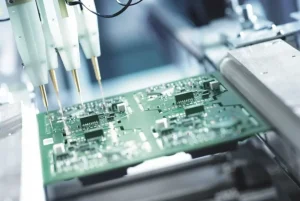
Automotive control systems operate in environments that are considerably more demanding than many conventional electronic products. A PCB installed inside a vehicle may experience temperature fluctuations, continuous vibration, electrical noise, mechanical shock, moisture, and long operating cycles.
Different control modules also have different technical requirements.
For example, powertrain and motor-control systems may require higher current-carrying capability and improved thermal management. Battery management systems require stable sensing and power-distribution circuits. ADAS and radar electronics may require high-density routing, controlled impedance, and high-frequency materials.
Through Custom PCB Manufacturing, engineers can optimize the PCB structure around the actual application rather than relying on a general-purpose board.
This approach can help achieve:
- Higher electrical reliability
- Improved thermal performance
- Better signal integrity
- Higher circuit density
- Greater resistance to environmental stress
- More efficient use of PCB space
- Better compatibility with specific automotive control modules
Material selection is one of the first considerations when developing an automotive PCB. Automotive electronic modules may operate across a wide temperature range, so the PCB material must provide appropriate thermal stability and dimensional reliability.
Depending on the application, engineers may select standard FR-4, high-TG materials, high-frequency laminates, heavy-copper structures, or other specialized materials.
For power-oriented automotive electronics, higher copper thickness can improve current-carrying capability and help distribute heat. For high-speed or RF applications, low-loss materials and carefully controlled dielectric structures may be more appropriate.
GOPCBA can evaluate material selection together with layer stack-up, copper thickness, thermal requirements, and electrical performance during the engineering stage.
Modern automotive control units often require multiple power, ground, signal, and communication layers. A properly designed Multilayer PCB can provide additional routing capacity while separating different functional circuits within the same board structure.
Multilayer construction can be particularly useful for:
- Engine and powertrain controllers
- Battery management systems
- Motor controllers
- ADAS control modules
- Vehicle communication systems
- Infotainment systems
- Body control modules
- Automotive power electronics
The stack-up must be carefully engineered because layer arrangement affects signal integrity, impedance, thermal behavior, manufacturability, and overall reliability.
For complex automotive designs, GOPCBA also provides PCB Design & Layout Services to support stack-up development, impedance calculations, DFM analysis, EMI/EMC considerations, and manufacturing optimization.
The manufacturing process for an automotive controller board requires precise process control from engineering review to final inspection.
Before production begins, the PCB design should be reviewed for manufacturability.
Engineers evaluate factors such as:
- Layer count
- Trace width and spacing
- Via structures
- Copper thickness
- Board thickness
- Material selection
- Impedance requirements
- Thermal requirements
- Surface finish
- Component assembly requirements
Early DFM analysis can identify potential manufacturing problems before fabrication begins, helping reduce unnecessary design revisions and production risks.
GOPCBA’s PCB Manufacturing Services support engineering review and manufacturing optimization for complex PCB projects.
For multilayer automotive boards, inner-layer circuits are formed through imaging and etching processes.
Precise pattern transfer is essential because dimensional errors in the inner layers can accumulate during subsequent lamination and affect final registration.
Manufacturing control should focus on:
- Trace geometry
- Copper distribution
- Layer-to-layer registration
- Insulation spacing
- Signal reference planes
These factors are especially important for high-density and impedance-controlled automotive PCB designs.
The lamination process combines cores, copper layers, and prepreg materials into a unified multilayer PCB structure.
Temperature, pressure, heating rate, cooling rate, resin flow, and layer registration must be carefully controlled.
Poor lamination control can result in:
- Layer misalignment
- Delamination
- Internal voids
- Resin starvation
- Board warpage
- Unstable dielectric thickness
For automotive electronics, stable lamination is particularly important because dimensional variation can influence drilling accuracy, impedance, electrical performance, and long-term reliability.
As automotive electronic modules become smaller and more integrated, conventional through-hole structures may not provide sufficient routing density.
Advanced HDI technology can use microvias, blind vias, buried vias, and sequential lamination to increase interconnection density within a limited PCB area.
For example, compact ADAS control units and communication modules may benefit from HDI structures that provide more efficient component breakout and shorter electrical connections.
GOPCBA supports HDI PCB Manufacturing for applications requiring high-density interconnections, microvias, blind vias, buried vias, and advanced multilayer structures.
After drilling, copper plating creates electrical connections between PCB layers while building the required conductive thickness.
Uniform plating is essential for electrical conductivity and mechanical reliability. Process parameters such as hole-wall quality, plating thickness, and current density must be controlled to minimize manufacturing defects.
Outer-layer circuit formation then establishes the final conductor pattern according to the approved PCB design.
The surface finish protects exposed copper and provides an appropriate surface for component assembly.
Depending on the application, PCB manufacturers may use finishes such as ENIG, ENEPIG, OSP, or other suitable processes.
The correct surface finish should be selected according to solderability, component requirements, storage conditions, reliability expectations, and the intended production process.
Quality control is a critical part of automotive PCB production because PCB performance can directly influence the reliability of vehicle electronic systems.
A comprehensive quality management process should cover incoming materials, production processes, electrical testing, dimensional inspection, and final product verification.
Typical inspection and testing processes may include: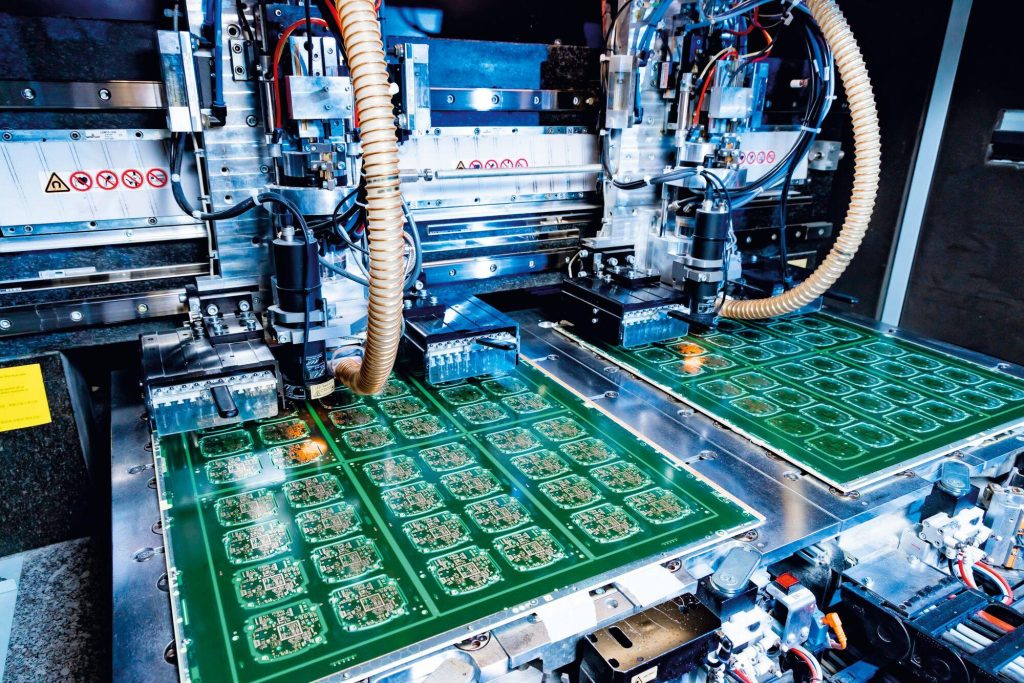
- Automated optical inspection
- Electrical testing
- X-ray inspection where required
- Dimensional inspection
- Copper thickness verification
- Impedance testing
- Solderability evaluation
- Surface-finish inspection
- Final visual inspection
Process traceability is also important. Production records can connect materials, process parameters, inspection results, and finished products, making it easier to analyze production variation and improve manufacturing consistency.
For automotive applications requiring complex structures, GOPCBA’s Automotive PCB Manufacturing capabilities cover multilayer structures, HDI technology, high-TG materials, high-frequency PCBs, heavy-copper PCBs, rigid-flex designs, and controlled-impedance solutions.
Electric vehicle battery management systems require reliable circuits for voltage measurement, current monitoring, temperature sensing, communication, and power management.
The PCB must provide stable electrical connections while supporting appropriate thermal and mechanical performance.
Motor controllers and power converters can involve relatively high currents and significant heat generation. PCB design therefore needs to consider copper thickness, thermal paths, current distribution, and component placement.
Heavy-copper structures and optimized thermal vias may be considered when required by the application.
Advanced driver assistance systems depend on high-speed sensors, processors, communication interfaces, and radar modules.
These applications may require HDI structures, controlled impedance, fine-line routing, low-loss materials, and carefully engineered multilayer stack-ups.
For high-frequency automotive applications, GOPCBA also provides High-Frequency PCB Manufacturing solutions for radar and other RF electronic systems.
Body control systems manage functions such as lighting, doors, windows, HVAC, access systems, and other vehicle electronic functions.
These modules often require compact PCB structures with high component density and reliable communication between different functional circuits.
Modern vehicles increasingly depend on high-speed communication networks for data exchange between control modules, sensors, processors, and external systems.
Controlled impedance, stable reference planes, appropriate materials, and optimized routing can help maintain signal quality in high-speed communication circuits.
Many automotive electronics projects require not only PCB fabrication but also component sourcing, SMT assembly, through-hole assembly, inspection, and testing.
Integrating PCB fabrication and assembly within one manufacturing workflow can simplify engineering communication and reduce coordination between multiple suppliers.
GOPCBA supports integrated PCB and PCBA manufacturing for prototype development, low-volume production, and volume manufacturing.
A typical production workflow may include:
- PCB design review
- DFM/DFA analysis
- PCB fabrication
- Component sourcing
- SMT assembly
- Through-hole assembly
- AOI inspection
- X-ray inspection
- Electrical testing
- Functional testing
- Final quality inspection
Early coordination between PCB fabrication and assembly can also help identify potential DFM and DFA issues before mass production.
Automotive electronics require a manufacturing partner capable of managing complex PCB structures, demanding materials, high-density interconnections, thermal requirements, and consistent production quality.
GOPCBA supports automotive PCB projects from engineering development and prototype fabrication to production manufacturing. Its capabilities include multilayer PCB fabrication, HDI, high-frequency PCB, high-TG materials, heavy copper, rigid-flex PCB, blind and buried vias, controlled impedance, and other advanced PCB technologies.
By combining engineering review, material selection, stack-up optimization, precision manufacturing, inspection, and assembly support, GOPCBA helps customers develop a more reliable and efficient PCB production workflow.
For automotive controller projects, the right PCB manufacturing strategy should begin with the actual application requirements rather than simply selecting a standard board structure. By matching PCB materials, layer structures, copper thickness, interconnection technology, thermal design, and inspection requirements to the vehicle’s operating environment, manufacturers can build circuit boards with the reliability and performance required for modern automotive electronics.
As vehicles continue to evolve toward electrification, intelligent driving, and connected systems, the demand for reliable automotive electronic control hardware will continue to grow.
Custom PCB manufacturing provides automotive developers with the flexibility to optimize circuit boards for specific control modules, vehicle platforms, and operating environments. From multilayer and HDI structures to high-frequency, heavy-copper, and controlled-impedance technologies, advanced PCB manufacturing capabilities can support increasingly complex automotive electronic designs.
With professional engineering support, precise manufacturing processes, comprehensive inspection, and integrated PCBA capabilities, GOPCBA provides a practical manufacturing solution for customers developing next-generation automotive electronics.