
Damp Heat: 6 Rules for Coated Assemblies
A damp heat test holds an assembly at a controlled temperature and humidity for a defined period, usually under electrical bias, and then measures whether the insulation between conductors has survived the exposure. It is a slow test by design, because the mechanisms it targets need time as well as moisture to develop. It reproduces the slow, quiet conditions that a product meets in a humid climate rather than a sudden shock.
The test is common on coated assemblies because a coating is only as good as its weakest point, and the weak points appear under humidity rather than in dry air. A board that passes a dry electrical test can fail a damp heat test after a few hundred hours without any visible damage.
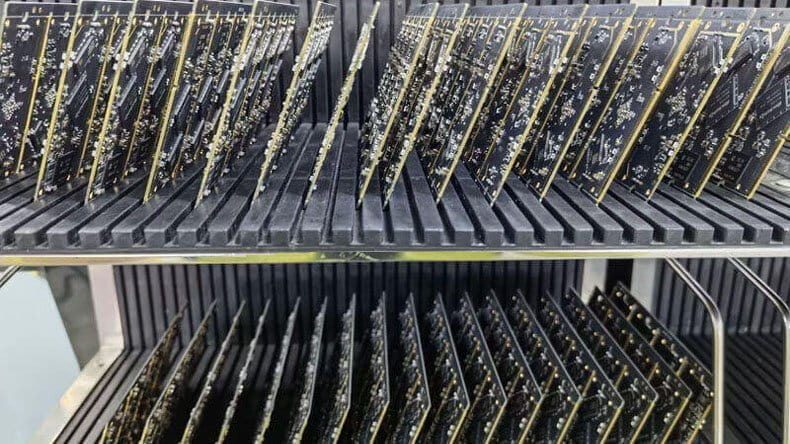
What a Damp Heat Test Reproduces
Humidity works on an assembly in three ways: it lowers the surface resistance between conductors, it allows ionic material to become mobile and it penetrates organic materials. Together those mechanisms support corrosion and electrochemical migration at voltages far below those that cause a dry breakdown.
The test therefore targets a different failure mode from thermal cycling or vibration. Where a product specification lists both, the damp heat test is the one that speaks to coating integrity and to the cleanliness of the surface under it.
Chamber Conditions, Ramp and Duration
Common conditions for damp heat are 40 C at 93 percent relative humidity or 85 C at 85 percent humidity, with the choice following the product class and the standard named in the specification. Those two combinations form the basis of most humidity testing on electronic assemblies. The higher the temperature, the faster the chemistry runs, and the shorter the test can be.
The ramp matters almost as much as the hold. A fast ramp can condense water on the sample before the chamber stabilises, which is a harsher condition than the test intends. Where condensation is deliberately part of the test, the cycle is written to produce it on every repetition, as described in the IPC test methods.
Insulation Resistance and What It Detects
Insulation resistance is usually the primary measurement, taken between isolated conductor pairs at intervals during humidity testing and again at the end. A fall of several orders of magnitude indicates that moisture and ionic material have formed a conductive path.
The value depends on geometry, so a limit has to be stated for a specific pattern rather than for a board in general, and the pattern should match the conductor spacing that matters on the product. A coupon with a known gap is what makes the number comparable between lots. A test coupon with a known conductor spacing gives a repeatable result, and the same discipline used in board quality measurements applies to the reading itself.
Bias Voltage and Electrochemical Effects
Bias is what separates a storage test from a life test. With a voltage applied, metal ions migrate toward the opposite electrode and can grow a conductive filament across the gap, which is the mechanism behind dendrite failures.
Higher bias accelerates the effect, but it can also produce failures that would never occur in service. The applied voltage should relate to the working voltage of the product, and the polarity arrangement should be chosen so that the pattern under test actually stresses the design.
Coating Integrity Under Humidity
Coating integrity decides whether the humidity reaches the surface at all. A continuous film keeps water away from the metal, while a film with a pinhole, a thin edge or a shadowed area that was never covered lets moisture straight through.
Thickness and cure both matter, and the measurement method in coating thickness work says whether the film is what it was designed to be. A coating that is thick but poorly bonded behaves worse than a thin one that covers completely, because the defect sits under a barrier that hides it.
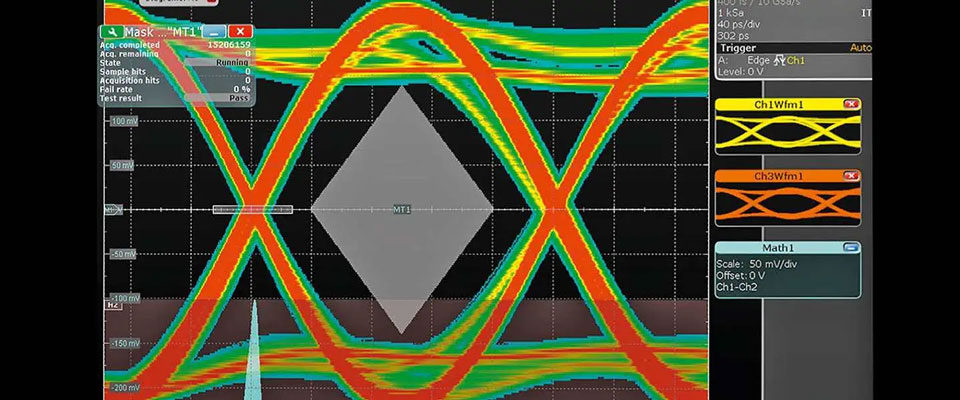
Failures: Corrosion, Migration and Dendrites
The failures found after a damp heat test are corrosion of the exposed metal, a loss of insulation resistance and visible growths between conductors, and all three can appear on a board that looked flawless when it went into the chamber. The growths are metallic and can be confirmed as dendrites by sectioning or by elemental analysis.
Flux residue, plating salts and handling contamination all supply the ions that make these failures possible. Their role is why cleanliness testing with methods such as ionic contamination testing is the natural companion to a humidity test rather than a separate activity.
Preparing and Conditioning Samples
Samples should be handled with gloves, packed so that surfaces do not touch, and conditioned before the test. Where the product is cleaned or coated, the samples have to be processed exactly as production does, because a laboratory prepared sample that skips the coating proves nothing.
The number of samples and the arrangement in the chamber both affect the result. Boards too close together create their own microclimate, and a sample placed near the chamber wall can see a different humidity from one in the middle. Where the assembly is coated before the test, the coating adhesion result should already be known so that a failure can be attributed.
Judging Results and Post Test Inspection
Pass or fail is decided by the insulation resistance limit and by the visual and functional condition of the sample afterwards. A sample that passes electrically but shows corrosion under magnification has not passed in any useful sense.
Post test inspection should include the areas that were stressed most: the edges of the coating, the shadowed faces of components and any point where the film terminates. A section through a suspect area is often more informative than another hundred hours in the chamber.
Specifications, Records and Relevance
The specification should state the temperature, the humidity, the bias, the duration and the measurement points, and it should name the standard it follows. Without those details a result cannot be compared with any other laboratory’s result, which makes the test useless for qualification.
Records should include the chamber trace, the resistance readings, the sample identification and the processing history of each board. Where the decision is between cleaned and no-clean processing, the choice should be documented in the way the clean versus no-clean evaluation requires, and then confirmed by the humidity result.
FAQ
How long does a damp heat test run? Common durations are 96, 240 or 1000 hours at the specified conditions, with the choice following the product class. Longer tests at milder conditions are often more representative of service than a short, severe one.
Why is bias applied during the test? Without voltage, ionic material is present but not driven, so migration and dendrite growth do not occur. Bias turns the test into a life test rather than a storage test, and it should be set to the working voltage of the product.
Can a coated board still fail a humidity test? It can, because the failure usually starts at a defect in the coating rather than through the film itself: an edge, a pinhole, a shadowed face or a contaminated surface under the coating. Coating the board does not remove the need for a clean surface.