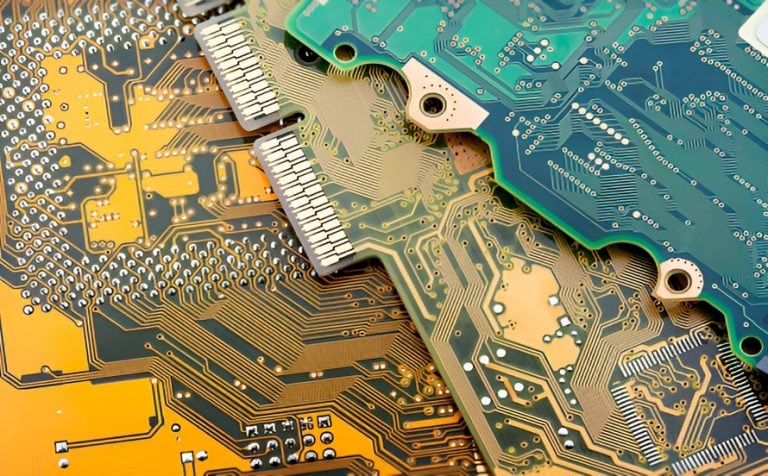
Among the many materials used for printed circuit boards, FR-4 PCB is one of the most widely adopted choices. FR-4 is a glass-fiber-reinforced epoxy laminate system that provides a combination of mechanical strength, electrical insulation, thermal stability, manufacturability, and cost effectiveness.
The term FR-4 is commonly associated with flame-retardant glass-reinforced epoxy laminate materials used in PCB construction. The “FR” designation refers to flame retardancy, while the “4” identifies the material system within the historical NEMA designation.
A typical FR-4 Material structure consists of woven glass fiber impregnated with epoxy resin and laminated under heat and pressure. Copper foil is bonded to the laminate to create the conductive layers required for circuit routing.
Because of its balanced performance and broad availability, FR-4 PCB material is widely used in consumer electronics, industrial equipment, automotive electronics, communication systems, computers, instrumentation, and many other applications.
However, FR-4 is not a single material with identical electrical and thermal properties. Different FR-4 laminate systems can have different glass styles, resin contents, Tg values, Dk/Df characteristics, CTE values, and thermal performance. Therefore, material selection should be based on the actual requirements of the application.
Key Characteristics of FR-4 PCB
1. Flame Retardancy
One of the defining characteristics of FR-4 PCB materials is their flame-retardant performance.
The epoxy resin system is formulated to meet applicable flame-retardancy requirements. This characteristic is important for electronic equipment where fire safety and material compliance are part of the product requirements.
The exact flame-retardant classification should always be confirmed from the selected laminate manufacturer’s datasheet and applicable certification.
2. Excellent Mechanical Strength
The combination of epoxy resin and woven glass fiber gives an FR-4 Circuit Board good mechanical strength and dimensional rigidity.
This makes FR-4 suitable for applications exposed to normal mechanical stress, vibration, handling, and assembly operations.
The glass reinforcement also helps maintain board dimensions during manufacturing and soldering.
3. Good Electrical Insulation
FR-4 provides effective electrical insulation between copper conductors and PCB layers.
Its electrical properties make it suitable for a wide range of analog and digital electronic applications. Depending on the selected laminate grade, electrical characteristics such as dielectric constant, dissipation factor, dielectric strength, and insulation resistance can vary.
For high-speed or RF applications, these parameters should be evaluated carefully rather than assuming that every FR-4 laminate has the same electrical performance.
4. Good Thermal Stability
A properly selected FR-4 Material can withstand the thermal conditions associated with PCB fabrication and common soldering processes.
High-Tg FR-4 materials are available for applications requiring improved thermal stability and reduced dimensional changes at elevated temperatures.
Thermal performance is particularly important for lead-free assembly processes, repeated thermal cycling, and products operating in demanding environments.
5. Dimensional Stability
The glass-fiber reinforcement provides FR-4 with good dimensional stability.
This is especially important during multilayer PCB fabrication, where precise registration between individual layers is required.
Dimensional stability also contributes to reliable drilling, lamination, fine-line fabrication, and component assembly.
6. Compatibility with Lead-Free Assembly
Many modern FR-4 laminate systems are suitable for lead-free PCB assembly processes.
However, the suitability of a specific laminate depends on its Tg, decomposition temperature (Td), thermal expansion characteristics, and the temperature profile used during assembly.
For demanding applications, designers should select the material based on the actual reflow and reliability requirements rather than treating all FR-4 materials as equivalent.
7. Good Manufacturability
One major advantage of FR-4 PCB Manufacturing is the mature and widely established manufacturing infrastructure surrounding FR-4 laminates.
FR-4 can generally be processed using standard PCB manufacturing technologies, including:
- CNC drilling
- Laser drilling for suitable structures
- Imaging
- Etching
- Copper plating
- Lamination
- Solder mask application
- Surface finishing
- Routing and V-scoring
Its widespread use also means that manufacturers and suppliers have extensive experience working with FR-4 systems.
8. Wide Range of Configurations
FR-4 PCB technology can be used for many different board structures, including:
- Single-sided PCBs
- Double-sided PCBs
- Multilayer PCBs
- High-Tg PCBs
- HDI PCBs
- Rigid-flex structures with appropriate material systems
- High-copper PCBs
- Mixed-material PCB constructions
This flexibility allows designers to select an FR-4-based material system according to the electrical, thermal, mechanical, and manufacturing requirements of the product.
Limitations of FR-4 PCB
Although FR-4 is highly versatile, it is not the optimal material for every application.
1. Limited High-Frequency Performance
Standard FR-4 Material may not provide the electrical consistency required for demanding high-frequency or microwave applications.
Its dielectric constant and dissipation factor can vary with material construction, resin content, frequency, temperature, and other conditions. At high data rates and frequencies, variations in Dk and Df can affect impedance control, insertion loss, propagation delay, and signal integrity.
For demanding RF and microwave applications, specialized low-loss or high-frequency laminates may be more appropriate.
2. Moisture Absorption
FR-4 is not completely moisture-proof. The laminate can absorb moisture from the surrounding environment.
Moisture can influence dielectric properties and may contribute to reliability concerns under certain thermal and environmental conditions.
For applications exposed to high humidity, condensation, or severe environmental cycling, moisture resistance should be considered during material selection and reliability evaluation.
3. Relatively Low Thermal Conductivity
Standard FR-4 has relatively low thermal conductivity compared with dedicated thermally conductive PCB substrates such as aluminum-based metal-core materials or specialized high-thermal-conductivity laminates.
As a result, FR-4 may not be the best choice for applications with high localized heat generation.
Designers may need to use copper planes, thermal vias, heat sinks, thermal interface materials, or alternative PCB substrates to manage heat effectively.
4. Thermal Expansion Considerations
FR-4 exhibits different coefficients of thermal expansion along different axes because of its glass-fiber-reinforced structure.
The Z-axis expansion becomes particularly important during high-temperature processes and thermal cycling.
For multilayer boards with high layer counts, fine-pitch components, or demanding reliability requirements, CTE and thermal expansion characteristics should be considered carefully.
5. Processing and Design Limitations
Although FR-4 is highly manufacturable, advanced PCB structures may still require strict process control.
Fine lines, microvias, high layer counts, thick copper, tight impedance tolerances, and complex multilayer stackups can increase manufacturing difficulty.
The appropriate FR-4 grade and fabrication process should therefore be selected according to the actual PCB design.
FR-4 PCB Applications
Because of its balanced cost and performance, FR-4 Circuit Board technology is used across many industries.
1. Communication Systems
FR-4 PCBs are widely used in communication equipment such as:
- Routers
- Network switches
- Modems
- Access points
- Communication controllers
- Data transmission equipment
For very high-speed communication hardware, specialized laminate systems may be selected when lower loss and tighter dielectric control are required.
2. Automotive Electronics
FR-4 PCB technology is used in various automotive electronic systems, including control modules, infotainment systems, navigation equipment, body electronics, and instrumentation.
Automotive applications can expose PCBs to vibration, temperature changes, humidity, and mechanical stress. Therefore, the appropriate laminate grade and PCB construction must be selected based on the vehicle’s environmental requirements.
3. Aerospace and Defense Electronics
FR-4-based boards can be used in selected aerospace and defense electronics, including control systems, communication equipment, instrumentation, and other electronic assemblies.
For extreme temperature, high-frequency, low-outgassing, or specialized reliability requirements, alternative or specialized laminate systems may be necessary.
4. Industrial Equipment
Industrial equipment frequently uses FR-4 Circuit Board technology for:
- Motor controllers
- PLC systems
- Sensors
- Industrial computers
- Automation equipment
- Measurement instruments
- Robotics
- Control systems
Its mechanical rigidity and established manufacturing process make FR-4 suitable for many industrial control applications.
5. Energy Systems
FR-4 PCBs can be found in power management and energy-related equipment, including monitoring systems, control units, inverters, converters, and energy storage electronics.
For high-power designs, however, thermal management must be carefully evaluated because standard FR-4 has limited thermal conductivity.
6. Security Systems
Security and surveillance equipment may use FR-4 PCB technology for cameras, access-control systems, alarm equipment, biometric devices, and monitoring controllers.
These boards provide a stable platform for integrating sensors, processors, communication interfaces, and power-management circuits.
7. Consumer Electronics
FR-4 is extensively used in consumer electronics because it offers a good balance between performance, manufacturability, and cost.
Typical products include:
- Computers
- TVs
- Home appliances
- Consumer networking equipment
- Audio equipment
- Industrial-grade consumer devices
- Various electronic controllers
8. Medical Electronics
FR-4 PCBs are used in many medical electronic systems, including monitoring equipment, diagnostic instruments, laboratory equipment, control units, and other electronic devices.
Medical applications may impose strict reliability, cleanliness, traceability, and regulatory requirements, so the PCB material and manufacturing process should be selected according to the specific product requirements.
FR-4 PCB Manufacturing Process
The FR-4 PCB Manufacturing process is similar to the manufacturing process used for many rigid PCBs. However, the exact process sequence depends on the layer count, copper thickness, board thickness, via structure, surface finish, and other design requirements.
1. PCB Design and Engineering Review
The process begins with PCB design.
Engineers define the circuit layout, stackup, copper thickness, trace width, via structure, component locations, and mechanical dimensions.
Before production, manufacturers typically perform a DFM review to identify potential problems involving:
- Minimum trace width and spacing
- Hole sizes
- Annular rings
- Layer registration
- Copper distribution
- Impedance requirements
- Solder mask clearance
- Board outline
- Manufacturing tolerances
A suitable FR-4 Material should be selected at this stage according to the electrical and thermal requirements.
2. FR-4 Laminate Preparation
FR-4 laminate consists primarily of woven glass reinforcement impregnated with epoxy resin.
The selected laminate is supplied in a defined thickness and copper foil configuration.
For multilayer boards, different core and prepreg constructions are combined to achieve the required final stackup and dielectric thickness.
3. Inner-Layer Circuit Formation
For multilayer FR-4 PCB production, the inner copper layers are imaged and etched according to the circuit design.
After imaging and development, unwanted copper is removed through controlled chemical etching.
The resulting copper pattern forms the internal signal, power, and ground structures.
4. Inner-Layer Inspection
The inner layers are inspected before lamination.
Automated optical inspection (AOI) can compare the manufactured pattern with the original design data and identify potential defects such as open circuits, shorts, missing features, or excessive copper.
5. Lamination
The prepared cores and prepreg materials are stacked according to the PCB stackup.
The stack is placed into a controlled lamination press, where heat and pressure cause the resin in the prepreg to flow and cure.
This process bonds the individual layers into a solid multilayer PCB.
Proper lamination control is critical for:
- Layer alignment
- Board thickness
- Interlayer bonding
- Dimensional stability
- Via reliability
- Thermal performance
6. Drilling
After lamination, mechanical drilling is used to create through holes and other required openings.
Depending on the PCB structure, laser drilling may be used for microvias and HDI features.
Drilling accuracy is essential for maintaining reliable interlayer connections.
7. Copper Plating
The drilled holes are chemically prepared before copper plating.
An initial electroless copper layer provides conductivity along the hole walls. Electrolytic copper plating is then used to increase copper thickness and create reliable plated-through connections.
8. Outer-Layer Circuit Formation
The outer copper layers are processed to create the required traces, pads, planes, and other conductive structures.
Imaging, plating, and etching processes are carefully controlled to achieve the required geometry and manufacturing tolerances.
9. Solder Mask Application
A solder mask coating is applied to protect most of the exposed copper.
After exposure and development, component pads and other required conductive areas remain exposed.
Solder mask improves electrical insulation, protects copper from environmental exposure, and reduces the risk of solder bridging during assembly.
10. Surface Finish
An appropriate surface finish is applied to exposed copper areas.
Common options include:
- HASL
- Lead-free HASL
- ENIG
- ENEPIG
- OSP
- Immersion tin
- Immersion silver
The finish should be selected according to solderability, storage requirements, contact requirements, assembly process, and product lifetime.
11. Testing and Inspection
The completed FR-4 PCB undergoes inspection and testing according to the applicable requirements.
Depending on the project, testing may include:
- AOI
- Automated or manual visual inspection
- Electrical continuity testing
- Isolation testing
- Flying probe testing
- Impedance testing
- Dimensional inspection
- Surface-finish inspection
The goal is to verify that the manufactured board meets the design and quality requirements before shipment.
How to Choose the Right FR-4 Material
Not every FR-4 Material is identical. Choosing the appropriate laminate grade is important for reliable PCB performance.
Designers should consider:
1. Glass Transition Temperature (Tg)
Tg indicates the temperature at which the resin system transitions from a relatively rigid state toward a softer state.
High-Tg materials may be appropriate for products exposed to elevated operating temperatures or demanding thermal cycling.
2. Decomposition Temperature (Td)
Td describes the temperature at which significant thermal decomposition of the resin system begins.
A higher Td can be beneficial for applications involving repeated high-temperature assembly processes.
3. Dielectric Constant and Dissipation Factor
For high-speed designs, Dk and Df are important electrical parameters.
Designers should use the laminate manufacturer’s specified values at relevant frequencies rather than relying on a generic FR-4 value.
4. Coefficient of Thermal Expansion
CTE affects dimensional changes caused by temperature.
For multilayer PCBs and high-reliability applications, especially those using fine-pitch components and plated-through holes, CTE should be included in the reliability analysis.
5. Thermal Performance
If the board contains high-power components, the thermal conductivity and thermal expansion characteristics of the selected material should be considered together with the copper structure and cooling system.
Kingda: FR-4 PCB Manufacturing Solutions
Kingda provides FR-4 PCB Manufacturing solutions for a wide range of electronic applications.
From material selection and engineering review to fabrication, inspection, electrical testing, and final processing, PCB production should be coordinated with the customer’s design requirements.
For standard applications, conventional FR-4 can provide an effective balance between electrical performance, mechanical strength, manufacturing efficiency, and cost.
For more demanding projects, Kingda can work with customers to evaluate factors such as:
- PCB layer count
- Board thickness
- Copper thickness
- High-Tg requirements
- Impedance control
- Fine-line routing
- HDI structures
- Thermal management
- Surface finish
- High-frequency material requirements
- Reliability and environmental conditions
Selecting the correct PCB Material at the beginning of the design process can help prevent performance and manufacturing problems later in the product lifecycle.
Conclusion
FR-4 PCB technology remains one of the most important material solutions in modern PCB manufacturing because it provides a practical balance of mechanical strength, electrical insulation, thermal stability, manufacturability, availability, and cost.
However, FR-4 should not be considered a single standardized material with identical performance in every application. Different laminate systems can provide significantly different Tg, Dk, Df, CTE, thermal, and reliability characteristics.
For general-purpose electronics, industrial equipment, communication products, automotive electronics, and many other applications, FR-4 remains a highly versatile choice.
For high-frequency, high-speed, high-temperature, or high-power applications, designers should evaluate the limitations of standard FR-4 and consider specialized material systems when necessary.
By selecting the appropriate FR-4 Material, optimizing the PCB stackup, applying proper DFM practices, and maintaining strict manufacturing process control, manufacturers can achieve reliable and consistent FR-4 PCB Manufacturing results.