What Is a Full-Size Keyboard PCB?
A Full-Size Keyboard PCB is the main electronic circuit board that connects the keyboard switches, controller, LEDs, and other electronic components. It detects key presses, processes the input signals, and communicates them to a computer or other host device.
A standard full-size keyboard typically uses a 104-key layout, providing a complete set of alphanumeric keys, function keys, navigation keys, and a dedicated numeric keypad. This traditional layout makes full-size keyboards suitable for gaming, office work, programming, accounting, data entry, and other applications where access to a complete set of keys is important.
The PCB serves as the electrical foundation of the keyboard. Its circuit design determines how switches are scanned, how multiple simultaneous key presses are handled, and how features such as RGB lighting, programmable keys, and USB connectivity can be implemented.
For applications requiring customized board dimensions, layer structures, or assembly configurations, manufacturers can also integrate keyboard PCB production with broader PCB manufacturing services to support prototype and production requirements.
Key Sections of a Full-Size Keyboard PCB
A full-size keyboard PCB generally corresponds to four major functional areas.
Alphanumeric Section
The alphanumeric section is the primary typing area. It contains letters, numbers, punctuation marks, modifier keys, and other standard typing keys.
This area is used for everyday typing, document creation, programming, gaming, and general computer operation.
Function Key Row
The function key row contains F1 through F12. These keys provide shortcuts for operating-system functions, software commands, and application-specific operations.
A dedicated function row provides immediate access to these commands without requiring secondary key combinations.
Navigation Cluster
The navigation cluster typically includes the arrow keys, Home, End, Page Up, and Page Down.
These keys are particularly useful for document editing, coding, spreadsheet operations, and navigating websites or applications.
Numeric Keypad
The dedicated numeric keypad is located on the right side of a conventional full-size keyboard.
It provides numerical keys and mathematical operators in a calculator-style arrangement, making it particularly useful for accounting, financial applications, spreadsheets, data entry, and other number-intensive tasks.
Types of Keyboard PCBs
Choosing the right Keyboard PCB depends on the keyboard structure, switch technology, customization requirements, and intended application.
Membrane Keyboard PCB
Membrane keyboards use flexible membrane layers to detect key presses. When a key is pressed, the membrane layers come into contact and complete the corresponding electrical circuit.
Membrane keyboards are generally lightweight, quiet, and economical. However, they typically provide less tactile feedback than mechanical keyboards and offer fewer customization options.
Mechanical Keyboard PCB
A Mechanical Keyboard PCB is designed to work with individual mechanical switches. Each switch provides a distinct actuation mechanism and tactile or linear response.
Mechanical keyboard PCBs are widely used for gaming, professional typing, programming, and enthusiast keyboards because they support durable switch designs and extensive customization.
Mechanical keyboard PCBs can also incorporate features such as RGB lighting, programmable keys, anti-ghosting, N-key rollover, and hot-swappable sockets.
Single-Layer PCB
A single-layer PCB contains one conductive copper layer. Its structure is relatively simple and can be cost-effective for basic keyboard applications.
However, the limited routing space can make single-layer designs less suitable for keyboards with complex features, extensive LED lighting, or advanced programmable functions.
Multilayer PCB
A Multilayer PCB contains two or more conductive layers separated by insulating dielectric materials.
Multilayer construction provides additional routing space and allows designers to separate signal, ground, and power structures more effectively. It is particularly useful for advanced keyboards with RGB lighting, complex switch matrices, controllers, USB interfaces, and additional programmable functions.
For more complex electronic products, multilayer construction can also support controlled routing and higher component density. Learn more about PCB Manufacturing and available PCB technologies.
Hot-Swappable PCB
A Hot-Swappable PCB allows mechanical switches to be installed or replaced without soldering them directly to the PCB.
This design is popular among keyboard enthusiasts because it makes switch replacement significantly easier. Users can experiment with different switch types, replace damaged switches, or customize the typing experience without modifying the PCB permanently.
Hot-swappable designs require compatible sockets, accurate PCB footprints, and sufficient mechanical clearance to ensure reliable switch installation.
Standard Full-Size Keyboard Layout and Dimensions
A conventional full-size keyboard follows a standardized arrangement developed around typing efficiency and user familiarity.
The main sections include:
- Alphanumeric section: Letters, numbers, punctuation, and modifier keys.
- Function key row: F1 through F12 and related system functions.
- Navigation cluster: Arrow keys, Home, End, Page Up, and Page Down.
- Numeric keypad: Dedicated numerical keys and mathematical operators.
The exact PCB dimensions can vary depending on the enclosure, mounting method, switch layout, bezel design, USB connector position, and additional features.
When developing a custom keyboard PCB, the electrical design should therefore be coordinated with the mechanical enclosure and final assembly requirements.
Benefits of a Full-Size Keyboard PCB
Complete Functionality
The biggest advantage of a full-size keyboard is its comprehensive key layout.
A single board provides access to:
- Alphanumeric keys
- Function keys
- Navigation keys
- Numeric keypad
- Modifier keys
- Dedicated control keys
This makes the format suitable for users who frequently switch between typing, numerical input, programming, gaming, and productivity applications.
Ergonomic Advantages
A standard full-size layout keeps frequently used keys in familiar positions.
Standard key spacing allows users to maintain consistent finger positioning, while the dedicated numeric keypad provides quick access to numerical input.
For professional users who spend many hours typing or processing numerical data, maintaining a familiar layout can improve workflow efficiency.
Customization Potential
Modern keyboard PCBs can support extensive customization.
Depending on the design, features may include:
- Programmable keys
- Macro functions
- RGB or single-color backlighting
- Hot-swappable switches
- Multiple key layers
- Custom firmware
- Anti-ghosting
- N-key rollover
- USB connectivity
These features allow manufacturers and keyboard brands to create products for different user groups without changing the fundamental full-size form factor.
Suitable for Gaming and Professional Applications
Full-size keyboard PCBs are suitable for gaming because they can support dedicated function keys, macro functions, anti-ghosting, and N-key rollover.
They are also practical for professional environments such as accounting, finance, programming, engineering, administration, and data entry because the dedicated numeric keypad improves numerical input efficiency.
How to Choose the Right Full-Size Keyboard PCB
Consider the Application
Start by identifying how the keyboard will be used.
Gaming: Look for fast scanning, anti-ghosting, N-key rollover, programmable keys, and optional RGB lighting.
Professional typing: Prioritize reliable switch support, comfortable key spacing, durability, and consistent electrical performance.
Programming: Programmable keys, multiple layers, customizable firmware, and convenient navigation functions can improve workflow efficiency.
Data entry: A dedicated numeric keypad and reliable switch matrix are particularly important.
Evaluate PCB Material
FR-4 is a common material for rigid keyboard PCBs because it provides a stable mechanical structure and good electrical insulation.
Material selection should also consider board thickness, operating environment, thermal requirements, mechanical strength, and production volume.
For projects requiring more advanced electrical or mechanical characteristics, material selection should be reviewed together with the PCB manufacturer before production.
Check Customization Requirements
Before selecting or designing a PCB, determine which features are essential.
Important considerations include:
- Hot-swappable sockets
- RGB lighting
- Programmable keys
- Custom firmware
- USB interface
- Indicator LEDs
- Rotary encoders
- Additional function keys
A clear feature list helps the manufacturer determine the appropriate layer count, component placement, routing strategy, and manufacturing process.
Select a Reliable Manufacturing Partner
The quality of the PCB directly affects keyboard reliability and user experience.
A professional manufacturer should be able to support the project from PCB fabrication through assembly and testing. This is particularly important for custom keyboard products because PCB manufacturing, component placement, soldering, and final testing must work together.
GOPCBA provides integrated PCB fabrication and PCBA services, including PCB manufacturing, component sourcing, SMT, through-hole assembly, testing, and other manufacturing solutions. PCB Assembly Services can be integrated into a broader production workflow when customers require assembled keyboard boards.
Key Design Considerations for Full-Size Keyboard PCBs
Switch Matrix Design
The switch matrix is one of the most important elements of a keyboard PCB.
Instead of connecting every switch directly to an individual controller input, keyboard switches are commonly arranged in rows and columns. The controller scans the matrix to determine which keys are being pressed.
The matrix design should minimize unnecessary routing complexity while maintaining reliable key detection.
Anti-Ghosting and N-Key Rollover
Ghosting can occur when multiple keys are pressed simultaneously and the keyboard incorrectly detects an additional key.
A properly designed switch matrix and appropriate diode configuration can help prevent unwanted key detection.
N-key rollover allows multiple keys to be detected simultaneously, which is particularly useful for gaming and other applications involving multiple simultaneous inputs.
RGB Backlighting
RGB backlighting is a popular feature in gaming and enthusiast keyboards.
The PCB must provide appropriate LED placement, electrical routing, power distribution, and control circuitry.
Power consumption should be considered carefully when designing a board with a large number of LEDs. Adequate power distribution and thermal considerations help maintain stable operation.
EMI and Signal Integrity
Electromagnetic interference can affect electronic devices by introducing unwanted electrical noise.
A well-designed keyboard PCB should include appropriate grounding, power distribution, signal routing, and component placement.
For more demanding electronic designs, the PCB layout should also consider return paths, noise coupling, and signal integrity during the engineering review process.
Hot-Swappable Switches
Hot-swappable functionality requires appropriate socket selection and accurate component footprints.
The PCB designer should verify:
- Socket compatibility
- Switch footprint
- Mechanical clearance
- Solder pad dimensions
- PCB thickness
- Component placement
- Electrical connectivity
These details help prevent mechanical interference and improve long-term switch replacement reliability.
Programmable Functions
Programmable keyboards require a suitable microcontroller and firmware architecture.
Depending on the product design, users may be able to configure:
- Key remapping
- Macro functions
- Layer switching
- Media controls
- Lighting effects
- Custom shortcuts
This functionality is especially useful for gaming keyboards, programming keyboards, productivity keyboards, and specialized input devices.
PCB Assembly Considerations
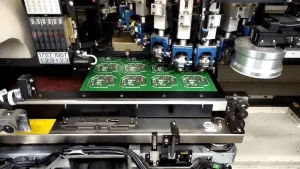
After PCB fabrication, the assembled board may require SMT, through-hole assembly, or a combination of both technologies.
Components commonly found on keyboard PCBs include:
- Microcontrollers
- Diodes
- Hot-swap sockets
- RGB LEDs
- USB connectors
- Resistors
- Capacitors
- Voltage regulators
- ESD protection components
For production keyboards, automated assembly can improve consistency and reduce manual soldering errors.
A complete PCB Assembly process may include solder paste printing, component placement, reflow soldering, inspection, through-hole assembly, functional testing, and final inspection. GOPCBA’s published assembly capabilities support SMT, through-hole, mixed assembly, BGA assembly, prototype assembly, and production assembly. PCB Assembly Capabilities
Testing and Quality Control
Reliable keyboard PCBs should be tested before shipment or final keyboard assembly.
Typical testing may include:
- Electrical continuity testing
- Open and short circuit testing
- Automated optical inspection
- Component placement inspection
- Solder joint inspection
- Functional testing
- USB interface testing
- Backlight testing
- Key matrix testing
Testing should verify that every key registers correctly and that additional functions such as RGB lighting, USB communication, programmable keys, and hot-swappable sockets operate as intended.
For customers requiring a complete manufacturing process, PCB fabrication and assembly can be combined into a single production workflow. Turnkey PCB Assembly can simplify component procurement, PCB fabrication, assembly, inspection, and testing through one manufacturing partner.
Full-Size Keyboard PCB Manufacturing Process
A typical production workflow includes:
- PCB design and engineering review
- Gerber and manufacturing data verification
- Material preparation
- PCB fabrication
- Drilling and copper plating
- Circuit imaging and etching
- Solder mask application
- Surface finishing
- Electrical testing
- PCB assembly
- Functional inspection
- Final packaging
For custom keyboard products, early engineering review is important because the PCB must fit accurately within the mechanical enclosure while maintaining correct switch, stabilizer, connector, and mounting-hole positions.
Manufacturers with integrated PCB and assembly capabilities can help reduce coordination between multiple suppliers and simplify production management.
Why Choose a Professional PCB Manufacturer?
A professional PCB manufacturing partner can provide more than basic board fabrication.
For a custom full-size keyboard project, useful capabilities may include:
- PCB design and engineering support
- DFM and DFA review
- Prototype production
- Low-volume production
- Mass production
- Component sourcing
- SMT assembly
- Through-hole assembly
- Electrical testing
- Functional testing
- Quality inspection
GOPCBA provides one-stop PCB and PCBA manufacturing services covering PCB design, fabrication, component procurement, SMT, DIP, testing, and finished-product assembly. PCB Manufacturing Services can support projects from prototype development through production.
For projects requiring design-for-manufacturing assistance, DFMA Services can also be incorporated into the engineering workflow to identify potential manufacturing and assembly issues before production.
Conclusion
A full-size keyboard PCB provides the electrical foundation for a complete 104-key keyboard layout, combining alphanumeric keys, function keys, navigation controls, and a dedicated numeric keypad.
The right PCB structure depends on the intended application, switch technology, material selection, layer count, customization requirements, backlighting, and manufacturing process.
For gaming and enthusiast keyboards, features such as hot-swappable switches, RGB lighting, N-key rollover, anti-ghosting, and programmable keys can significantly expand customization options. For professional and data-entry applications, the traditional full-size layout provides convenient access to both typing and numerical input.
When moving from prototype to production, choosing an experienced PCB manufacturing and assembly partner can help ensure consistent quality, reliable electrical performance, and efficient production.