Industrial Virtual Reality Equipment: DFM, Supply Chain, Calibration, Testing, and Quality Control
Industrial virtual reality (VR) equipment is moving beyond entertainment and gaming into manufacturing, industrial training, maintenance, simulation, digital twins, logistics, healthcare, and other professional applications. Compared with consumer VR products, industrial VR headsets must deliver higher reliability, better optical stability, accurate spatial tracking, thermal performance, and long-term mechanical durability.
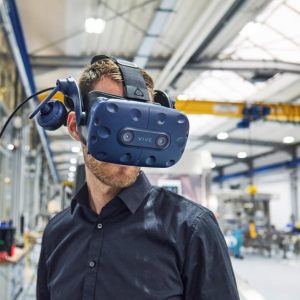
For manufacturers, developing industrial VR equipment is not simply a matter of selecting high-performance displays and sensors. The entire product must be engineered for manufacturability, repeatable assembly, automated testing, supply-chain stability, and scalable production.
A standardized testing methodology is therefore essential for industrial VR hardware development, from early-stage design verification to mass production. Hardware engineers must manage tight optical alignment tolerances, synchronize multiple sensors, improve factory yield, and integrate sensitive optical and electronic components into ruggedized enclosures.
For manufacturers such as Kingda, combining PCB design, electronic assembly, mechanical engineering, optical integration, and manufacturing process control can help create industrial VR products that maintain stable performance even under demanding operating conditions.
Key Takeaways
- A well-structured DFM design can simplify assembly, accelerate production, and make maintenance more efficient.
- Automated optical inspection and functional testing can identify defects at an early stage, reducing material waste and overall scrap rates.
- Long-term supplier agreements can help stabilize the availability of critical components such as microdisplays, optical assemblies, sensors, and electronic components.
- Every industrial VR headset should undergo comprehensive thermal, mechanical, optical, electrical, and functional testing before shipment.
- A reliable PCB assembly and electronic architecture are essential for stable sensor synchronization, power management, signal processing, and high-speed data transmission.
- Modular product architecture can simplify testing, repair, component replacement, and mass production.
- Proper thermal management helps minimize sensor drift, processor throttling, display instability, and long-term reliability problems.
DFM for Industrial Virtual Reality Equipment
Design for Manufacturing (DFM) is one of the most important engineering methodologies for developing industrial VR equipment. DFM evaluates product structure, component selection, assembly processes, tolerances, materials, and manufacturing requirements before mass production begins.
For industrial VR systems, DFM should cover more than the mechanical housing. It should also include the optical system, sensors, display modules, batteries, cables, connectors, PCB design, PCBA, thermal structures, and final assembly process.
A DFM-oriented development process can help manufacturers:
- Reduce unnecessary component complexity.
- Minimize assembly steps.
- Improve component accessibility.
- Optimize mechanical tolerances.
- Reduce alignment errors.
- Improve production yield.
- Simplify automated inspection.
- Reduce rework and manufacturing costs.
- Improve long-term product reliability.
Early collaboration between product designers, PCB engineers, optical engineers, mechanical engineers, and manufacturers is especially important for industrial VR products because small dimensional errors can affect optical alignment, tracking accuracy, and user experience.
Optical and Display Integration for VR Headsets
Microdisplay alignment is one of the most demanding manufacturing processes in a VR headset. The display, lens, optical frame, and mechanical housing must maintain highly controlled relative positions to prevent image distortion, uneven focus, poor edge clarity, and binocular mismatch.
Depending on the optical architecture, manufacturers may need to control:
- Display-to-lens distance.
- Lens tilt.
- Optical axis alignment.
- Inter-pupillary alignment.
- Display position.
- Mechanical reference points.
- Lens-to-housing tolerances.
Automated positioning equipment can place display panels and optical assemblies onto precisely designed reference structures. Datum features can then guide machine-vision systems during automated alignment.
Automated Optical Inspection (AOI) can also be incorporated into the production line to identify visual and dimensional defects before final assembly.
How AOI Improves VR Manufacturing
| AOI Function | Manufacturing Impact | Production Benefit |
|---|---|---|
| Real-time defect detection | Identifies problems early | Reduces overall scrap |
| Optical alignment inspection | Detects lens/display misalignment | Improves image quality |
| Component positioning verification | Prevents assembly errors | Improves first-pass yield |
| Display inspection | Identifies pixel, brightness, and color problems | Reduces defective units |
| Automated quality records | Creates traceable inspection data | Supports process improvement |
AOI is particularly valuable when production volumes increase. Detecting a defective component during an early assembly stage is significantly less expensive than discovering the same defect after the complete VR headset has been assembled.
Cleanroom procedures may also be required when assembling sensitive optical engines. Exposed lenses, microdisplays, and optical surfaces should be protected from dust, fingerprints, particles, and other contaminants.
Where possible, optical modules should be enclosed or sealed as early as practical in the assembly process. This helps protect optical components from contamination and supports consistent image quality throughout the production lifecycle.
Mechanical Tolerances and Ruggedized Enclosures
Industrial VR equipment is often exposed to considerably harsher conditions than consumer electronics. Devices may experience accidental drops, vibration, dust, temperature changes, repeated handling, and continuous operation.
A rugged industrial VR enclosure should therefore be designed around both mechanical protection and sensor stability.
Important design considerations include:
- Reinforcing internal ribs to absorb impact energy.
- Using protective structures around optical components.
- Adding appropriate gaskets around openings.
- Designing rigid mounting points for tracking cameras.
- Protecting connectors against repeated mechanical stress.
- Providing adequate thermal paths for processors and power components.
- Maintaining dimensional stability across the operating temperature range.
A rigid mechanical frame is especially important for tracking systems. If the housing deforms under pressure, the relative positions of cameras and inertial sensors may change. Even small positional changes can influence spatial tracking and calibration.
For this reason, mechanical stability should be considered together with sensor calibration and PCB assembly. The electronics, sensors, and mechanical reference structures must work as a unified system.
Modular Design for Factory Integration
A modular architecture can significantly simplify industrial VR production.
A headset can be divided into several functional subassemblies, such as:
[ Sensor Array Sub-Assembly ] ──┐
                                ├──> [ Main Docking Frame ] ──> [ Final Product ]
[ Display Pod Sub-Assembly  ] ──┤
                                │
[ Power Strap Sub-Assembly  ] ──┘
Each module should be tested before final assembly.
For example, the display module can be tested for:
- Display functionality.
- Brightness.
- Color uniformity.
- Refresh performance.
- Optical alignment.
- Signal integrity.
The sensor module can be tested for:
- Camera functionality.
- IMU performance.
- Sensor synchronization.
- Tracking accuracy.
- Calibration stability.
The power module can be tested for:
- Battery voltage.
- Charging performance.
- Power delivery.
- Protection circuitry.
- Thermal behavior.
This approach allows manufacturers to isolate defective modules instead of scrapping the entire headset. It also makes maintenance and field servicing easier.
For high-volume production, modular DFM can reduce assembly complexity while supporting higher throughput and more consistent quality.
PCB Design and PCBA Considerations for Industrial VR
Although the optical and mechanical systems receive considerable attention, the electronic architecture is equally important.
The PCB inside an industrial VR headset must support multiple functions, including sensor interfaces, display connectivity, power management, processing, wireless communication, and thermal management.
A suitable PCB design should consider:
- High-speed signal integrity.
- Controlled impedance.
- Power distribution.
- Grounding and return paths.
- Electromagnetic compatibility.
- Sensor synchronization.
- Connector reliability.
- Thermal dissipation.
- Component placement.
- Manufacturing tolerances.
High-speed display interfaces and sensor data channels may require careful routing to minimize signal loss, crosstalk, electromagnetic interference, and timing problems.
A multilayer rigid PCB can provide a stable platform for high-density electronic integration, while rigid-flex PCB structures may be considered where space constraints and mechanical movement require flexible interconnections.
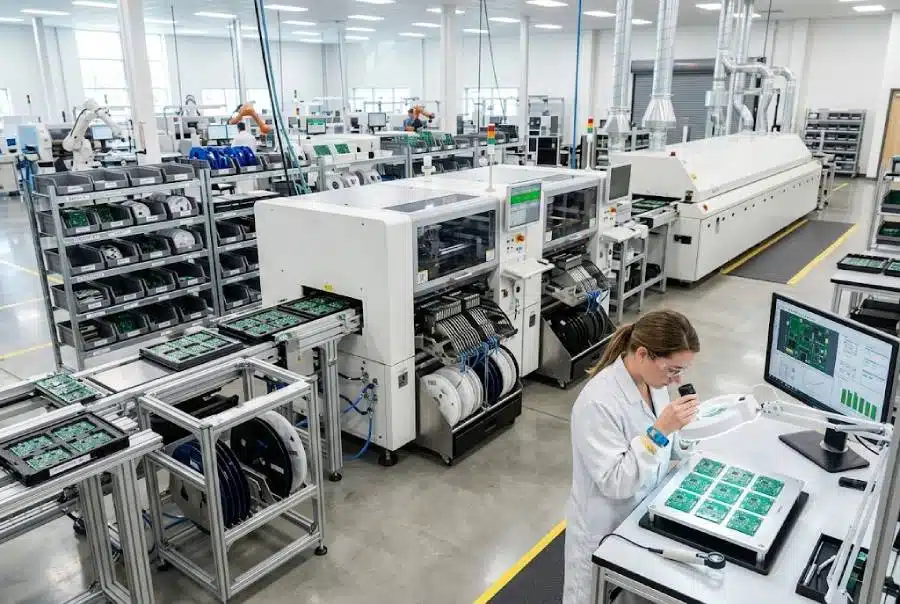
For the manufacturing stage, PCBA quality is critical. Solder joint integrity, component placement accuracy, via reliability, connector assembly, and electrical testing can all influence final VR system performance.
Kingda can be positioned as a manufacturing and engineering partner during this stage, helping integrate PCB considerations into the broader VR product development and manufacturing workflow.
Supply Chain Management for VR Hardware
A stable supply chain is essential for scaling industrial VR production. Delays involving microdisplays, optical components, sensors, processors, batteries, connectors, or custom mechanical parts can interrupt the entire production schedule.
Procurement of Microdisplays and Custom Optical Components
Microdisplays provide the visual foundation of a VR headset. Their resolution, brightness, contrast, response characteristics, power consumption, and availability can significantly affect the final product.
Manufacturers should evaluate suppliers based on:
- Long-term production capacity.
- Component consistency.
- Optical specifications.
- Quality-control procedures.
- Lead times.
- Lifecycle support.
- Engineering-change management.
For custom optical components, early supplier involvement is recommended because lens design, coating specifications, mechanical interfaces, and optical tolerances may require multiple rounds of validation.
Long-term supply agreements can reduce the risk of unexpected component shortages during mass production.
Sensor Procurement and Quality Grading
VR tracking requires fast and synchronized sensor inputs. A typical industrial VR system may combine cameras, inertial measurement units, proximity sensors, depth sensors, and other sensing technologies.
Each sensor should be evaluated according to predefined acceptance criteria.
| Sensor Type | Quality Criteria | VR Application |
| IMU | Bias and drift tolerance | Real-time motion tracking |
| Tracking camera | Image quality and frame synchronization | Spatial tracking |
| Depth sensor | Measurement accuracy | 3D environment mapping |
| Proximity sensor | Detection consistency | User and device interaction |
| Position sensor | Repeatability | Motion and alignment control |
Only components that meet established specifications should proceed to final headset assembly.
A standardized grading system can prevent marginal components from entering production and can help manufacturers maintain consistent tracking performance across large production batches.
Procurement of Industrial-Grade Enclosures
Industrial environments require stronger mechanical protection than typical consumer applications.
When selecting enclosure materials and suppliers, manufacturers should consider:
- Impact resistance.
- Temperature resistance.
- Chemical resistance.
- Dust and moisture protection.
- Dimensional stability.
- Weight.
- Moldability.
- Surface durability.
- Long-term availability.
The main frame may use reinforced engineering plastics or other lightweight structural materials. Experienced injection-molding suppliers can help optimize wall thickness, ribs, bosses, snap-fit structures, and mounting features.
Gaskets and protective covers should also be inspected regularly to ensure that the enclosure maintains its intended environmental protection.
A reliable supply chain ensures that ruggedized industrial VR hardware can be delivered consistently without compromising component quality.
Production-Line Calibration and Testing
Production-line calibration must be standardized and repeatable. Every VR headset should undergo defined inspection and functional testing before shipment.
A robust test strategy should include:
- Optical inspection.
- Display functional testing.
- Sensor calibration.
- Spatial tracking verification.
- Electrical testing.
- Thermal testing.
- Mechanical inspection.
- Final system validation.
Automated Optical Testing Stations
Automated optical test stations can evaluate display characteristics and optical alignment at high speed.
A typical automated inspection workflow can be structured as:
[ Headset Mount ] ──> [ High-Resolution Test Camera ] ──> [ Spatial Analysis Engine ]
                                                          │
                                                          ▼
                                             [ Pass / Fail Decision ]
High-resolution cameras can inspect microdisplay output, image uniformity, brightness, color performance, distortion, and alignment.
Automated software can compare test results against predefined acceptance limits. Products outside the specification can be automatically separated for rework or further investigation.
This approach improves production consistency while reducing dependence on subjective visual inspection.
Calibration of Immersive Tracking and Sensor Arrays
Accurate sensor timing is essential for smooth VR interaction. Multiple cameras and inertial sensors must operate within carefully controlled synchronization parameters.
A standardized calibration process may include:
- Secure the headset on a calibrated motion fixture.
- Establish the mechanical reference position.
- Rotate the device through predefined angles.
- Capture sensor and camera data.
- Compare measured values with reference coordinates.
- Calculate calibration parameters.
- Store the resulting parameters in non-volatile memory.
- Perform a final tracking verification.
A rigid test fixture is important because movement of the headset during calibration can introduce measurement errors.
Accurate calibration helps minimize tracking latency and spatial drift, which are especially important for industrial training and simulation applications.
Thermal Stress and Aging Analysis
Industrial VR equipment may operate continuously for extended periods. Heat generated by processors, display drivers, power-management components, batteries, and other electronic circuits can affect system stability.
Thermal management should therefore be considered during both PCB design and mechanical design.
| Operating Condition | Potential Impact Without Thermal Management | Benefit of Effective Thermal Management |
| Sensor temperature increase | Sensor output may drift | Improved calibration stability |
| Processor temperature increase | Thermal throttling | More consistent processing performance |
| Housing temperature increase | User discomfort and material stress | Better long-term usability |
| Extended operation | Accelerated component aging | Improved component lifetime |
| Temperature cycling | Mechanical expansion and contraction | Better dimensional stability |
Thermal testing should evaluate the complete system rather than individual components alone.
Engineers can use controlled temperature chambers and extended operating cycles to identify potential thermal hotspots and performance degradation.
A properly designed thermal system may include:
- Heat spreaders.
- Thermal interface materials.
- Conductive mechanical structures.
- Heat sinks.
- Ventilation paths where appropriate.
- Optimized component placement.
- Low-resistance thermal paths within the PCB.
Quality Control and Compliance for VR Manufacturing
Quality control becomes increasingly important as production volume increases.
Manufacturers should track key production metrics such as first-pass yield, defect rate, rework rate, field-return rate, and root-cause categories.
First-Pass Yield and Failure-Rate Analysis
A practical production-quality system should identify failures as early as possible.
| Quality Metric | Example Target | Potential Failure Source |
| First-pass yield | >95% | Optical or assembly defects |
| Tracking deviation | <0.1 mm where applicable to the defined test setup | Camera mounting or calibration |
| Display defect rate | Defined by product specification | Panel or driver defects |
| Rework rate | Minimized through process control | Assembly variation |
| Field-return rate | Continuously reduced | Reliability or manufacturing defects |
The exact acceptance criteria should always be defined according to the specific product architecture, test equipment, application requirements, and customer specifications.
Root-cause analysis should be performed whenever recurring failures are detected.
Common causes may include:
- Optical misalignment.
- Loose camera mounts.
- Poor solder joints.
- Connector damage.
- PCB assembly defects.
- Sensor calibration errors.
- Thermal instability.
- Mechanical deformation.
- Component variation.
Maintaining detailed production records allows engineering teams to identify recurring problems and improve the manufacturing process.
Safety Certification and Regulatory Compliance
Industrial VR equipment intended for international markets must comply with applicable electrical, electromagnetic compatibility, wireless, battery, optical, and product-safety requirements.
Depending on the target market and product configuration, manufacturers may need to evaluate requirements associated with:
- CE marking.
- FCC requirements.
- EMC compliance.
- Radio-frequency regulations.
- Battery safety.
- Electrical safety.
- Optical safety.
- Environmental and material regulations.
The exact certification requirements depend on the destination market and the technical characteristics of the product.
Battery insulation and protection circuitry should be carefully evaluated to minimize risks associated with overheating, short circuits, overcharging, and mechanical damage.
Optical systems should also be assessed according to their specific light-source technology. If the product incorporates lasers or other potentially hazardous optical sources, applicable optical safety requirements must be addressed during product development.
Clear compliance documentation helps manufacturers demonstrate that the equipment is suitable for its intended operating environment.
Accelerated Life and Reliability Testing
Industrial VR equipment must withstand repeated use over an extended product lifetime. Accelerated reliability testing can help identify weaknesses before products reach customers.
A comprehensive reliability program may include:
[ Drop Stress Test ] ──> [ Hinge Flex Cycles ] ──> [ Vibration Test ]
                                      │
                                      ▼
                            [ 3D Spatial Accuracy Audit ]
Typical tests may include:
- Drop testing.
- Vibration testing.
- Repeated hinge or strap movement.
- Connector insertion and removal cycles.
- Thermal cycling.
- High-temperature operation.
- Low-temperature operation.
- Humidity testing.
- Long-duration functional testing.
- Optical performance verification.
After mechanical stress testing, the headset should be recalibrated and checked again.
This is particularly important for tracking systems because a device may continue to power on normally while its camera alignment or spatial accuracy has degraded.
Scaling Industrial VR Production
Scaling industrial VR equipment from prototype production to mass manufacturing requires engineering milestones that connect design, manufacturing, testing, and supply-chain management.
A successful scale-up process can include:
Design Validation
Confirm that the optical system, sensors, processor, battery, PCB, enclosure, and software architecture meet the defined specifications.
Manufacturing Validation
Verify that production fixtures, assembly procedures, inspection systems, and test equipment can repeatedly produce compliant products.
Process Optimization
Use production data to identify bottlenecks, reduce rework, improve first-pass yield, and optimize material utilization.
Supply-Chain Validation
Confirm that critical components have stable suppliers, acceptable lead times, and sufficient production capacity.
Final Quality Validation
Ensure that every production unit meets defined optical, electrical, mechanical, thermal, tracking, and functional requirements.
An integrated DFM strategy can reduce manufacturing complexity while improving production efficiency.
For VR products with complex electronics, close coordination between PCB engineering, PCBA manufacturing, mechanical design, optical integration, and final assembly is particularly important.
Kingda can be incorporated into the manufacturing workflow as a PCB and electronics manufacturing partner, supporting the transition from prototype validation toward stable production.
Frequently Asked Questions
How can manufacturers maintain high optical yield during VR headset mass production?
High optical yield depends on controlling the complete optical assembly process. Clean assembly environments, precise mechanical reference points, automated alignment, machine-vision inspection, and standardized calibration procedures can reduce optical defects.
AOI and automated optical testing should be implemented as early as practical so that defects can be detected before expensive downstream assembly processes.
Why does industrial VR equipment benefit from modular design?
Modular design allows individual subassemblies to be tested before final integration. Display modules, sensor arrays, power modules, and mechanical assemblies can be validated independently.
When a defect occurs, technicians can replace the affected module rather than scrapping the entire headset. This reduces repair time, improves production efficiency, and simplifies maintenance.
How should VR tracking arrays be calibrated?
A VR tracking array should be mounted on a stable and calibrated test fixture. The system can then capture sensor data across predefined positions and orientations, compare the results with reference coordinates, calculate calibration parameters, and store the results in the device.
The final product should undergo a verification test after calibration to confirm tracking accuracy and repeatability.
How does thermal testing protect VR hardware performance?
Thermal testing identifies performance degradation caused by elevated temperatures and extended operation.
Excessive heat can contribute to processor throttling, sensor drift, battery degradation, display instability, and accelerated component aging. Proper thermal design combined with controlled environmental testing can improve system stability and product lifetime.
How can manufacturers secure components for large-scale VR production?
Manufacturers should identify critical components early and establish qualified alternative suppliers where practical.
Long-term supply agreements can be useful for high-risk components such as microdisplays, custom optical parts, sensors, processors, connectors, batteries, and specialized electronic components.
Supply-chain planning should be integrated with the product development schedule so that component availability does not become a bottleneck during mass production.
Conclusion
Industrial VR equipment requires much more than high-resolution displays and advanced tracking algorithms. Successful products depend on the integration of PCB design, PCBA manufacturing, optical engineering, mechanical design, thermal management, sensor calibration, automated testing, supply-chain planning, and quality control.
A DFM-oriented development strategy helps manufacturers identify production risks before mass manufacturing begins. Modular architecture simplifies assembly and repair, while automated optical and functional testing improves consistency and production yield.
At the electronic level, a reliable PCB provides the foundation for high-speed communication, sensor integration, power management, and system control. Proper PCB assembly and inspection are equally important for ensuring long-term reliability.
By combining rigorous engineering standards with standardized calibration, reliability testing, and supply-chain management, manufacturers can develop industrial VR equipment that performs consistently in demanding environments.
For companies developing or scaling industrial VR products, Kingda can be integrated into the electronics manufacturing workflow to help bridge the gap between PCB development, prototype validation, and scalable production.