Rigid-Flex PCB Design, Types and Manufacturing Control A rigid-flex PCB joins stiff board sections and bendable circuit sections in one continuous structure. The rigid areas carry connectors and components, while the flexible areas route signals through tight mechanical spaces. This removes separate cables and connectors from many assemblies. The result…
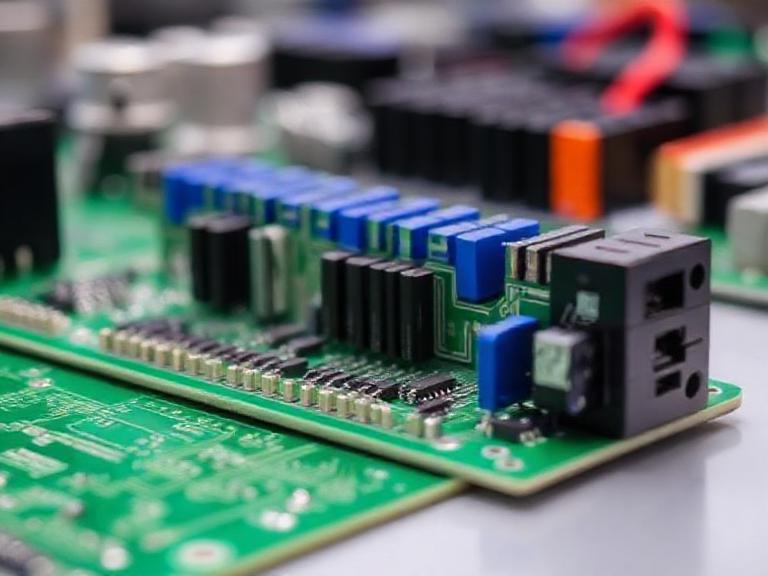
Power Amplifier PCB: Design, Components & Manufacturing A power amplifier PCB carries a small input signal and delivers a much larger one into a real load. That load may be a loudspeaker, an antenna, a motor or an industrial actuator. The board must pass high current, spread heat and keep…
Laser Sensing PCB: Precision, Types and Benefits A laser sensing board fails or succeeds on details that never appear in a sensor datasheet. The optical path, the analog front end, the power rail and the mechanical reference all sit on one substrate. Each choice shifts measurement accuracy in ways a…
DUV LED PCB: Applications, Benefits and Design Deep ultraviolet LEDs emit in roughly the 200 to 280 nm band, a range used for disinfection, photochemistry, and analytical instruments. The board under those LEDs carries the current, spreads the heat, and holds the control circuit together. That makes the DUV LED…
Power Lighting PCB: Types, Benefits and Applications A power lighting PCB carries current to LEDs and moves heat away from them. That second job separates it from a board that only routes signals. High-power LEDs push a large share of their input energy out as heat, and that heat must…
Ceramic PCB: Materials, Benefits and Manufacturing A ceramic PCB uses an inorganic substrate instead of the usual organic laminate. That single change alters how heat moves, how the board behaves at temperature, and how the factory must process it. Engineers turn to ceramic when FR-4 cannot carry the thermal load…
Blind Vias PCB: Design, Manufacturing and Applications A blind via connects an outer layer to one or more inner layers and stops before the far side. That single geometric fact drives most of the design, process and cost decisions around blind vias PCB work. The structure saves routing space, shortens…
Top 16 HDI PCB Manufacturers and How to Vet Them HDI boards pack more routing into less space, so the supplier list matters as much as the design. Microvias, thin dielectrics and sequential lamination leave little room for process drift. A capable factory controls laser drilling, plating and lamination with…
PCB Vias: Types, Drilling Methods and Via Filling A via is a plated hole that connects copper layers inside a printed circuit board. Fabrication drills or laser-forms the hole, then plates it with copper to form a conductive path. Unlike a component hole, a via exists for interlayer connection rather…
PCB Via Plugging: Types and IPC-4761 Classes An open via looks harmless on a drawing. During reflow it can pull solder away from a pad, trap flux, or let contamination reach an inner layer. Via plugging closes that hole with solder mask, resin, or copper, and the choice changes cost,…