
Via Plugging And Mask Filling On PCB
A via that is left open collects flux, solder and contamination during assembly, and the accumulated material can leach out later and cause a defect. The industry has three answers: tent the via with mask, plug it with a resin, or fill it with mask ink. Each produces a different surface and a different level of reliability, and the choice has to be made at the design stage because it changes the fabrication process.
This article explains what each method does, when each is needed, what the requirements are, and how the result is inspected.
Why A Via Is Covered At All
A via has three possible requirements. It may have to be covered so that it cannot be soldered, which matters when the via is close to a pad and could wick solder away from a joint. It may have to be flat so that a component can be placed on top of it, which is the requirement that drives via in pad. Or it may have to be covered so that it does not collect material that will later cause a problem, which is the weakest of the three and the most common.
The electrical function is unaffected in all cases. A via is a connection between layers, and covering it does not change that. What changes is whether anything can enter the barrel and whether the surface is flat enough for the next operation, and the two are separate questions. The structures themselves are described under via in pad or plated through.
Tenting Versus Plugging
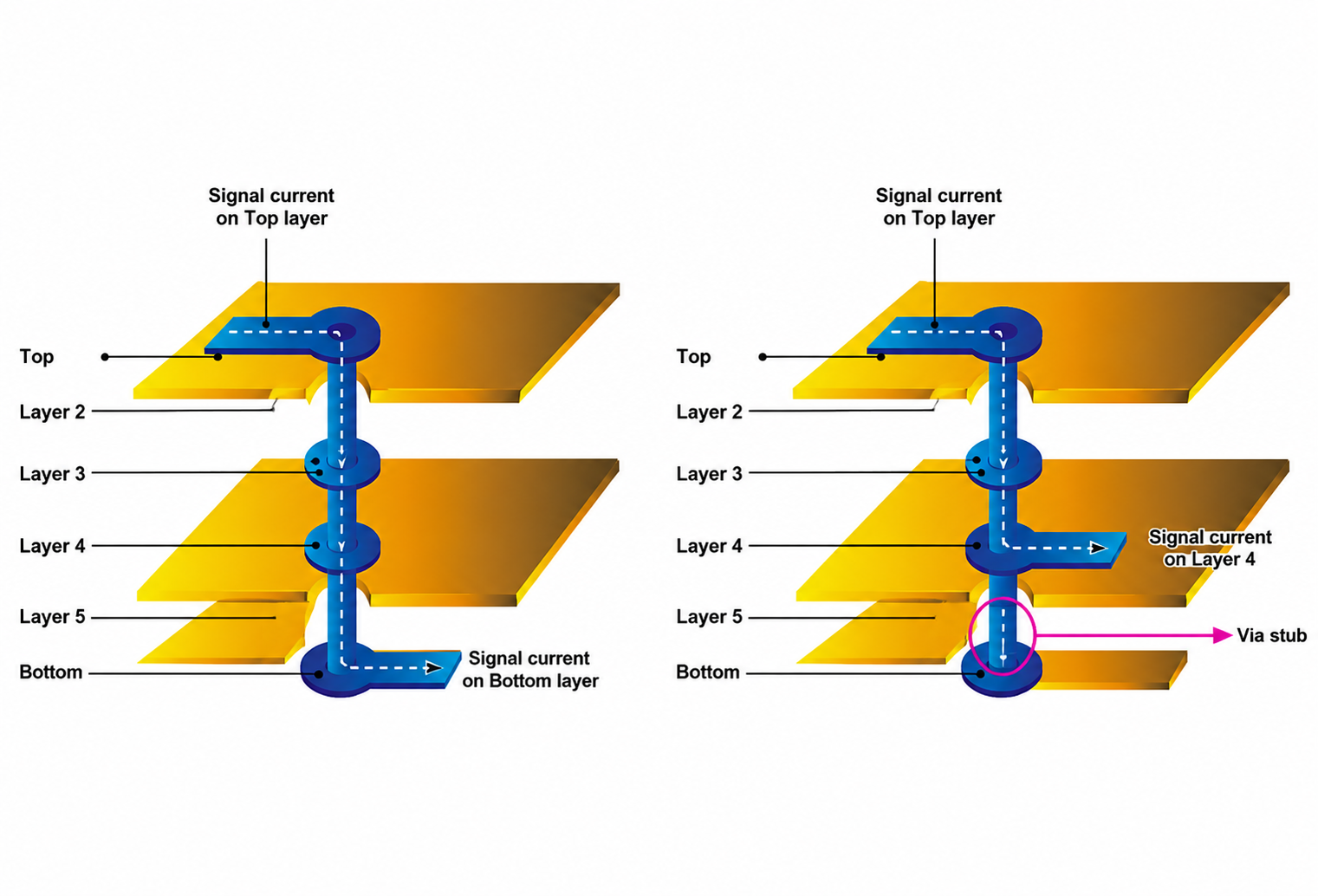
Tenting is the simplest method. A disc of solder mask is printed over the via on one or both sides, and the mask bridges the hole. The barrel is not filled; it is covered. The result is a dome of mask over the hole, which is adequate where nothing has to be placed on top of it and where the via is not on a fine pitch field.
A plug goes further: material is pushed into the barrel and the surface is levelled. The material may be a solder mask ink, a resin, or a conductive or non conductive paste, and the process is a separate operation with a squeegee and a stencil. The result is a via that is filled and flat, and it is the requirement for a via in pad or for a via that sits on a surface where a component has to be placed.
Requirements For A Filled Via
A filled via is specified by three figures. The first is the extent of the fill, usually expressed as a percentage of the barrel depth that must be filled. The second is the planarity, which is the flatness of the surface over the via relative to the surrounding board, typically within a few microns for a via in pad. The third is the coverage, which states whether the fill must be capped by plating or by mask.
A partially filled via is a common failure. Material enters the barrel from one side only, the barrel is bridged but not filled, and the void underneath is later filled with flux or with plating solution. The measurement that catches this is a section, and the requirement has to be stated precisely because a plug that only bridges the hole satisfies a loose specification and fails the application. The plating related processes are described under electroplating and via filling in HDI.
Process And Material Consequences
Plugging with solder mask ink is done as part of the mask process, which is why it is cheap. The ink shrinks as it cures and the surface ends up slightly below the mask around it, and the process cannot fill a large via or a thick board reliably. Plugging with a resin is a separate operation, uses a material chosen for its flow and its coefficient of expansion, and can fill a via properly, at a higher cost and with an additional cure.
The material has to be compatible with everything else. It has to survive the plating chemistry where it is applied before plating, the mask and the reflow where it is applied before assembly, and the coating and the cleaning afterwards. A resin that expands more than the laminate will push the pads apart when it is heated, and a material that is not fully cured will outgas in the reflow oven and produce a void in the joint above it.
Design Rules That Follow
The via diameter and the board thickness determine what can be filled. A small via in a thin board is easy, while a large via in a thick board needs a resin rather than an ink and a process that can push the material into the barrel. As a rule, a via that is to be filled should be no larger than about 0.3 millimetres and the aspect ratio should be within what the process can fill, and the design should keep the pads and the mask clear of the fill area so that the material has somewhere to go.
Where a via is on a pad, the mask opening and the fill requirement interact. A filled via in pad with a mask opening over it that is larger than the pad leaves the fill exposed and it can be lifted by the vacuum of the placement nozzle. The rules that keep the mask and the pads in order are described under manufacturable design guidelines.
Inspection
Inspection depends on the requirement. A tented via is inspected visually for a complete cover and for a mask dome that has not cracked, and the cracks appear as fine lines over the hole after the board has been through reflow. A filled via is inspected for planarity with a surface profilometer or optically, and for completeness by a section on a sample.
The sample section is the only method that shows whether the barrel is filled or merely bridged. It is usually taken from a coupon that carries the same via sizes as the product, and it is the evidence that the process is capable. A production check on every board is not practical, so the process is qualified once and controlled by the parameters afterwards.
Additional Considerations for This Build
Practical attention to via plugging pays for itself here, because it decides whether the finished board behaves as the drawing intended. Where the requirement is not stated on the fabrication drawing or in the assembly notes, the shop has to assume a default, and that default is rarely the value the design was simulated with. Stating via plugging explicitly, together with the tolerance that applies, removes the assumption and keeps the result predictable from batch to batch.
Deliberate attention to mask filling pays for itself here, because it decides whether the finished board behaves as the drawing intended. Where the requirement is not stated on the fabrication drawing or in the assembly notes, the shop has to assume a default, and that default is rarely the value the design was simulated with. Stating mask filling explicitly, together with the tolerance that applies, removes the assumption and keeps the result predictable from batch to batch.
Careful attention to resin plug pays for itself here, because it decides whether the finished board behaves as the drawing intended. Where the requirement is not stated on the fabrication drawing or in the assembly notes, the shop has to assume a default, and that default is rarely the value the design was simulated with. Stating resin plug explicitly, together with the tolerance that applies, removes the assumption and keeps the result predictable from batch to batch.
Process Control and Verification
On a design of this kind, resin plug is the item that decides how the rest of the board is arranged. Where the requirement is not written down, the shop supplies its own default, and the default is chosen for the process rather than for the design. The measurements that matter are the repeatable ones: conductor width and spacing, annular ring, finished hole size, plating thickness and surface finish are all verifiable on a coupon that travels with the panel.
FAQ
Does a tented via leak? It can. A mask dome over a via is thin at the top of the hole and can crack during reflow, and a cracked tent allows flux to enter the barrel. It works for most products but is not a sealed barrier.
Is a plugged via the same as a filled via? In common use the terms overlap, but the specification matters. A plug bridges the opening, while a fill occupies the barrel and leaves a flat surface, and only the second supports a component placed on top.
Can a via be filled before plating? It can, and it is done when the fill has to be flush with the copper for a subsequent plating step. The material then has to survive the plating chemistry and the plating has to adhere to it, which restricts the choice considerably.