Preventing PCBA Manufacturing Data Errors: A Practical Guide
Why Data Accuracy Comes First on the PCBA Line
PCBA manufacturing runs on automated placement lines that can finish an order in hours once production starts, but the speed that makes these lines productive is exactly what makes incorrect data dangerous. Every placement machine, reflow oven, and inspection station simply executes the program and the material list it is given, so a single wrong value loaded at the start of a run is repeated on every board in the batch. In a workshop full of high-value fast automation equipment, the output of an entire order can become defective product before anyone notices, which is why data accuracy is the first thing to protect in PCBA manufacturing.
Most factories still depend on people for loading and inspection at the machine. A technician prepares material trays, an operator loads feeders, another employee copies numbers into the system, and the machine trusts whatever it receives. Daily experience on assembly lines points the same way every time: when data problems appear, the failure usually starts with a manual step such as reading a label, typing a value, or matching a reel to a slot, not with the machine itself.
The cost of a data error is high because it is usually discovered late. When a wrong material tray is installed, the misloaded components may pass through placement and reflow before inspection catches them, leaving a batch of boards that must be scrapped or reworked, a pile of opened components that cannot return to stock, and a delivery date that is missed. When the error sits in the records instead of the components, the damage is quieter but real: a customer audit finds serial numbers that do not match the materials recorded, and confidence in the whole factory drops.
For this reason PCBA manufacturing workshops organize a large part of their pre-production effort around checking the bill of materials before the machines start. The production department reviews the BOM, the material preparation list, and the program files, and production begins only after everything is confirmed normal and the line has reached a stable production effect. Careful as this review is, it still depends on human attention, which is why leading factories add an automatic layer on top of it: an error-proofing system that verifies the setup data a second time with barcodes and software.
Common Sources of Data Errors in SMT Setup
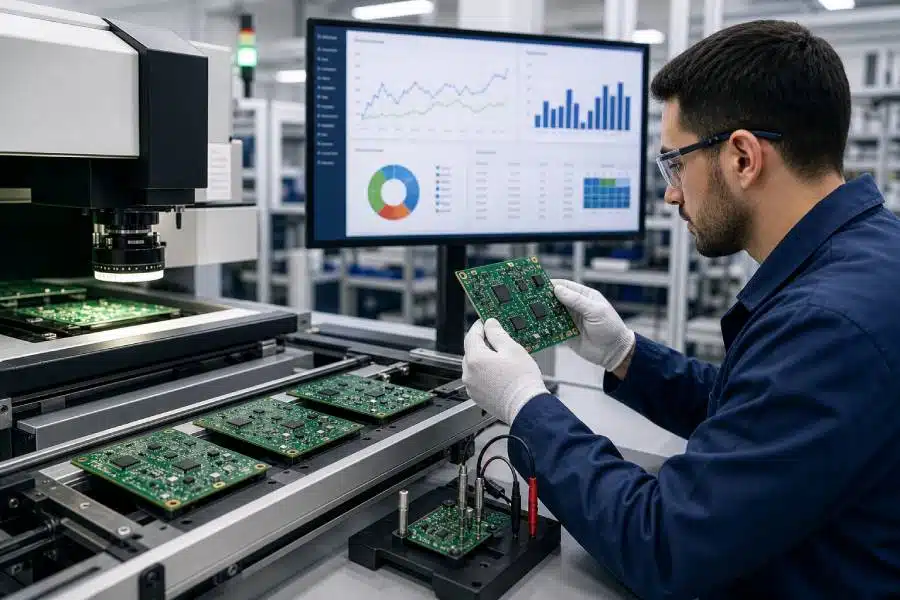
Experience on PCBA manufacturing lines shows that incorrect data usually enters through one of five doors. First, the material identification on the tray is wrong, so the name printed on the label does not correspond to the physical object inside. Second, the material preparation quantity for a reel or coil is wrong, most often insufficient, which forces a stop mid-run or an unplanned changeover. Third, the feeder number that must match a material reel one to one is copied manually, and the copy can be wrong. Fourth, when feeders are pushed into the machine after loading, the placing sequence is incorrect, so the machine reads the right reels in the wrong order. Fifth, and most fundamental, any manual operation can lead to omission at any moment, no matter how experienced the employee is.
All five sources share the same shape: data is transferred by hand between the physical world of trays, reels, and feeders and the digital world of the BOM and the placement program. A second operator checking the first one reduces the rate of errors but does not remove it, and on a busy line with dozens of feeders and hundreds of component values the check is hard to keep complete. The practical answer is not to ask people to be more careful but to make the verification automatic, which is exactly what error-proofing systems are designed to do.
How Error-Proofing Systems Verify the Data
Error proofing in PCBA manufacturing combines hardware and software so that the line verifies instead of assumes. The core tool is barcode technology: every material reel, tray, and feeder position receives a readable code, and the system automatically matches three sets of data, namely the project BOM, the station list of the line, and the materials actually used in the operation. When the three agree, loading is accepted; when they disagree, the mistake is shown immediately instead of being carried into production. This puts a second, tireless pair of eyes on every decision that used to depend on memory, and it works the same way on a small prototype line and on a high-volume SMT PCB assembly line.
The verification covers the data that matters most for setup: the component part number and value printed on the label, the quantity prepared for each material, the feeder number assigned to each reel, and the position of the feeder inside the machine. Because the codes are scanned rather than typed, transcription errors disappear, and because the comparison is done by software, the check is performed in exactly the same way for the first feeder of the day and the last.
Step 1: Import and Validate the Placement Program
The first key step for a PCBA manufacturer is to bring the placement data under the same control as the BOM. The technician imports the position table of the placement machine into the error-proofing system with a single operation, and the system automatically compares it with the BOM held in the database. Any difference, whether a component listed in the BOM but missing from the position table, a part number assigned to the wrong coordinate, or an extra value that has no place on the board, is flagged before a single reel is loaded. Preventing a position table error at this point is cheap; finding it after the first boards come out of reflow is not.
Keeping the comparison meaningful requires the system BOM to be the same document that engineering released. When a revision changes, the master data is updated once, the placement program is imported again, and the validation runs against the new version, so the line can never silently run an old program against a new BOM.
Step 2: Scan and Verify Every Material Loaded
The second key step happens when the production line employees load and receive materials. The operator first scans the station number on the machine with a scanning gun, then scans the barcode labels on the material. The PCBA manufacturing system automatically checks whether the loading is correct by comparing the scanned reel with the material expected at that station for the current program. If the result is wrong, the machine system sounds an alarm and locks the line, and production cannot continue until IPQC confirms the reason and enters a password to release the lock. Employees who try to accept data without this permission trigger the alarm and stop the production line as well.
This step removes the manual copy of the feeder number, because the feeder position is identified by the station scan, the reel identity by the barcode scan, and the pairing is made by software. It also catches a wrong placing sequence: if a feeder that was prepared correctly is pushed into the wrong slot, the station scan no longer matches the expected material and the machine refuses to start. Every scan leaves a record in the system, so when the run is finished the factory can show which reel, from which lot, ran at which station, which is exactly the evidence a quality audit asks for.
Step 3: IPQC Sign-Off on Measured Values
The third key step brings the quality department into the loop. The station that was scanned and confirmed by the production line appears on the IPQC computer, and the system prompts the inspector to check the measured values reported for that station and that material. IPQC sends the measured value data to the system through the bridge connection, and the machine system automatically decides whether the measured values are acceptable against the preset range for the product, instead of leaving the judgment to memory. Confirmed values are stored together with the operator identity, the time, and the station, so the PCBA testing records of the order begin at material loading rather than at the test bench.
The workshop group can start production only after all the measured values for the first material loading have passed the IPQC check. This gate keeps one questionable value from becoming an entire batch of defective boards, and it forces the first article verification to happen before the line is committed. When a material runs out or the product changes, the next loading goes through the same scan, verify, and confirm sequence, and the line starts again only on approved data.
Keeping the Data Clean Beyond Machine Setup
An error-proofing system is most effective inside a factory that keeps the surrounding data clean. The BOM in the database must be the revision actually released by engineering, material labels must carry barcodes that match the physical content, and received quantities should be verified when components enter the warehouse, because a reel with a correct label but a wrong count will still stop the line. All of this starts before assembly: a clean and complete release package from PCB manufacturing gives the assembly system the accurate starting point it needs.
The practical habits are simple: print a barcode for every prepared tray, count reels when they arrive, remove obsolete programs after each engineering change, review the error log every week, and turn every alarm into a short lesson for the operators. Factories that follow them see fewer setup errors, less scrap on first runs, shorter changeovers, and documentation that survives a customer audit, and the pattern holds equally for prototype batches, low-volume orders, and mass production.
How gopcb Protects Data Accuracy on Your Order
gopcb applies the same discipline on its own production lines. Engineering reviews the BOM and the program files before production, materials are scanned against the station list while feeders are loaded, IPQC signs off the measured values of the first loading, and every step is recorded in the order traceability file, so customers receive boards that can be traced back to the exact reel, station, and program that produced them. The whole workflow sits inside the same quality management system that governs our lines from goods in to final inspection.
Whether you need a prototype, a pilot series, or volume production, send gopcb your Gerber files, bill of materials, and expected quantities. The engineering team will check the data, confirm the material and program setup, and quote your boards with the confidence that comes from data verified before the first component is placed. For the entire chain under one roof, combine assembly with turnkey PCB assembly, so your BOM, components, records, and quality data stay consistent from the first part to the shipped unit.