Low Loss PCB Laminate Material: Complete 2026 Engineering Guide
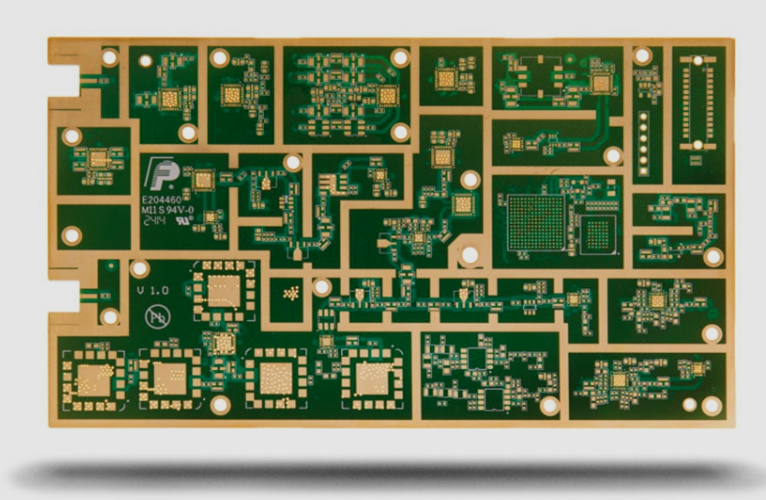
Low loss PCB laminate material is engineered to minimize dielectric loss and signal attenuation at high frequencies — typically with a dissipation factor (Df) below 0.010 at 10 GHz. For 5G mmWave, AI servers running 112G PAM4, and radar systems, ultra-low-loss laminates with Df below 0.002 are now the baseline requirement. This guide covers Dk/Df properties, material families, selection criteria, and practical design tips.
What Is Low Loss PCB Laminate Material?
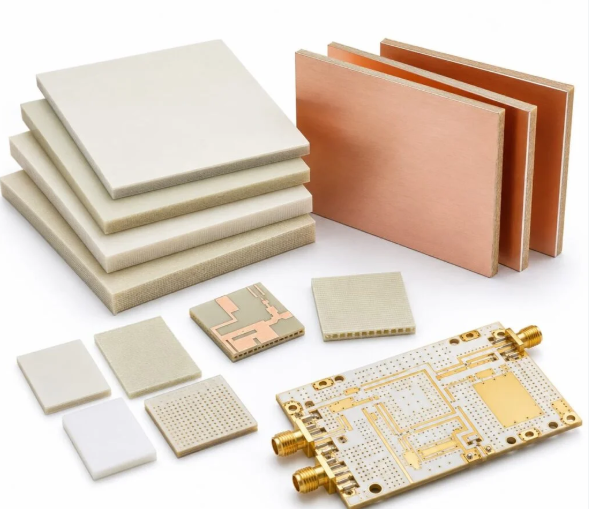
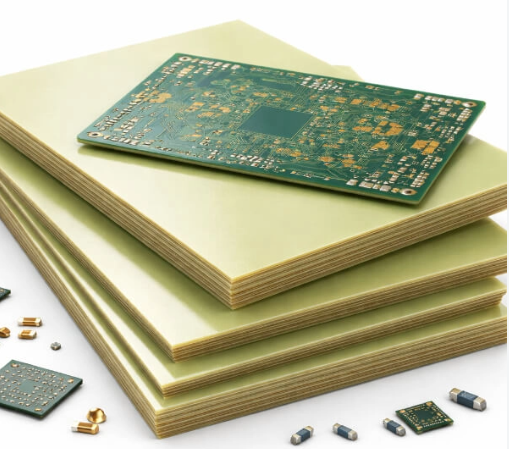
Low loss PCB laminate material refers to copper-clad laminates (CCL) formulated with resin systems — such as polyphenylene ether (PPE), hydrocarbon, or PTFE — that exhibit low dielectric constant (Dk) and low dissipation factor (Df) at high frequencies. Standard FR-4 has a Df of approximately 0.018–0.025 at 10 GHz, generating 1.5–2.0 dB/cm of insertion loss. Low-loss materials reduce this by 5–50×, making them essential for signals above 5 GHz.
Key Material Parameters: Dk, Df, Tg, and CTE
Four parameters dominate low-loss laminate selection: Dk (dielectric constant) determines signal propagation velocity; Df (dissipation factor) measures energy loss; Tg (glass transition temperature) defines thermal reliability; and CTE (coefficient of thermal expansion) affects via integrity under thermal cycling.
Dielectric Constant (Dk)
Low-loss laminates typically have Dk values between 3.0 and 3.8 at 10 GHz. Dk stability across frequency and temperature is more critical than the absolute value — Dk drift causes phase jitter that can kill PCIe Gen 7 links.
Dissipation Factor (Df)
Df is directly proportional to dielectric insertion loss. For 112G PAM4 channels, materials with Df below 0.002 at 28+ GHz are required. For 224Gbps designs, Extreme Low Loss (ELL) materials with Df of 0.0010–0.0018 are now standard.
Thermal Properties (Tg and Td)
AI server boards often have 24–36 layers. High Tg (≥180°C) and high Td (≥350°C) ensure reliability during lead-free reflow and field operation.
| Parameter | Symbol | Typical Range (Low-Loss) | Why It Matters |
|---|---|---|---|
| Dielectric Constant | Dk (εr) | 3.0 – 3.8 @ 10 GHz | Determines impedance & propagation delay |
| Dissipation Factor | Df (tan δ) | 0.001 – 0.010 @ 10 GHz | Directly proportional to insertion loss |
| Glass Transition Temp | Tg | 170 – 280 °C | Thermal reliability during assembly |
| CTE (Z-axis) | CTEz | 30 – 50 ppm/°C | Via reliability under thermal cycling |
Major Low Loss PCB Laminate Material Families
Panasonic Megtron Series
Panasonic’s Megtron family is the industry standard for high-speed digital applications. Megtron 6 (R-5775) uses a PPE resin system with E-glass or low-Dk glass cloth, achieving Dk ~3.4 and Df ~0.002 at 10 GHz. Megtron 6(N) with low-Dk glass achieves Dk 3.40 and Df 0.0015 at 1 GHz, stable up to 50 GHz. Megtron 7 pushes Df below 0.001 for 112G+ applications. For high-volume production, high volume PCB assembly services often specify Megtron 6 as the baseline for 25 Gbps+ designs.
Rogers Corporation Laminates
Rogers offers ceramic-filled hydrocarbon (RO4000 series) and PTFE-based (RO3000, RT/duroid) laminates. RO4350B (Dk 3.48, Df 0.0037 at 10 GHz) is widely used for RF/microwave circuits. RT/duroid 5880 (Dk 2.20, Df 0.0009) delivers the lowest loss but requires specialized processing. For mixed-signal designs, mixed technology PCB assembly combines Rogers RF layers with standard digital layers.
Isola Group Laminates
Isola’s I-Tera MT40 (Dk 3.45, Df 0.0031 at 10 GHz) offers a cost-effective alternative to PTFE. TerraGreen 400G is a halogen-free ultra-low-loss laminate with Df 0.0018 at 10 GHz. Isola materials are frequently specified in 400G/800G switch and AI accelerator designs.
ITEQ Corporation Laminates
ITEQ’s IT-968SE achieves Df of 0.0015 at 10 GHz for 112G+ PAM4 applications. IT-8300GA is an ultra-low-loss, halogen-free material competing with Megtron 7. For SMT PCB assembly, ITEQ materials offer familiar FR-4-like processing characteristics.
Other Key Suppliers
AGC (formerly Nelco) offers Meteorwave 8000 with Df 0.0016 for 800G switches. Nanya’s NPG-198K features Dk 3.37 and Df 0.0015–0.002 at 10 GHz. ACCM launched Celeritas HM001 (Tier 9 loss) and HM50 (negative CTE) in June 2026 for AI accelerator packages.
Low Loss vs. Ultra-Low Loss vs. Extreme Low Loss
The industry uses three tiers: Low-Loss (Df 0.005–0.010) for 10–28 Gbps; Ultra-Low-Loss (Df 0.002–0.005) for 28–56 Gbps; and Extreme Low Loss (Df below 0.002) for 56–112 Gbps+. For 224Gbps PAM4, only ELL materials with Df 0.0010–0.0018 suffice.
| Material | Supplier | Dk @ 10 GHz | Df @ 10 GHz | Tg (°C) | Max Data Rate |
|---|---|---|---|---|---|
| Megtron 6 (R-5775) | Panasonic | 3.4 | 0.002 | 200 | 25 Gbps |
| Megtron 7 (R-5785) | Panasonic | 3.3 | 0.001 | 200 | 112 Gbps |
| Rogers RO4350B | Rogers | 3.48 | 0.0037 | 280 | 40+ GHz |
| Isola I-Tera MT40 | Isola | 3.45 | 0.0031 | 200 | 56 Gbps |
| ITEQ IT-968SE | ITEQ | 3.16 | 0.0015 | — | 112 Gbps+ |
Applications: Where Low Loss PCB Laminate Material Is Required
AI Servers and GPU Accelerators
AI server PCBs running NVLink 5.0, PCIe Gen 6, and 112G PAM4 SerDes require ultra-low-loss laminates with Df below 0.002. T-Glass supply remains critically constrained through 2026 with lead times of 8–14 weeks. For new designs, qualify at least two material options. Turnkey PCB assembly services can help navigate material sourcing challenges.
5G and mmWave Systems
5G mmWave (24–40 GHz) and 6G applications demand ultra-low-loss materials. Rogers RO3003 and RT/duroid 5880 deliver loss tangent of 0.001–0.0013 at 10 GHz. Panasonic XPEDION 1 R-5515 is a halogen-free thermoset for mmWave radar.
High-Speed Digital and Networking
400G/800G switches, optical modules, and high-performance computing (HPC) backplanes use low-loss laminates to meet channel insertion loss budgets. Isola FR408HR remains one of the most frequently specified materials in these applications.
Automotive Radar and Aerospace
Automotive radar (24–77 GHz) and aerospace systems require materials with stable Dk across temperature and frequency. ITEQ IT-8350G is engineered for 24–77 GHz radar applications.
Megtron 6 vs. Rogers 4350B: How to Choose
Choose Rogers 4350B (Dk 3.48, Df 0.0037) for pure RF/microwave circuits above 10 GHz where lowest loss is critical and your design is 2–6 layers. Choose Megtron 6 (Dk 3.71, Df 0.004) for high-speed digital or mixed-signal designs with 8+ layers where multilayer fabrication compatibility and 30–40% lower cost are priorities. At 10 GHz, Rogers 4350B has ~0.22 dB/cm insertion loss vs. ~0.26 dB/cm for Megtron 6 — a difference of ~0.04 dB/cm.
Manufacturing Considerations for Low Loss PCB Laminate Material
Low-loss materials require careful handling. PTFE-based materials need specialized processing with longer lead times. Thermoset low-loss materials (Megtron, Isola, ITEQ) process similarly to FR-4 but require tighter lamination parameters. Copper foil selection matters: HVLP (Hyper Very Low Profile) copper reduces conductor loss caused by skin effect. For prototype PCB assembly, working with a fabricator experienced in low-loss materials is essential to avoid yield issues.
Cost Considerations
Low-loss laminates carry a significant premium over FR-4. Standard FR-4 costs $15–25 per sheet (18×24″); low-loss FR-4 costs $40–80; Rogers RO4350B costs $120–200. PTFE and ceramic-filled materials cost 3–20× more than FR-4. However, for high-speed designs, the material cost is often a small fraction of total board cost — for a complex 20-layer HDI board, the laminate premium may be only 5–10% of total board cost.
Future Trends: 2026 and Beyond
The global high-speed low-loss PCB laminates market is projected to grow from $2.1 billion in 2025 to $7.0 billion in 2032. Key drivers include AI accelerator deployments, 800G/1.6T switches, and 5G/6G infrastructure. ACCM’s Celeritas series (June 2026) introduces negative-CTE materials that reduce board CTE below 10 ppm/C while delivering Tier 9 loss performance at 100+ Gbps. Panasonic continues to push Megtron 7 and next-generation materials with Df below 0.001.
Frequently Asked Questions
What is considered a low loss PCB laminate material?
A low loss PCB laminate typically has a dissipation factor (Df) below 0.010 at 10 GHz. Ultra-low-loss materials have Df below 0.005, and extreme low loss (ELL) materials have Df below 0.002.
What is the difference between Dk and Df?
Dk (dielectric constant) measures how much a material slows signal propagation. Df (dissipation factor) measures how much signal energy is lost as heat. Both are critical for high-frequency performance.
Is Megtron 6 better than Rogers 4350B?
It depends on the application. Rogers 4350B offers lower loss and tighter Dk tolerance for RF/microwave designs. Megtron 6 offers better multilayer compatibility and lower cost for high-speed digital designs.
Why can’t I use FR-4 for high-speed designs?
FR-4 has high Df (0.018–0.025 at 10 GHz) causing 1.5–2.0 dB/cm insertion loss. At 10 GHz on a 15 cm trace, FR-4 loses 22–30 dB — consuming the entire channel budget.
What is the cheapest low loss PCB laminate material?
Low-loss FR-4 variants (e.g., Isola I-Speed, ITEQ IT-150DA) offer the most cost-effective entry point with Df of 0.006–0.008.
Key Takeaways
- Low loss PCB laminate material is defined by Df below 0.010 at 10 GHz, with ultra-low-loss below 0.005 and extreme low loss below 0.002.
- Panasonic Megtron 6, Rogers 4350B, Isola I-Tera MT40, and ITEQ IT-968SE are the leading material families in 2026.
- AI servers running 112G PAM4 require Df below 0.002 — Megtron 7, T-Glass, or I-Speed CAF are the minimum viable options.
- Material selection balances electrical performance (Dk/Df), thermal reliability (Tg/CTE), manufacturability, and cost.
- Always specify HVLP copper with ultra-low-loss cores to minimize conductor loss.
- For new designs, qualify at least two material sources to mitigate supply constraints.
Need help selecting the right low loss PCB laminate material for your next high-speed design? Contact gopcb for free technical consultation, DFM analysis, and quick-turn prototyping — no minimum order quantity required.