Rogers 4350B PCB: Properties, Stackup and Cost Guide
Rogers 4350B has become the default laminate for a large share of RF, microwave and millimeter wave work, because it holds a stable dielectric constant, keeps loss low and still laminates like a conventional material. The catch is price: the raw sheet costs several times what FR-4 does, and every process step around it follows the same direction. This guide covers what the material actually delivers, how a stackup is built around it, and where the money goes.
What Rogers 4350B Actually Is
Rogers 4350B is a ceramic filled hydrocarbon thermoset laminate. Ceramic filler raises the dielectric constant to a predictable value and keeps it stable over frequency and temperature, while the hydrocarbon resin keeps loss low. That combination is what separates it from ordinary FR-4, whose epoxy resin absorbs energy at microwave frequencies and whose dielectric constant drifts with temperature and humidity.
The headline numbers are a dielectric constant of about 3.48 at 10 GHz and a dissipation factor near 0.0037, measured with the standard clamped stripline method. Glass transition temperature exceeds 280 degrees Celsius, so the material survives lead free reflow and repeated assembly cycles without the dimensional movement that would ruin impedance. It is available with standard copper weights and is compatible with conventional subtractive processing.
Electrical Properties That Drive the Choice
Loss in a transmission line comes from conductor loss and dielectric loss. Above a few gigahertz the dielectric term dominates, which is why the dissipation factor matters more than the copper profile. A laminate with a dissipation factor of 0.0037 dissipates roughly an order of magnitude less energy than FR-4 at 0.02, and that difference shows up directly in insertion loss and eye height on a long channel.
A stable dielectric constant matters just as much because trace geometry is designed around it. If the value moves with temperature or panel position, the impedance moves with it and the return loss suffers. Rogers 4350B keeps the value close to 3.48 across a wide band, so a single trace width can serve multiple bands, and impedance control can be held within a few percent rather than a broad tolerance band.
Stackup and Fabrication Considerations
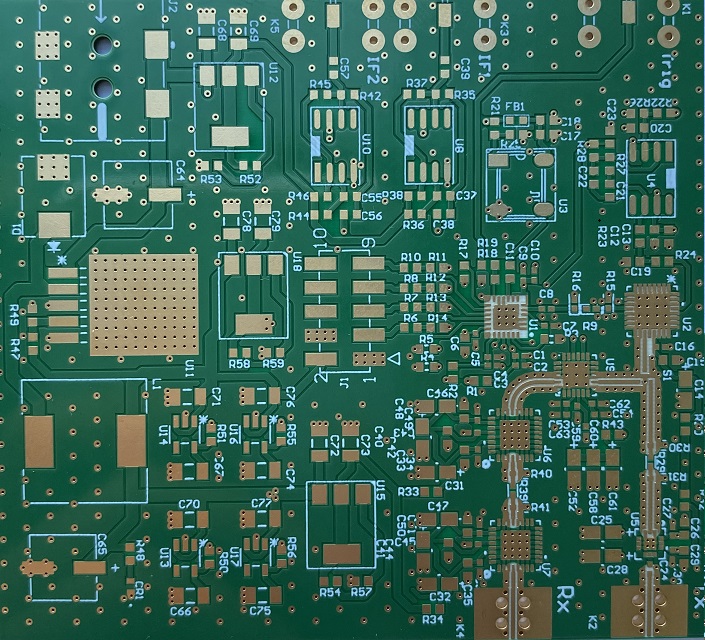
The material is normally used in a hybrid stackup, with Rogers 4350B carrying the RF layers and FR-4 forming the rest of the board. That keeps the expensive dielectric only where the radio needs it, and it also reduces the mechanical mismatch between a soft high frequency core and the rigid rest of the structure. Mixed dielectric builds need care at the lamination stage, since different resins flow at different rates and any unbalanced copper will show up as warp. Stack planning rules that apply to these mixed builds are collected in multilayer design rules.
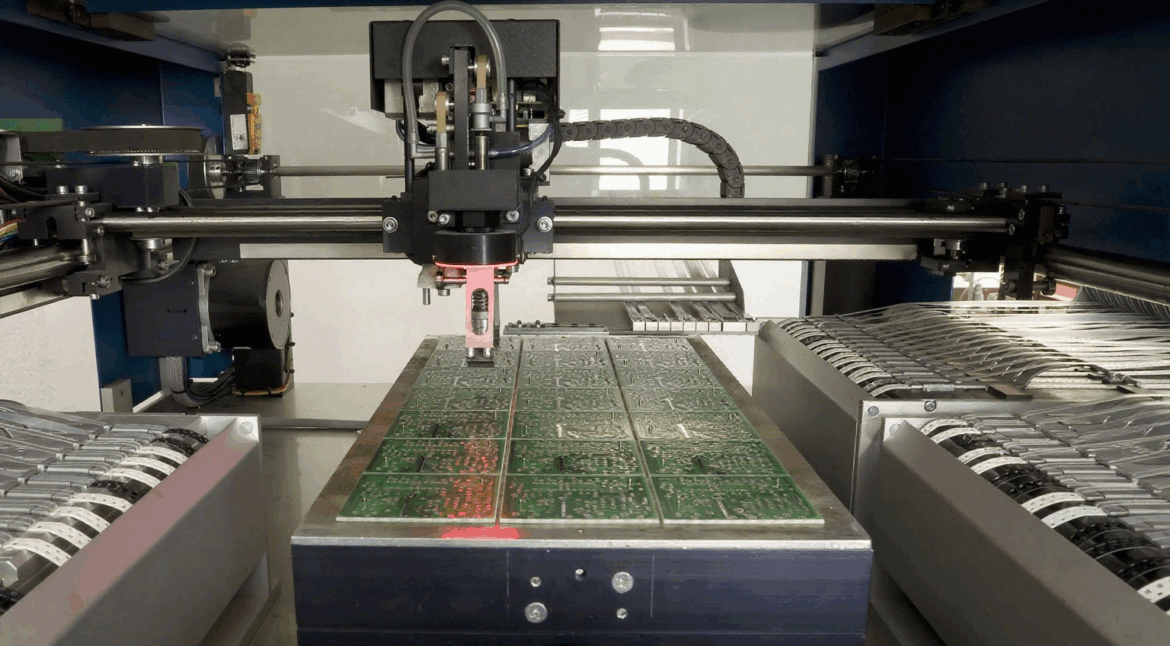
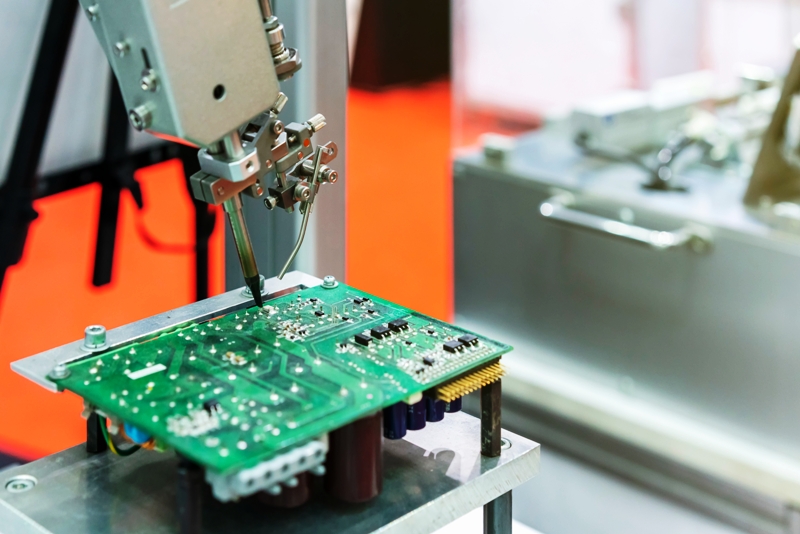
Processing follows familiar steps with tighter controls. Drilling parameters are adjusted for the filled resin, which is more abrasive than FR-4 and wears tools faster. Depth control on back drilling and press fit holes needs attention, and panel plating must be uniform enough to keep skin effect losses predictable. Because the dielectric is sensitive to moisture, baking before lamination is not optional, and impedance coupons are usually placed on every panel rather than on a sample basis.
Where the Cost Comes From
The raw material is the first driver. A sheet of Rogers 4350B costs roughly four to six times as much as the equivalent FR-4 core, and that premium flows straight into the quoted price. Layer count compounds it: a two layer board typically lands between 250 and 400 dollars per square meter, a four layer between 450 and 650, and a six layer between 600 and 850. Boards that need controlled impedance on every signal layer sit at the top of those ranges, a trade-off analysed in low cost signal quality improvements. Simple single layer RF panels sit lower, around 150 to 300 dollars per square meter.
Secondary drivers add another 20 to 50 percent on some orders. Moving from one ounce to two ounce copper raises cost by 15 to 30 percent. Electroless nickel immersion gold adds 25 to 40 dollars per square meter over immersion tin. Impedance control adds 10 to 20 percent because of engineering time and test coupons, and tight tolerance requests lengthen the production cycle. Engineering and design preparation fees of 50 to 200 dollars, tooling of 80 to 300 dollars and RF test reports of 30 to 100 dollars per report are frequently quoted separately instead of being bundled.
Regional Cost Comparison
Geography changes the number more than most buyers expect. For a four layer Rogers 4350B board, typical pricing runs 450 to 650 dollars per square meter in China with a 7 to 10 day lead time, 650 to 950 dollars in the United States with 10 to 14 days, and 700 to 1100 dollars in Europe with 12 to 18 days. The gap reflects labor, material logistics and the smaller number of shops that hold the material in stock.
Volume changes it too. Orders large enough to justify a dedicated panel and a fixed lamination cycle can see discounts up to about 25 percent, and material purchased for a planned production run is far cheaper per square meter than a one off prototype built from a cut sheet. Freight, duties and compliance documentation can add another 10 to 15 percent, which is easy to overlook when comparing quotations from different regions.
Reducing Cost Without Losing Performance
The single most effective lever is the hybrid stackup described earlier, which can remove 20 to 35 percent of material cost by confining the low loss laminate to the layers that carry RF. Panel utilization comes next: nesting more circuits per panel, or resizing the board to fit a standard panel, can save 50 to 100 dollars per panel on a dense design. Substituting immersion tin or immersion silver for ENIG saves 20 to 40 dollars per square meter as well, provided the assembly process allows it.
Design discipline pays repeatedly. Reusing one validated stackup and via scheme across several products removes a layer of engineering and first article cost, and keeping the RF section compact limits both material area and the number of impedance controlled layers. A fabrication partner such as gopcb can usually identify further savings during a DFM review by adjusting panel size, copper balance and surface finish before tooling is committed, which is far cheaper than changing them after the first build.
When 4350B Is the Wrong Choice
Rogers 4350B is not automatically the answer. Below roughly 3 GHz, and on digital channels with a generous loss budget, a high Tg FR-4 with controlled impedance will pass the same compliance tests at a fraction of the cost. The material earns its premium when the channel is long, the frequency is high, or phase stability across temperature matters, as it does in phased array feeds and radar front ends. It is also a poor fit for designs that need thick copper for current, because other laminates handle heat at lower cost.
FAQ
Is Rogers 4350B suitable for 5G and radar work? Yes. It is widely used for antenna arrays, radar sensors, filters and power amplifiers, where its low dissipation factor and stable dielectric constant keep loss and phase behavior predictable.
Can Rogers 4350B be mixed with FR-4 in one board? Yes, and hybrid builds are common because they cut cost substantially. They do require a controlled lamination cycle, balanced copper and a validated stackup to avoid warp and signal degradation.
What is a typical lead time? Around 7 to 10 working days in China for a standard four layer board, extending to 10 to 14 days in the United States and 12 to 18 days in Europe, with expedited service available at extra cost.