Megtron 6 PCB: Material Properties and Cost Drivers
Megtron 6 sits in the top tier of high speed laminates, used where 25G, 56G and 112G channels have to cross a backplane or a switch card with enough margin left for the rest of the link budget. It achieves that with a very low dissipation factor and a resin system that keeps the dielectric constant steady, but it costs several times more than FR-4 and it takes longer to process. This article explains the material, the stackups it enables, and the cost structure behind a quotation.
What Megtron 6 Is
Megtron 6 is a modified polyphenylene ether laminate from a Japanese supplier, available in a range of core and prepreg thicknesses. Its dissipation factor is around 0.002 and its dielectric constant about 3.4, which places it alongside the better Rogers materials electrically while offering a resin system that laminates more like a conventional board. Glass transition temperature is high enough for lead free assembly and for the multi stage press cycles used in high layer count builds.
The material is usually paired with ultra flat glass cloth. Standard woven glass creates a periodic bump in the dielectric constant along a trace as it passes over and between bundles, which spreads propagation delay and shows up as jitter on very fast channels. Flattened glass reduces that variation, and on 112G designs the glass weave effect is often a larger contributor to jitter than loss itself.
Where the Electrical Advantage Comes From
Channel loss is dominated by the dielectric as frequency rises, so the dissipation factor sets the practical reach of a link. At 0.002, Megtron 6 loses far less energy than FR-4 at roughly 0.02, and the difference is enough to extend a 56G channel by several inches without adding a retimer. Lower loss also translates into higher eye height at the receiver, which gives the designer margin for connectors, vias and cables elsewhere in the path.
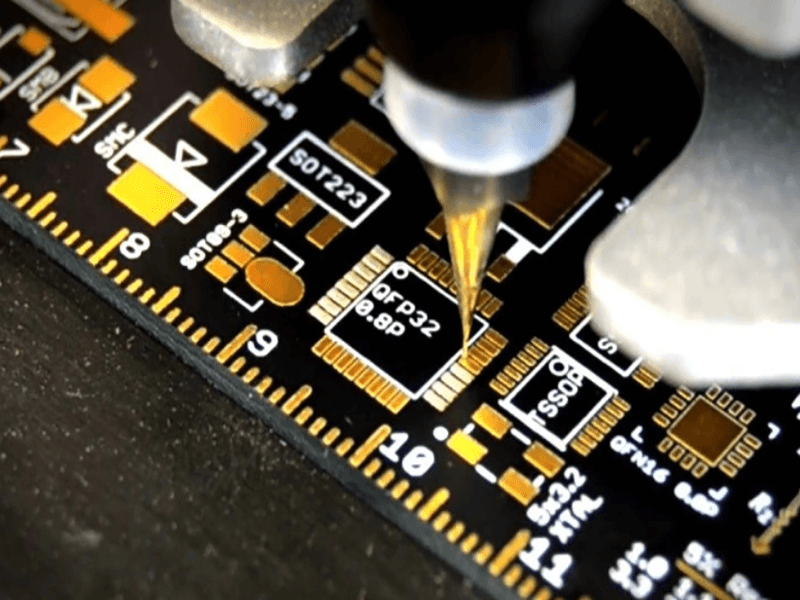
A stable dielectric constant supports impedance control, because trace width is calculated from the value and any drift moves the impedance away from its target. Megtron 6 holds its value across frequency and temperature closely enough that a single geometry serves multiple channels, and a well controlled stackup can be held within a few percent rather than a broad window. That predictability is a large part of why the material appears on designs with hundreds of differential pairs.
Stackups the Material Enables
Typical high speed builds use 8 to 20 layers with Megtron 6 on the signal layers and a lower cost laminate for power and ground. This hybrid stackup keeps the expensive dielectric where it is needed, since a plane layer does not need low loss to do its job; the same principle is applied in EMI reduction through stackup and layout. Where density demands it, the design may also use stacked microvias and buried vias, which is where the fabrication difficulty rises sharply, and the trade-offs are set out in blind and buried via stack selection.
Layer count and via technology drive both yield and cost. An eight layer board with stacked microvias is far more expensive to build than a twelve layer through via design with the same electrical performance, because each additional lamination cycle and laser drilling step adds handling and yield risk. Designers should confirm that the density is genuinely required before committing, since removing a stack of microvias often saves more money than any material substitution.
Where the Cost Comes From
Material cost is the first line item. Megtron 6 laminate and prepreg typically run 80 to 120 dollars per square meter, against 10 to 30 dollars for ordinary FR-4, and with prepreg and copper the material set for a build usually lands between 200 and 400 dollars per square meter. Flattened glass adds another 20 to 30 percent on top of the base laminate price.
Processing adds more. Laser drilling for microvias below 75 microns runs about 50 to 100 dollars per batch, high temperature multi stage lamination adds roughly 20 to 50 dollars per square meter, and the extended test programme of impedance measurement, X-ray and thermal reliability adds 80 to 150 dollars per batch. Yield on complex high speed builds runs five to ten percent below a comparable FR-4 product, and that risk is priced into every quotation.
Regional Pricing and Real Quotations
For a four layer impedance controlled prototype with ENIG finish, expect roughly 150 to 250 dollars per square meter in China, 250 to 400 in the United States and 300 to 450 in Europe. A six layer board with buried vias moves to about 200 to 400 dollars in China, and an eight layer HDI design with stacked microvias to 350 to 600 dollars, again lowest in China and highest in Europe. Lead time follows the same pattern: about 7 to 10 working days in China, 10 to 14 in the United States and 12 to 16 in Europe.
Quotations should also be checked for items that are often excluded. Stackup simulation and review may be billed at 50 to 150 dollars, additional impedance or test coupons at 30 to 60 dollars, ENEPIG finish at 0.10 to 0.30 dollars per square inch, and tooling or set up charges of 100 to 300 dollars on small batches. Import duties and compliance documentation add further cost on cross border orders, so the total landed price on a high speed PCB order is the only figure worth comparing.

Reducing Cost Without Losing Performance
A hybrid build is the most reliable lever, removing 100 to 200 dollars per square meter by reserving the low loss material for signal layers only. Standardising one stackup and one via scheme across several projects removes engineering and first article cost each time, and a disciplined HDI review that eliminates unnecessary stacked microvias can save 50 to 150 dollars per board on its own. Panel utilisation matters as well, because nesting several circuits and running them together raises yield.
There is also a material choice decision to make. Rogers 4350B costs less than Megtron 6 and performs well on RF and microwave boards, but it is a poorer fit for long multi gigabit digital channels where flattened glass and very low loss are the priority. Megtron 6 is the better choice for switch fabrics, accelerator cards and backplanes, while a lower grade low loss material is often sufficient for 25G links, and the stackup rules behind those choices appear in multilayer PCB advantages for high speed. A fabricator such as gopcb can usually model both options against the link budget and recommend the cheaper one that still passes.
Test and Qualification Requirements
A high speed PCB built on this laminate is not finished when the copper pattern is correct. Impedance coupons are measured on every panel, insertion loss and return loss are characterised on test vehicles that reproduce the real channel, and the results are compared with the design target before the batch is released. On 112G projects it is common to request eye diagram data as well, because loss alone does not capture the skew and jitter that glass weave and via stubs introduce.
Qualification also covers reliability. Thermal cycling, interconnect stress testing and reflow simulation confirm that vias and laminate survive assembly and field conditions, and cross sections verify dielectric thickness, registration and plating quality. These steps add cost, yet they are what allows a high speed PCB design to be released to production without discovering a signal integrity problem after a thousand boards have already been built.
FAQ
Is Megtron 6 suitable for millimeter wave and 77 GHz radar? Yes. Its low dissipation factor and stable dielectric constant make it a good fit for automotive radar and millimeter wave front ends, provided the stackup and via transitions are designed to match.
Is there a cheaper alternative? For RF and microwave boards, Rogers 4350B is less expensive and performs well. For long high speed digital channels, a mid grade low loss laminate is often sufficient at lower cost, so the choice should follow the loss budget.
Does Megtron 6 require special processing? It needs controlled lamination at higher temperature, adjusted drilling parameters, and tighter process discipline than FR-4, plus impedance coupons and extended electrical testing on high speed builds.