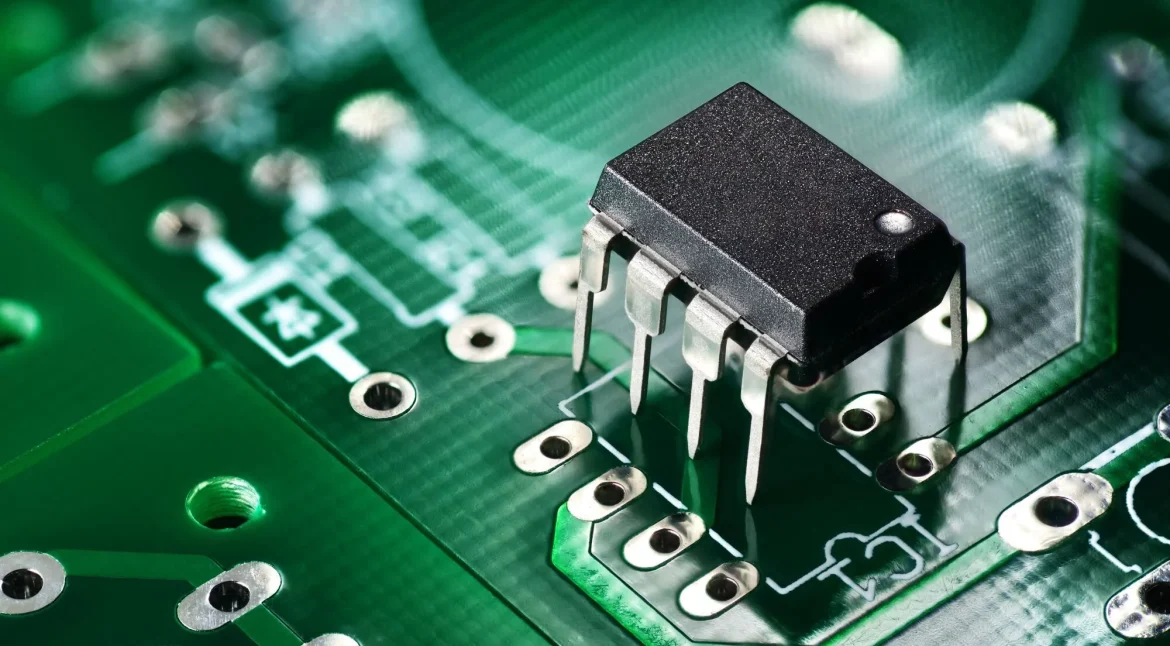
PCB Fabrication Design Rules: Minimum Features and CAM Checks Every design rule in a CAD tool has a counterpart in the fabricator’s process, and where the two disagree the process wins. A trace narrower than the etching process can hold is not a thin trace; it is an open circuit.…

Layout Review Checklist: Placement, Ground and Decoupling Most layout mistakes are not exotic. They are the same ones that appear in every design review: a part that cannot be replaced, a decoupling capacitor too far from its device, a ground that was never thought about, a connector that collides with…
Avionics PCB: Standards, Materials and Reliability Requirements An avionics board carries the functions that keep an aircraft flying and the people inside it safe, and it does so in an environment that combines vibration, altitude, temperature extremes and a service life measured in decades. The design rules are not exotic,…
EMI Control in Digital Circuits: Layout Techniques Digital circuits are the most common source of electromagnetic interference on a modern board, and they are also the least obvious one. A clock line carries a square wave with fast edges, and a fast edge contains energy at frequencies many times the…
How to Choose PCB Design Software for Your Team Every PCB design software package on the market can draw a board, so the choice cannot be made on feature lists alone. What separates tools in daily use is how they handle the tedious parts: keeping the footprint library consistent, catching…
X-Ray Inspection for PCB Fault Detection As packages have moved from visible leads to hidden solder balls, optical inspection has lost its grip on the most critical joints on the board. A ball grid array hides every connection beneath the package, and a through-hole barrel is buried inside the laminate.…
Ringing, Crosstalk and Reflections: Signal Integrity Fixes Signal integrity stops being a background concern the moment edge rates get short enough that a trace behaves like a transmission line rather than a wire. Above that point the geometry of the routing decides whether a receiver sees a clean edge or…
PCB Design Basics: Libraries, Placement, Routing and Checks PCB design is easy to start and difficult to finish well. The tool will accept any arrangement of parts and any route that does not violate the rules it has been given, and the judgement about whether the result is good belongs…
5-Layer PCB Price: Stackup, Adders and Quantity A five layer board is an unusual choice, and that is the first thing to understand about its price. Most designs use an even number of layers for a reason that has nothing to do with electrical performance: a symmetric stackup laminates flat,…
Single-Sided PCB Price: Substrate, Finish and Volume A single-sided board is the cheapest way to build a circuit, and in large volumes it is remarkably cheap indeed. Components mount on one side and copper runs on the other, so there are no plated holes to drill, no inner layers to…