BMS PCB Requirements for Electric Vehicle Battery Management Systems
Battery Management Systems (BMS) are critical components in electric vehicles, responsible for monitoring battery status, managing charging and discharging processes, balancing individual battery cells, and ensuring overall battery safety. As electric vehicle technology continues to advance, BMS systems require printed circuit boards with higher reliability, precision, integration, and environmental resistance.
The PCB used in a BMS must operate reliably under challenging conditions, including extreme temperatures, humidity, continuous vibration, electrical noise, and long service cycles. Therefore, advanced manufacturing technologies and strict quality control are essential for producing reliable BMS PCB solutions.
Strict Reliability Requirements for BMS PCB
Electric vehicles operate in complex environments where temperature fluctuations, mechanical vibration, and electrical stress can significantly affect electronic components. A BMS PCB must maintain stable performance throughout the vehicle’s lifetime.
During PCB material selection, thermal expansion characteristics must be carefully considered to ensure compatibility between the PCB substrate and electronic components. Proper matching of thermal expansion coefficients helps prevent solder joint cracking, copper trace damage, and connection failures caused by repeated temperature changes.
In low-temperature environments, PCB materials must maintain sufficient mechanical strength and flexibility to reduce the risk of cracking or structural failure. At the same time, vehicle vibration places continuous stress on solder joints and PCB structures, requiring excellent mechanical durability.
Advanced PCB Manufacturing Services ensure that suitable materials, precise fabrication processes, and strict inspection procedures are applied to improve long-term reliability. PCB Manufacturing Services
High-Precision Measurement and Control Requirements
A BMS must accurately monitor key battery parameters, including voltage, current, temperature, and charging status. The accuracy of these measurements directly affects battery performance, safety, and lifespan.
For example, when measuring the voltage of individual battery cells within a battery pack, measurement errors must be controlled at the millivolt level. This requires highly reliable circuit design, precise signal transmission, and effective noise reduction technology.
PCB layout plays an important role in achieving accurate measurements. Signal circuits must be carefully separated from high-power circuits to minimize electromagnetic interference. Proper grounding strategies, signal isolation methods, and optimized routing structures help maintain signal integrity.
For advanced automotive applications, Automotive PCB Manufacturing requires careful control of material selection, stack-up design, impedance control, and manufacturing precision to achieve stable electrical performance. Automotive PCB Manufacturing
In addition, battery balancing circuits require optimized component placement and effective thermal management to ensure stable operation during long-term charging and discharging cycles.
High Integration and Thermal Management Requirements
Modern BMS solutions integrate multiple functions, including battery monitoring, fault diagnosis, communication interfaces, protection circuits, and power management. As more functions are integrated into smaller spaces, PCB designs face increasing challenges related to routing density and heat dissipation.
A high-performance Battery Management System PCB must support compact layouts while maintaining reliable electrical separation between different functional modules.
Advanced PCB technologies such as multilayer structures and HDI solutions enable engineers to achieve higher wiring density within limited board space. These technologies provide more routing flexibility and support complex electronic systems requiring compact designs. HDI PCB Manufacturing
Thermal management is another important consideration. During operation, power components and control circuits generate heat that can affect PCB reliability. High thermal conductivity materials, optimized copper distribution, thermal vias, and efficient heat dissipation paths help maintain stable operating temperatures.
For demanding automotive electronics, multilayer PCB structures can separate power, ground, and signal layers, improving both thermal performance and electrical stability. Multilayer PCB Manufacturing
Electromagnetic Compatibility Requirements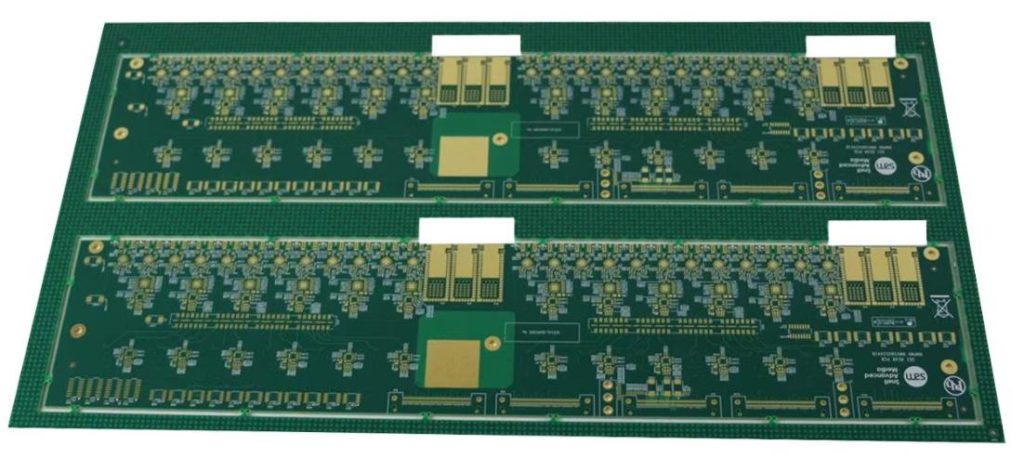
Electric vehicles contain many sources of electromagnetic interference, including motors, power converters, wireless communication modules, and high-current electrical systems. A BMS PCB must not only prevent interference between internal circuits but also resist external electromagnetic disturbances.
To improve electromagnetic compatibility (EMC), PCB manufacturers apply multiple design and manufacturing techniques:
- Separating high-power circuits from sensitive signal circuits
- Optimizing PCB grounding structures
- Adding filtering circuits to power and signal lines
- Using shielding solutions for sensitive electronic components
- Controlling signal impedance and transmission paths
A carefully designed PCB stack-up helps maintain stable signal transmission and reduces electromagnetic interference risks. Controlled impedance structures are especially important for automotive communication and high-speed electronic systems. Controlled Impedance PCB Manufacturing
Advanced PCB Solutions for BMS Applications
As electric vehicles move toward higher energy density, faster charging speeds, and smarter battery management, BMS systems require PCB solutions with stronger reliability and higher manufacturing precision.
A reliable BMS PCB manufacturing process should include:
- Advanced material selection
- Precise multilayer fabrication
- High-density interconnection technology
- Thermal management optimization
- Electrical testing and inspection
- Strict process control
By combining advanced manufacturing capabilities with engineering expertise, PCB manufacturers can provide stable solutions for electric vehicle battery systems, energy storage systems, and other high-reliability applications.
GOPCBA provides advanced PCB solutions supporting multilayer PCB, HDI PCB, high-reliability PCB, automotive electronics PCB, and other complex circuit board requirements for modern electronic applications. GOPCBA PCB Capabilities
Conclusion
The performance and safety of electric vehicle battery systems depend heavily on PCB reliability and manufacturing quality. BMS PCB designs must meet demanding requirements for environmental durability, measurement accuracy, integration density, thermal performance, and electromagnetic compatibility.
Through advanced materials, precision manufacturing processes, and comprehensive quality control, high-performance PCB solutions can help ensure safer, more efficient, and longer-lasting electric vehicle battery systems.