CEM-1 PCB Material: Properties and When to Use It
CEM-1 occupies a middle ground that many designers never consider and many buyers should. It is cheaper than FR-4, far more robust than FR-2, and punchable in a press rather than drilled, which makes it the material of choice for a whole class of single-sided control boards produced in volume.
What CEM-1 Actually Is
A CEM-1 PCB is a composite laminate. Its core is a paper-based substrate impregnated with resin, and its two outer faces are reinforced with woven glass cloth. The result is a board that behaves mechanically like a glass-reinforced material on the surface while costing close to a paper-based one.
That construction is the source of both its strengths and its limits. The woven glass faces give the board resistance to moisture and to the mechanical abuse of handling and assembly, while the paper core keeps the price low. It is not, however, a substitute for FR-4 in demanding applications.
Composite Construction and the Glass Surface
The glass cloth on each face carries the copper foil, and the paper core provides thickness and rigidity. Because the surface is glass-reinforced, adhesion of the copper and of the solder mask is closer to FR-4 than to a paper-only material, and the board resists the humidity that attacks unsealed paper laminates.
Thickness availability is broad, from thin panels used for simple controls to thicker boards that can carry a moderate number of through-hole parts without flexing. The material is typically supplied with a natural or slightly translucent appearance under the mask.
CEM-1 vs FR-4 vs FR-2
FR-2 is the cheapest laminate, based on paper with a phenolic resin, and it is suitable only for the simplest single-sided boards where cost dominates. It absorbs moisture, it is dimensionally unstable under heat, and it cannot tolerate the thermal shock of wave soldering without care.
FR-4 is the opposite end of the range, a fully woven glass epoxy laminate with excellent mechanical and electrical stability and a price to match. CEM-1 sits between them: better than FR-2 in moisture resistance, thermal stability and mechanical strength, and cheaper than FR-4 while remaining compatible with standard single-sided and simple double-sided processes.
Electrical Properties and Dielectric Strength
The dielectric constant of CEM-1 is comparable to FR-4, so impedance calculations for simple boards do not change dramatically. Dielectric strength is adequate for consumer and appliance products operating at mains voltage with proper creepage and clearance.
Tracking resistance is the parameter to watch where the board carries high voltage. Moisture absorbed by the paper core can reduce surface resistance and promote tracking, so conformal coating is often specified for boards used in humid environments or in appliances exposed to condensation.
Punchability and Mechanical Processing
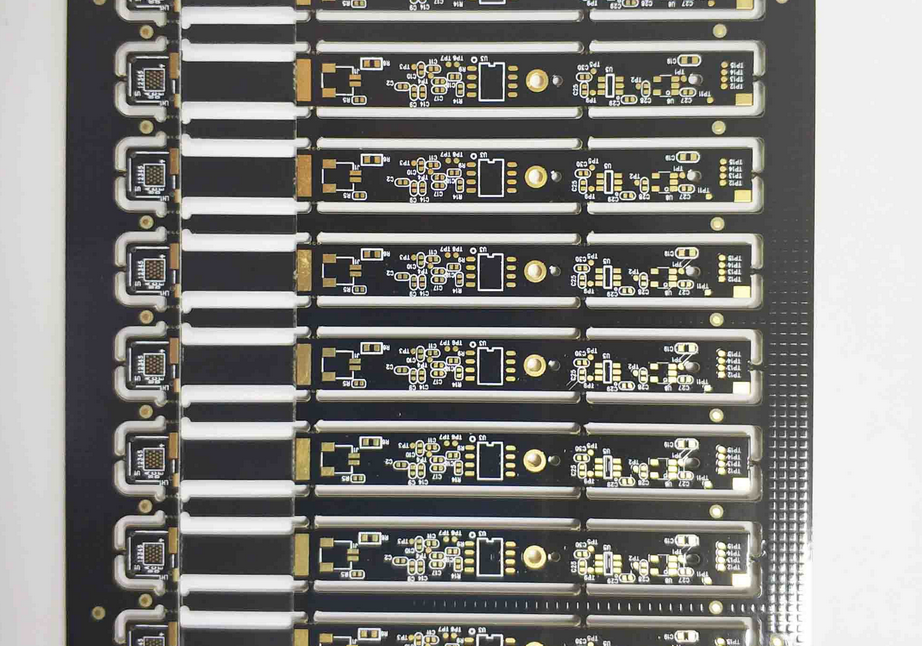
The reason CEM-1 exists in volume production is punchability. In a press tool, the material can be sheared to shape, with holes formed in the same stroke, which removes drilling from the process entirely for single-sided boards and reduces cost per panel dramatically.
Punching requires a tool, so the economics depend on quantity. A design produced in tens of thousands of pieces justifies the tooling, while a low-volume build is cheaper to drill, which is why FR-4 remains the practical choice for prototypes and small runs of the same circuit.
Thermal Limits and Soldering
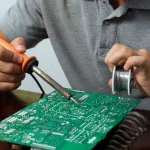
CEM-1 tolerates the temperatures of through-hole soldering and single-sided reflow, but it has less thermal margin than FR-4. Prolonged contact with a soldering iron, repeated rework in the same area or a hot air station held too long will degrade the resin.
For lead-free assembly the process window narrows. A higher reflow peak shortens the time the board can spend above the glass transition temperature, so the profile matters more than it does on FR-4, and rework procedures should be specified rather than improvised.
Where CEM-1 Fits: Appliances and Controls
The typical application is a single-sided control board in an appliance, a power supply, a lamp driver or a consumer product where the circuit is simple, the volume is high and the operating environment is moderate. Remote controls, chargers and simple timers are classic examples.
It also suits boards that must be punched into a non-rectangular shape, where the tooling can produce the outline and the holes in one operation. The limits appear when the design needs fine traces, controlled impedance, high layer counts or repeated thermal cycling.
Design Rules for CEM-1 Boards
Design as if the board were a single-sided FR-4 with a narrower process window. Keep traces generous, since fine features cost more to etch and are more likely to be damaged during handling. Maintain adequate creepage and clearance for the working voltage, and check the trace width and current calculation for the power paths.
Keep the mechanical design simple. Punching needs clearance around the board edge and a consistent hole pattern, and the outline should be specified on the drawing with the punch tooling in mind, as described in board outline and mounting design.
Where the board will be handled, coated or assembled automatically, confirm the process steps are compatible. A short review against manufacturable PCB design guidelines catches the cases where a rule written for FR-4 does not apply to a composite material.
Cost and Availability
Material cost is the smallest part of the saving. The real gain comes from tooling: punching replaces routing and drilling, which removes cycle time and consumable tools from every panel. That is why CEM-1 dominates cost-sensitive single-sided production despite being only modestly cheaper per square metre.
Availability is generally good in standard thicknesses, though specialty finishes and unusual thicknesses may have longer lead times than the same specification in FR-4. For a new product, confirm stock before committing the design to a punch tool.
Handling, Storage and Shelf Life
Composite laminates absorb moisture more readily than fully glass-reinforced materials, so storage matters. Boards should be kept in sealed packaging with desiccant, and panels that have been exposed to humid air for an extended period may need baking before soldering to prevent delamination and popcorning around holes.
The shelf life of a punched CEM-1 board is also affected by the surface finish. An organic finish ages much faster than a metallic one, so a board produced in a large batch and consumed over several months is better served by a finish that tolerates storage.
Handling is the remaining variable. Punched edges can be rougher than routed ones, and the exposed resin at the cut face is more susceptible to moisture ingress than the glass-reinforced surface. Where the board will operate in a humid environment, a coating that seals the edge as well as the surface gives the most protection.
FAQ
Can CEM-1 be used for double-sided boards? Simple double-sided boards are produced in CEM-1, but the material is most competitive in single-sided designs where punching can be used for the full panel. As soon as plated through holes and finer features appear, FR-4 usually becomes the better choice.
Is CEM-1 suitable for mains voltage products? Yes, with proper creepage and clearance and usually with a coating to protect against moisture. The material is common in appliance and power supply boards, so the constraint is design practice rather than the laminate itself.
Does CEM-1 work with lead-free soldering? It can, provided the reflow profile is controlled and rework is limited. The thermal margin is smaller than FR-4, so the process should be validated on the actual board rather than assumed from a generic profile.