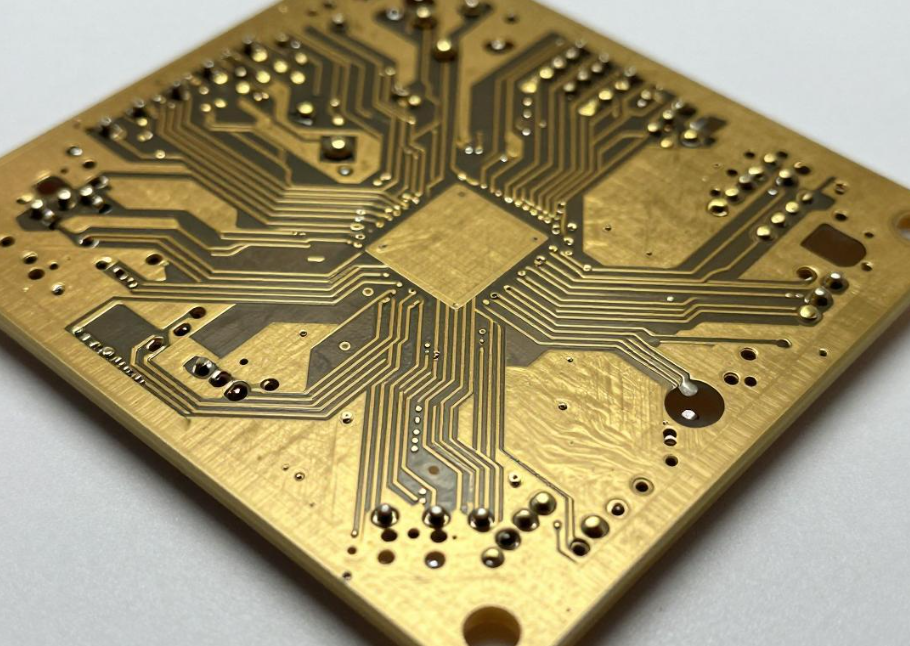
For high-volume ENIG PCB manufacturing, gold thickness uniformity is influenced by much more than the nominal immersion-gold process time. Bath chemistry, temperature, pH, solution circulation, agitation, rack configuration, board loading density, and equipment condition all affect the chemical environment around the exposed nickel surface.
During continuous production, the chemistry of an immersion-gold bath is not static. Gold-containing species are consumed, reaction by-products and metal ions accumulate, and chemical balance can gradually shift. At the same time, pumps, spray nozzles, fixtures, and circulation systems may experience performance changes.
As a result, a first-piece board can meet the specified thickness while subsequent boards show increased variation if the process is not continuously monitored.
For mass production, stable ENIG process control requires the interaction of chemical management, equipment maintenance, loading control, statistical monitoring, and measurement feedback. The objective is to keep the plating environment sufficiently stable so that different boards and different locations on the same board experience comparable process conditions.
1. How ENIG Bath Chemistry Affects Gold Thickness Uniformity
The immersion-gold process is based on a displacement reaction between the exposed nickel surface and gold-containing species in the process solution. The actual deposition behavior depends on the chemistry formulation and operating window specified by the chemical supplier.
Therefore, individual parameters such as gold concentration, pH, temperature, complexing agents, and impurities should not be evaluated independently. Their interaction determines reaction stability and the resulting deposit characteristics.
1.1 Gold-Containing Species and Chemical Consumption
Gold-containing species participate directly in the immersion-gold reaction. During continuous production, the total chemical loading changes as more exposed nickel surface area is processed.
If replenishment is not properly linked to the actual production load, the bath can gradually move away from its qualified operating window. This may result in changes in deposition rate or deposit characteristics.
However, there is no universal gold-concentration value that applies to every immersion-gold chemistry. The acceptable range should be established according to the specific chemical system, supplier process specification, equipment configuration, and production requirements.
For mass production, the process should therefore include:
- Regular bath analysis
- Production-area or chemical-consumption tracking
- Controlled replenishment
- Trend monitoring
- Defined action limits
- Traceable chemical records
Fixed-time replenishment alone is generally less robust than replenishment based on actual process data.
1.2 pH and Temperature Control
ENIG process control also depends strongly on maintaining pH and temperature within the qualified process window.
pH affects reaction kinetics and the stability of the process chemistry. Excessive deviation can change deposition behavior and may also influence nickel-surface reactions.
Temperature affects reaction rate as well. Increasing temperature generally accelerates chemical reactions, but operating outside the qualified range can change deposit morphology, reaction selectivity, and bath stability. Excessively low temperature may reduce deposition activity and throughput.
The exact operating window depends on the chemistry supplier’s formulation and process specification rather than a universal industry value.
For large tanks, temperature uniformity is particularly important. A temperature sensor located at only one point cannot necessarily confirm that the entire tank is at the same temperature.
Therefore, production qualification should consider:
- Heater distribution
- Circulation efficiency
- Tank geometry
- Sensor location
- Temperature mapping
- Actual board position
- Process dwell time
A stable average temperature is not sufficient if significant local temperature gradients exist.
1.3 Complexing Agents and Metallic Impurities
Complexing agents help maintain the required chemical equilibrium of the process solution. Changes in their concentration or activity can affect the availability and behavior of gold-containing species.
At the same time, metal ions such as nickel and copper can enter the solution during continuous operation. If contaminants accumulate beyond the chemistry supplier’s specified control limit, they may alter reaction kinetics, deposit characteristics, or bath stability.
For this reason, ENIG bath control should include more than gold replenishment.
A complete chemical-management program may include:
- Gold concentration
- pH
- Temperature
- Complexing chemistry
- Nickel concentration
- Copper or other relevant metal ions
- Specific gravity where applicable
- Organic contamination where applicable
- Chemical age or turnover
- Replenishment history
When a parameter approaches its defined action limit, the appropriate response may involve controlled replenishment, partial solution replacement, purification, or complete bath replacement, depending on the chemistry supplier’s process instructions.
Simply adding raw materials without controlling accumulated contaminants can eventually reduce process stability.
2. Agitation and Solution Flow: Managing Local Process Differences
During immersion gold, reactants near the exposed nickel surface are continuously consumed. The solution immediately adjacent to the surface therefore differs from the bulk solution.
Agitation and circulation help replace this boundary-layer solution and maintain more consistent mass transfer.
Poorly controlled flow can contribute to differences between:
- Board center and edge
- Upper and lower board regions
- Front and rear tank positions
- Different panel locations
- Boards loaded at different positions
However, stronger agitation is not automatically better. Excessive or poorly directed flow can also create non-uniform process conditions.
The goal is a stable and repeatable flow field rather than maximum flow rate.
2.1 Circulation System Design
Production systems may use combinations of circulation, pumping, filtration, agitation, or other solution-movement mechanisms.
The actual configuration should be validated through process qualification and thickness mapping.
Important control points include:
- Pump performance
- Flow rate
- Nozzle condition
- Nozzle orientation
- Circulation-path symmetry
- Filter condition
- Tank obstruction
- Agitation consistency
The objective is to reduce large differences in solution exchange between different board locations.
2.2 Hidden Equipment Degradation
One of the more difficult problems in mass production is gradual equipment degradation.
A pump may continue operating while its actual flow rate has decreased. A spray nozzle may remain visually intact while partial blockage changes the flow pattern. Filters may gradually load with contaminants.
These changes may not produce obvious cosmetic defects. Instead, the first indication may be increased gold thickness uniformity variation in production data.
Preventive maintenance should therefore be connected to measurable process indicators.
Useful monitoring items include:
- Pump flow performance
- Nozzle blockage
- Pressure or circulation indicators
- Filter replacement intervals
- Heater performance
- Temperature distribution
- Fixture condition
- Equipment alarm history
3. Rack and Board Loading Effects on Gold Thickness
The way PCBs are mounted and loaded into the process tank can directly affect solution access.
A fixture that physically blocks a functional pad can prevent the exposed nickel surface from receiving the same chemical exposure as surrounding areas.
Similarly, excessive loading density can restrict solution movement between adjacent boards.
When boards are placed too closely together, the solution-exchange conditions between neighboring surfaces may differ from those at more exposed outer surfaces. This can contribute to systematic variation across a production batch.
The appropriate board spacing depends on tank geometry, fixture design, circulation capability, board size, and the specific process. Therefore, a fixed universal spacing value should not be applied without process validation.
3.1 Fixture Contact Locations
Fixture contact points should preferably be located in designated process areas rather than functional pads.
The production team should verify:
- Contact-point location
- Effective plated area
- Board orientation
- Electrical contact requirements
- Fixture coverage
- Solution accessibility
- Compatibility with panelization
For large PCBs, dedicated fixtures may provide better repeatability than forcing a standard rack configuration to accommodate substantially different board geometries.
3.2 Loading Density and Production Capacity
Increasing the number of boards processed per tank cycle can improve throughput, but capacity should not be increased beyond the validated process window simply to meet production targets.
Higher loading density can change:
- Exposed surface area
- Solution flow
- Chemical consumption
- Local mass transfer
- Temperature distribution
- Fixture loading
- Chemical replenishment requirements
The maximum validated loading should therefore be treated as a process-control parameter.
4. Immersion-Gold Time Control and Nickel Corrosion Risk
Immersion gold is generally a self-limiting displacement process, but this does not mean that process time can be increased indefinitely.
If the process is insufficient, the gold coverage may not meet the specified requirement. If exposure is unnecessarily prolonged, continued chemical interaction with the nickel surface may increase the risk of nickel corrosion or other interface-related defects, depending on the chemistry.
This is why process time should be controlled within a qualified operating window.
A common mistake is to use one fixed time for all production conditions.
In reality, deposition behavior can change as:
- Bath chemistry ages
- Chemical concentration changes
- Contaminants accumulate
- Temperature changes
- Production loading changes
- Equipment flow characteristics change
The correct approach is to establish the qualified time window during process validation and then use bath-analysis data and XRF inspection results to confirm that the process remains within control.
Process time should be adjusted only through controlled engineering procedures rather than informal operator changes.
5. SPC Implementation for Mass Production
Stable mass production requires more than first-piece inspection. A first-piece result demonstrates that one point in time met the acceptance criteria; it does not prove that the entire production run will remain stable.
SPC for PCB manufacturing can provide a more systematic way to identify process drift.
Step 1: Monitor Bath Conditions
The production team should periodically analyze relevant chemical parameters according to the chemistry supplier’s control plan.
Typical monitoring may include:
- Gold concentration
- pH
- Temperature
- Relevant metal-ion concentrations
- Chemical age
- Replenishment amount
- Production area processed
The data should be recorded against defined control or action limits.
Step 2: Perform In-Process XRF Monitoring
Representative monitoring boards or coupons can be processed at defined intervals and measured using calibrated XRF equipment.
Measurement locations should cover representative risk areas rather than relying on one pad.
Depending on the product, the measurement plan may include:
- Board edge
- Board center
- BGA region
- Large pads
- Small isolated pads
- Different panel positions
The resulting data can be used to monitor average thickness, minimum and maximum values, and statistical variation.
Step 3: Establish Trend and Alarm Criteria
The purpose of SPC for PCB manufacturing is not simply to collect data. Engineers should establish meaningful warning and action criteria.
For example, a gradual shift in the process mean may trigger investigation before the specification limit is actually exceeded.
Similarly, increasing within-board variation can indicate a problem with:
- Flow distribution
- Chemical stability
- Fixture condition
- Loading density
- Panel design
- Equipment degradation
Early intervention can prevent a small process drift from becoming a large batch-level problem.
Step 4: Maintain Full Traceability
Each production lot should be traceable to relevant manufacturing information, including:
- Chemical batch
- Production date and time
- Tank identification
- Bath analysis results
- Replenishment records
- Equipment status
- Fixture configuration
- Loading quantity
- XRF results
- Operator or production shift
When a quality issue occurs, this information allows engineers to correlate the defect with specific process conditions.
6. Engineering Checklist for Evaluating ENIG Production Capability
Before approving a high-volume ENIG PCB supplier or production line, engineers can review the following areas:
- Confirm the immersion-gold chemistry and qualified operating window.
- Verify the bath-analysis and replenishment procedure.
- Check gold concentration, pH, temperature, and relevant impurity controls.
- Review circulation and agitation design.
- Verify pump, nozzle, filtration, and heater maintenance.
- Confirm tank temperature uniformity.
- Review fixture contact locations.
- Confirm validated board-loading density.
- Verify the process-time control method.
- Confirm multi-point XRF inspection capability.
- Review SPC charts and process-trend monitoring.
- Check lot-level traceability.
- Establish clear response procedures for out-of-control conditions.
- Validate critical changes through pilot production before mass release.
7. Integrating Chemistry, Equipment, and Measurement
The most effective approach is not to control each parameter independently, but to establish a closed-loop process system:
Bath analysis → equipment monitoring → controlled loading → process execution → XRF measurement → SPC analysis → corrective action
For example, if XRF data show that the board edge is consistently thicker than the center, engineers should not immediately change immersion time.
Instead, the investigation should compare:
- Bath chemistry
- Temperature distribution
- Flow pattern
- Pump performance
- Fixture orientation
- Board position
- Panelization
- Exposed copper distribution
- Production loading
Similarly, if thickness gradually decreases over several production hours, the investigation should examine chemical consumption, replenishment accuracy, bath age, contamination, and equipment conditions.
This approach helps distinguish between a chemical problem, an equipment problem, and a design or loading problem.
8. Key Principles for Stable ENIG Gold Thickness
For high-volume production, consistent gold thickness uniformity depends on maintaining comparable chemical and physical conditions across the entire process.
The key principles are:
- Keep bath chemistry within its qualified operating window.
- Control temperature across the complete tank rather than at one measurement point.
- Maintain stable and validated solution circulation.
- Prevent excessive fixture coverage of functional areas.
- Keep board loading within the validated capacity.
- Control immersion time through documented process parameters.
- Use multi-point XRF measurement for process feedback.
- Apply SPC to detect trends and process drift.
- Maintain complete chemical and equipment traceability.
- Investigate abnormal variation using cross-functional failure analysis.
Conclusion
Stable gold thickness in high-volume ENIG PCB production is the result of coordinated chemical, mechanical, and statistical process control.
Bath chemistry determines the available reaction environment. Temperature and pH influence reaction behavior. Circulation and agitation affect mass transfer. Fixtures and loading determine solution accessibility. Process time controls the exposure window, while XRF measurement and SPC provide feedback on actual production performance.
Therefore, ENIG process control should not depend on a single first-piece inspection or a fixed process-time setting. A robust manufacturing system continuously connects bath analysis, equipment maintenance, loading control, XRF inspection, SPC, and traceability.
Kingda can support high-volume ENIG PCB manufacturing through engineering review, process control, surface-finish inspection, production monitoring, and quality-management practices designed to improve plating consistency and manufacturing traceability.